



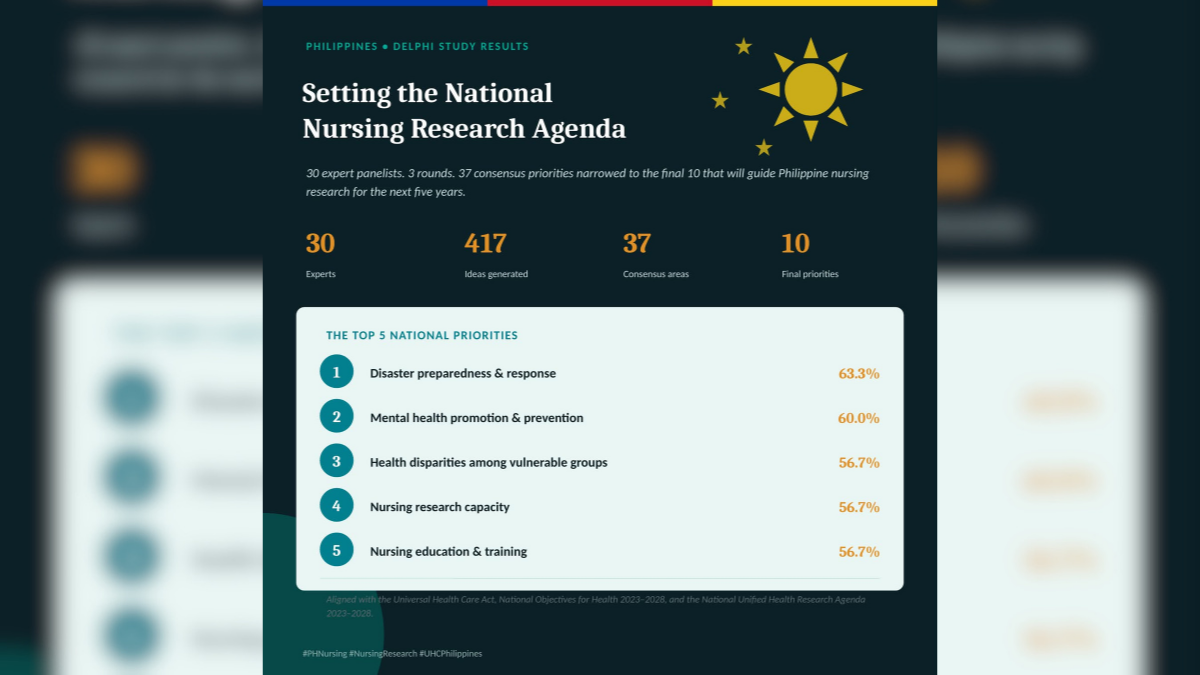

A national consensus study has, for the first time, produced an evidence-based National Nursing Research Agenda for the Philippines, identifying ten research priorities that nursing leaders say should guide the profession’s research investment over the next five years.

The study, conducted using the Delphi consensus method, drew on the expertise of 30 panelists — nurse researchers and leaders of national nursing organizations, including several association presidents. Over three structured rounds, the panel generated 417 initial research ideas, consolidated them into 37 candidate research topics, confirmed 36 of those topics as consensus priorities, and finally selected the ten deserving the greatest national attention through 2031.
Topping the list: disaster preparedness and response, selected by 63.3% of the panel, followed closely by mental health promotion and prevention in communities at 60.0%. Health disparities among vulnerable populations, nursing research capacity, and nursing education and training tied for third place at 56.7% each.
“This isn’t a wish list — it’s what thirty of the country’s most experienced nursing researchers and leaders agreed, through a rigorous, structured process, deserves our attention first. Disaster preparedness topping the list reflects the reality nurses live with every day in this country.” — Dr. Jerome Babate, Lead Investigator, Filipino Nursing Diaspora Network
The findings arrive at a pivotal moment for Philippine health policy. The final priorities closely track the direction of the Universal Health Care (UHC) Act, the Department of Health’s National Objectives for Health 2023–2028, and the Philippine Council for Health Research and Development’s National Unified Health Research Agenda 2023–2028. Researchers say this convergence gives the findings a degree of external policy coherence — while also carving out a distinctly nursing-focused research lane within the broader national health agenda.

“The priorities aren’t just important to nursing — they’re important to the country. Mental health, disaster response, rural access, chronic disease: these are problems every Filipino household recognizes. What’s new is that nursing now has a validated, evidence-based roadmap for where its research should focus to help solve them. With this, we should also strengthen nurse retention through job satisfaction with proper salary margins, leading to decent lives for nurses that is free from exploitation, false trainings & fake volunteerism in healthcare facilities” — Dr. Leah Paquiz, Co-Lead Investigator, Board of Nursing
The ten final priorities, in order of expert support:
- Disaster preparedness and response (63.3%)
- Mental health promotion and prevention in communities (60.0%)
- Addressing health disparities among vulnerable populations (56.7%)
- Enhancing nursing research capacity (56.7%)
- Improving nursing education and training (56.7%)
- Strengthening nurse retention and job satisfaction (50.0%)
- Improving care for elderly populations (46.7%)
- Improving access to healthcare in rural areas (46.7%)
- Management of chronic diseases in primary care (46.7%)
- Promoting patient safety culture in healthcare settings (43.3%)
Study organizers say the agenda’s value will depend on what happens next. They are calling on national nursing organizations, government agencies, universities, hospitals, and research funders to align research calls, postgraduate programs, scholarships, and institutional research strategies with the ten priorities — and note that several, including disaster preparedness and rural health access, will require collaboration well beyond the nursing profession itself.
The research team also disclosed the study’s limitations candidly: the panel, while highly credentialed — 83.3% held doctoral degrees and 90% had over a decade of research experience — was predominantly male (73.3%) and did not include patients, families, or community members. Organizers say future priority-setting exercises should widen participation, and that the agenda itself will be periodically reviewed and updated as health needs, technology, and policy evolve.
“A research agenda is only useful if it’s used. Our next job is making sure funders, universities, and health systems actually act on what these ten priorities say. Through this agenda, nurses must remain cognizant of the distinctive role that nurses play in national health” — Dr. Pearl Ed Cuevas, Co-Lead Investigator, Global Society for Philippine Nurse Researchers Inc.
