



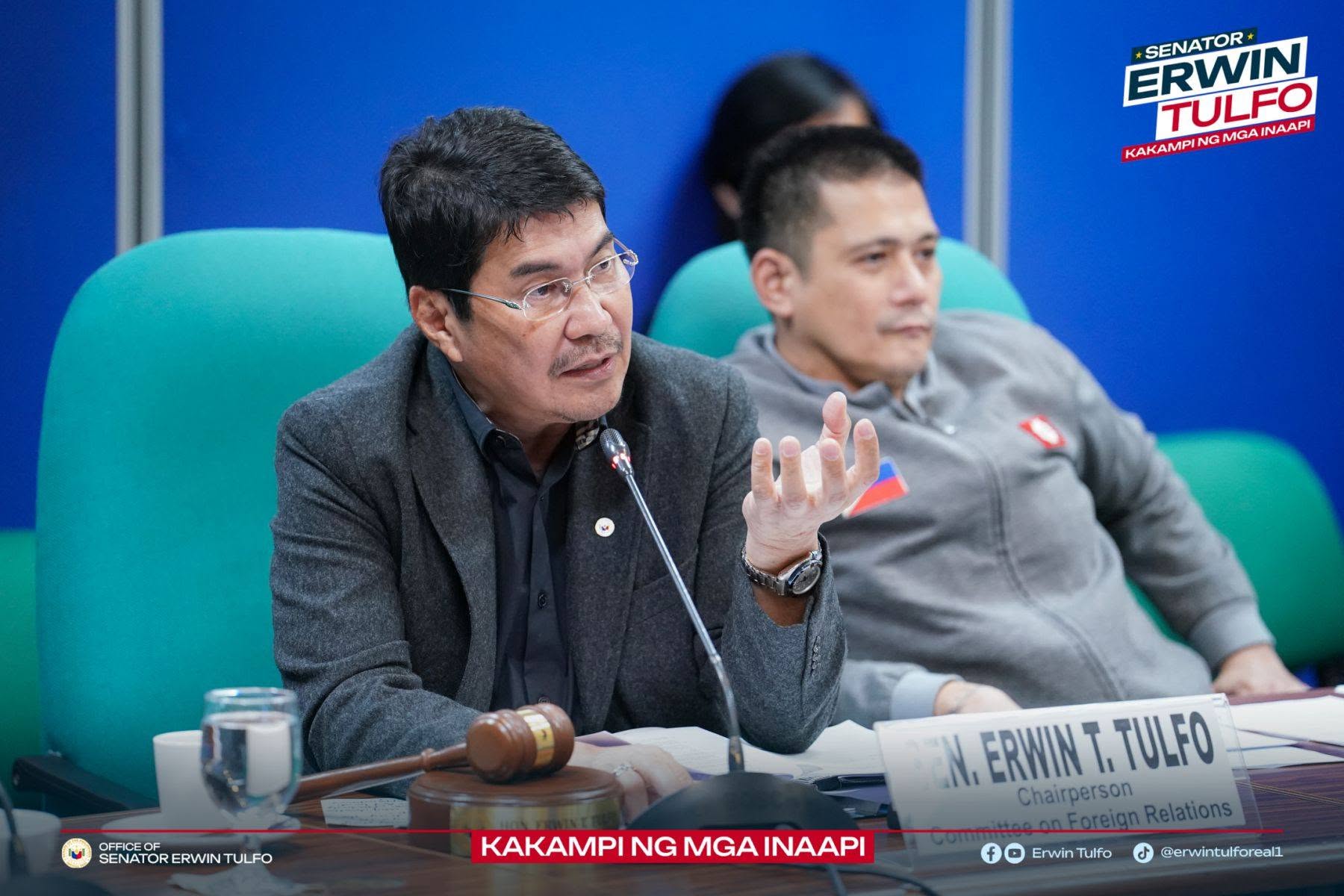

Cabinet secretaries, department heads and the country’s highest elected officials—up to the president and vice president—would lose pay for unexplained absences under a bill Sen. Erwin Tulfo intends to file, a proposal that would extend to government’s upper ranks the same attendance-based compensation already applied to rank-and-file workers.

Tulfo, who heads the Senate Blue Ribbon committee, said the measure would also withdraw allowances from any official who stays away without filing proper leave. His list of those covered runs through senators, congressmen and other elected officials alongside appointed department leaders.
“It’s embarrassing that our staff or ordinary government employees don’t get paid when they are absent without prior notice, but we officials still get paid even if we are absent for weeks or months?” the senator said.
He framed the gap as one that has gone unchecked precisely because of who benefits from it. “It has become a habit, and no one calls it out even if someone is absent but still receiving a salary. Because they are high-ranking officials, who would dare call us out, right?” Tulfo said, adding: “It should be equal, whether you are an ordinary employee or a high-ranking official, it should be no work, no pay for everyone.”
The bill carries no number yet and has not been filed. It would serve as a Senate counterpart to House Bill 7432, which Ilocos Rep. Sandro Marcos filed in January 2025 to tie lawmakers’ salaries in both chambers to their attendance at sessions and committee hearings. Marcos’s version reaches only members of Congress, while Tulfo’s would sweep in the broader roster of senior officials.

Driving the proposal is the case of Sen. Ronald “Bato” dela Rosa, who stayed away from the Senate for roughly six months beginning November 2025 while continuing to draw his salary. According to Senate attendance records cited by GMA News, Dela Rosa logged the chamber’s highest number of absences in the 20th Congress, missing 31 of 58 plenary sessions between July 28, 2025 and March 18, 2026. He has denied wrongdoing in the matter that drove him from public view, and has said he did not personally collect his Senate pay during the period—though he acknowledged his staff received it in the early months.
Dela Rosa dropped out of sight after reports of an International Criminal Court arrest warrant tied to alleged crimes against humanity during the Duterte administration’s anti-drug campaign. He briefly reappeared on May 11 to vote in the leadership contest that installed Sen. Alan Peter Cayetano as Senate president, then left the Senate complex in the early hours of May 14 as tension eased following a shooting incident at the building. His whereabouts have not been established since.
Tulfo drew a contrast with Sen. Jinggoy Estrada, who he said moved to give up his own pay after his June 1 arrest on graft charges. “I salute Senator Jinggoy because even though he hasn’t been convicted yet, since he can no longer attend Senate hearings, he took the initiative and said he should no longer be paid. That is the right thing to do,” Tulfo said.
The senator’s central argument is that holding office should carry no exemption from the standards ordinary employees already live under—an equivalence he insists must hold regardless of rank or the public funds entrusted to those at the top.
