



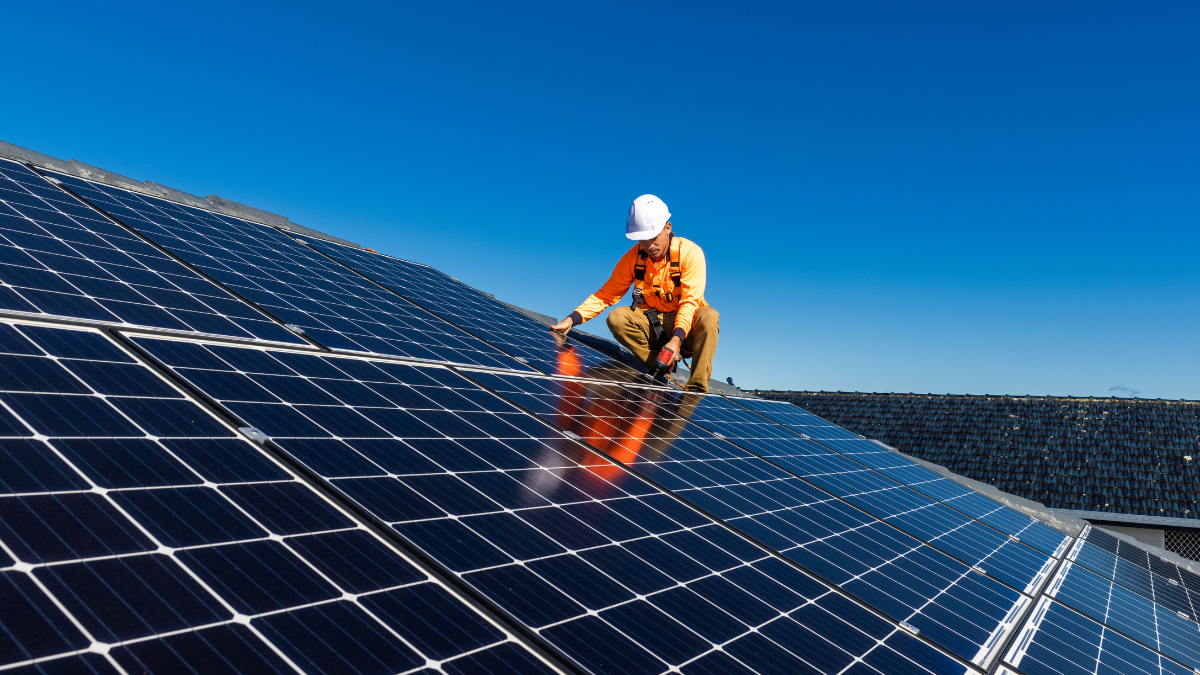

A third of solar units within Meralco’s franchise area are unregistered, according to data cited by the power distributor’s top official — a figure that has fueled calls to bring rogue installations into compliance as residential solar adoption accelerates across the country.

Lawrence Fernandez, Meralco’s Vice President and Head of Utility Economics, raised the concern during a Senate hearing, urging the Department of Energy and the Department of Trade and Industry to tighten technical and safety standards for solar equipment and to address what he described as “guerrilla” solar installations — setups that sidestep local government permitting requirements.
“There are a lot of installations compared to what’s registered. So given the streamlining, maybe the bill can also include a provision on how the industry can regularize those guerrilla installations,” Fernandez said.
The figures behind Meralco’s franchise area underscore the scale of the shift. The utility currently counts around 20,000 net metering installations with a combined capacity exceeding 170 megawatts, while larger commercial operators have added a further 370 megawatts of solar capacity outside the program — bringing total registered solar capacity in the area to roughly 500 megawatts.
Despite that registered base, Fernandez flagged gaps in equipment compliance that persist even among formal installations.

“We have seen that there is already a standard for inverters, for example, but there are installers who do not use those inverters that adapt to international standards,” he said.
Fernandez also expressed support for proposed amendments to the Renewable Energy Act authored by Senator Sherwin Gatchalian, which would streamline the net metering program, give the Energy Regulatory Commission authority to define the program’s scope, and ease permitting for grid-connected solar systems. The current net metering framework, established under the 2008 Renewable Energy Act, allows consumers to install up to 100 kilowatts of renewable energy capacity and export surplus power to the grid in exchange for bill credits, but has drawn criticism for slow approval timelines and burdensome permit requirements.
Driving demand for solar is the country’s retail electricity pricing environment, where rates frequently climb above P10 to P12 per kilowatt-hour. A formally installed small residential rooftop system typically costs between P200,000 and P350,000 — a barrier that, combined with limited public awareness, has kept adoption from reaching its potential despite strong interest. An Ateneo de Manila University study conducted in 2024 found that 82 percent of surveyed households wanted to shift to solar panels, though only 20 percent had concrete plans to do so.
National data points to an already significant footprint: the Philippine Statistics Authority and the Department of Energy recorded solar energy use by 27.2 percent of households in 2023 under the Household Energy Consumption Survey.
