



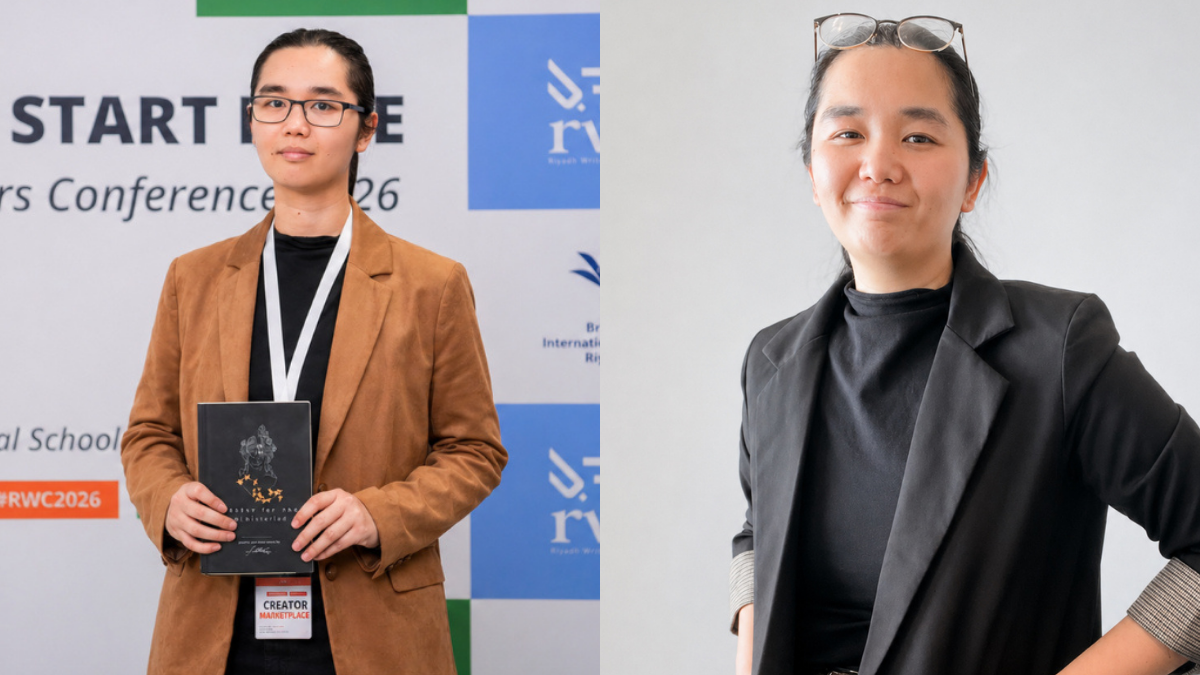

Moving to a new country is rarely a choice you make for yourself the first time. Pia Fajelagutan was four years old when her family relocated to the UAE so she could grow up alongside her father — a decision that would quietly determine the entire shape of her life. She didn’t choose to leave the Philippines. She was carried into a different world before she had words for it. What she did choose, eventually, was how to inhabit that world on her own terms.

Now 32, Pia holds the title of Lead Talent Acquisition at Riyadh Air, a Saudi airline so new she was among its first 400 employees. She is also a published poet, a former artist-in-residence at The Crypt Gallery in London, and a member of the Riyadh Writers community, where she exhibited at the group’s inaugural conference this year. She has facilitated workshops at the Emirates Airline Festival of Literature and the Abu Dhabi International Book Fair. And she remains, in her own words, someone permanently suspended between worlds — not quite a foreigner, not an Emirati, not fully a Filipino in the way she once imagined — but entirely clear about who she is.
The daughter of ‘Sir Armando’
In a detail that says more about her than almost anything else, Pia recalls moments during candidate screening when a name stops everything cold. Her surname, “Fajelagutan,” is unusual enough that strangers pause, look up from a CV, and ask: “Ikaw ba yung anak ni Sir Armando?”
Her father, Armando, spent his own career in aviation. The industry that built Pia’s professional life is the same one that built her family’s. “Those moments always stop me in my tracks,” she says. “They remind me that I’m not just building my own path — I’m carrying my family’s name wherever I go.”
It’s a weight she doesn’t seem to resent. If anything, it’s an anchor. She describes her father as someone who carried the family name with “quiet integrity and humility,” and she speaks about the responsibility of not undoing what he built. For someone who grew up in motion — Dubai, Abu Dhabi, Riyadh, London — the sense of lineage provides something steady.
Building beginnings
Pia’s decade-plus in aviation recruitment has taken her from Emirates, where scale and speed demanded rapid growth, to Etihad Airways, where she rose to Recruitment Manager, to Global Aerospace Logistics, where the work carried a more precise, military-adjacent weight. Each role, she says, “taught me a different language of leadership, of solidarity, of people.”
At Riyadh Air, she describes something rarer: the energy of pure possibility. “There’s no legacy baggage, no ‘this is how we’ve always done it,'” she says. “We’re building something, and that means the decisions we make today will actually shape the culture of this airline long-term.” She was there for the selection of the first Emirati astronauts during her time with a previous employer. She helped build the workforce behind Zayed International Airport. These are the kinds of milestones that don’t make it onto a LinkedIn banner but stay with a person.
When asked why recruitment, she doesn’t reach for the expected answer. “I’ve always been more interested in what people are reaching for than what they’ve already done,” she says. The most satisfying moments, she adds, are “the quiet ones — watching someone grow into a role they once reached for, watching the gradual unfolding of capability and confidence.”
The poem inside the pipeline

People frequently ask Pia how poetry and talent acquisition fit inside the same life. Her answer is immediate: they’re the same instinct. “To listen closely, to read what is said and unsaid, and to honor the human story in front of you.”
She published a book. She headlined at the Hold Space Festival in the UK. She performed across venues that, as she puts it, “allowed me to bring language to life.” What began as something private slowly became public, and in that transition, the two sides of her work began to inform each other in ways she no longer tries to explain away.
The loneliness she describes from childhood — missing extended family, feeling like an impostor in her own cultural identity — found its shape through writing. “Writing gave form to what I couldn’t always articulate.” That emotional precision, it turns out, translates directly into reading people for a living.
She is also candid about the professional realities of being a Filipino woman in rooms that sometimes required her to work harder to be taken seriously. “I’ve learned to be confident without being aggressive, to hold my ground without losing my warmth,” she says. “It’s a balance you calibrate over time.” It reads less like a complaint than like a report from the field.
What holds
Ask Pia about the future and you get a list that is genuinely difficult to predict. She wants to create platforms for underrepresented artists — workshops, mentorship, shared spaces. She has a childhood dream of founding a grassroots wrestling federation, not as a competitor (“My very unathletic frame will definitely count me out of any of the physicality”) but as a storyteller and promoter of others. She wants to return to teaching mathematics. And then, almost as a given: “Writing will remain. That’s my non-negotiable.”
Her advice to Filipinos abroad is the kind that doesn’t pretend the experience is easy. “Your worth is not defined by the amount you remit,” she says. “The pressure to be the ‘hero’ can quietly erode your sense of self if you’re not careful.” She asks people not to suppress their homesickness, not to shrink themselves to fit in, and — on love — to remember that what sustains it across distance “is not feeling, but follow-through.”
Her mantra: Root down, reach out. Between worlds, never lost.
It could read as something she settled on for an interview, except that her entire life demonstrates it. She carries her father’s name through aviation corridors he once walked. She carries Filipino warmth into spaces that don’t always expect it. She has spent nearly three decades living between cultures without being dissolved by any of them.
“I want to leave every space,” she says, “however briefly I pass through it, a little more human than I found it.”
For someone who has never quite stopped moving, that turns out to be a remarkably grounded thing to want.
