



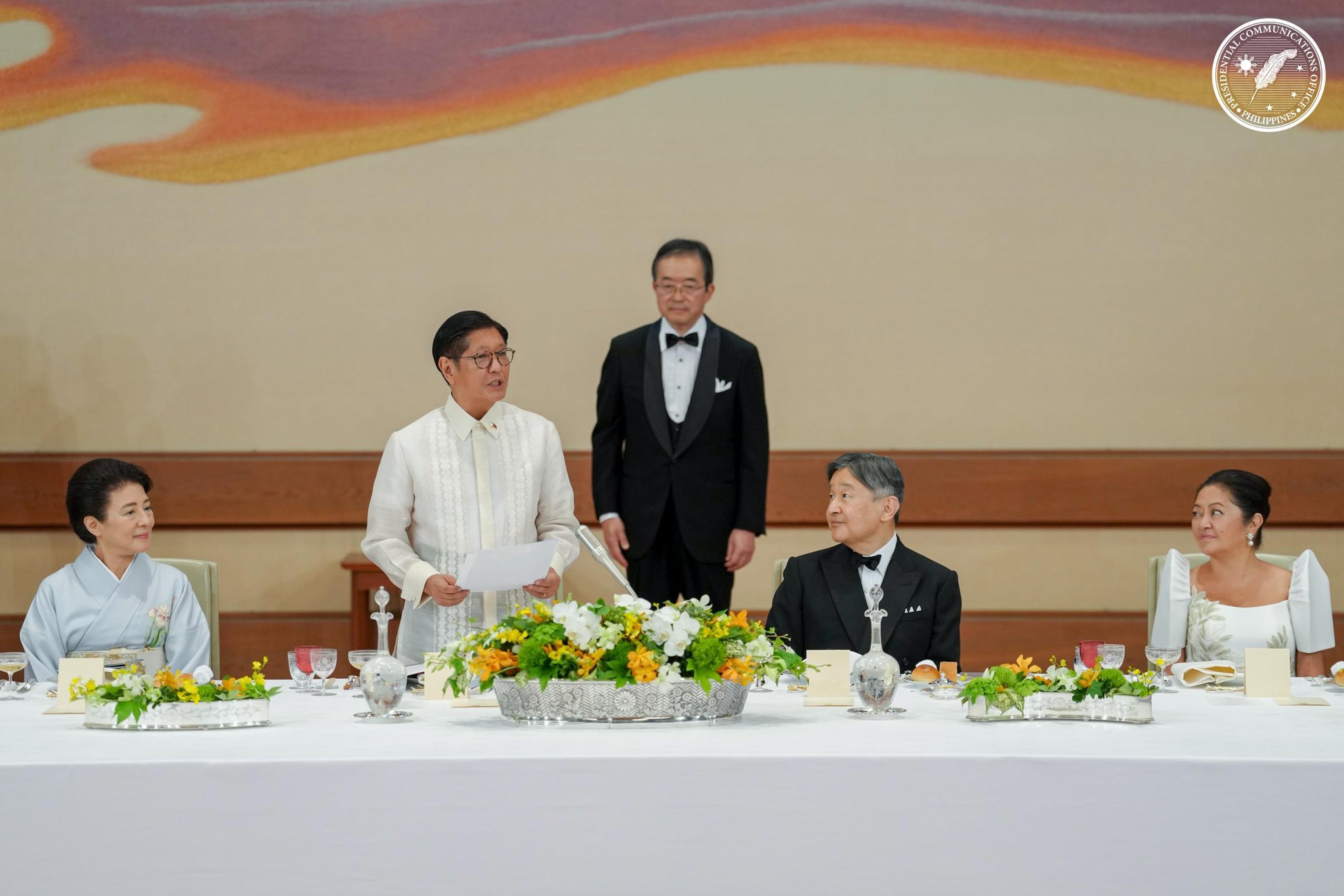

Maritime security and the resilience of the rules-based international order took center stage as President Ferdinand Marcos Jr. urged stronger defense alliances with like-minded nations during his state visit to Japan.

Speaking before the Japan-Philippines Parliamentary Friendship League on Wednesday, May 27, Marcos framed the current period of global instability as a reason to deepen engagement rather than pull back. “In such an environment, the importance of trusted partnerships that are anchored in shared values, mutual respect and adherence to international law has never been more evident,” he said.
The President pointed to growing disruptions in supply chains and mounting pressure on established international norms as evidence that strategic alliances could no longer be treated as optional. He described the international system as undergoing a “profound transformation,” with regions around the world increasingly exposed to geopolitical friction.
Marcos stressed that unimpeded access to waterways is indispensable to global commerce and energy supply, calling their protection a shared responsibility. “These realities underscore the importance of strengthening our defense and security cooperation,” he said.
On the bilateral front, Marcos said the Philippines and Japan are natural partners as maritime democracies, bound by aligned values and a common interest in keeping regional sea lanes open. “Like Japan, the Philippines believes that maritime security is an essential pillar of a free, open and inclusive region,” he said.
Concrete defense ties between the two countries are formalized through the Reciprocal Access Agreement and the Acquisition and Cross-Servicing Agreement. Marcos also reaffirmed the Philippines’ commitment to ASEAN centrality as the foundation of a regional security architecture it describes as “open, inclusive and rules-based.”

Both nations have longstanding and unresolved maritime disputes with China. The Philippines contests Beijing’s expansive claims in the South China Sea, a waterway through which more than $5 trillion in annual trade passes. Vietnam, Malaysia, Brunei, and Taiwan have overlapping claims in the same area. A Hague-based arbitral tribunal ruled in 2016 that China’s maritime claim had no legal basis and upheld the Philippines’ sovereign rights within its exclusive economic zone — a ruling Beijing has refused to accept. Japan, for its part, is locked in a separate dispute with China over the Senkaku Islands in the East China Sea.
While Marcos stopped short of naming China in his address to the parliamentary group, he told reporters before arriving in Tokyo that the Philippines and Japan share common experiences in dealing with what he described as “coercive acts.”
The address came on the same day Marcos received Japan’s highest state honor. Emperor Naruhito conferred on him the Grand Cordon of the Supreme Order of the Chrysanthemum — a decoration established in 1876 under Emperor Meiji and typically reserved for foreign heads of state and royalty in recognition of exceptional contributions to Japan.
First Lady Liza Marcos, who accompanied the President at the Imperial Palace, received the Grand Cordon of the Order of the Precious Crown, an honor traditionally bestowed on female members of foreign royal families and senior women dignitaries during state visits.
The Philippines, in turn, awarded Emperor Naruhito the Order of Lakandula with the rank of Supremo or Grand Collar — the rank designated for sitting or former heads of state — and conferred on Empress Masako the Order of Gabriela Silang, which is given to spouses of heads of state or government.
Malacañang described the Imperial audience as the “highlight” of Marcos’ four-day state visit.
