



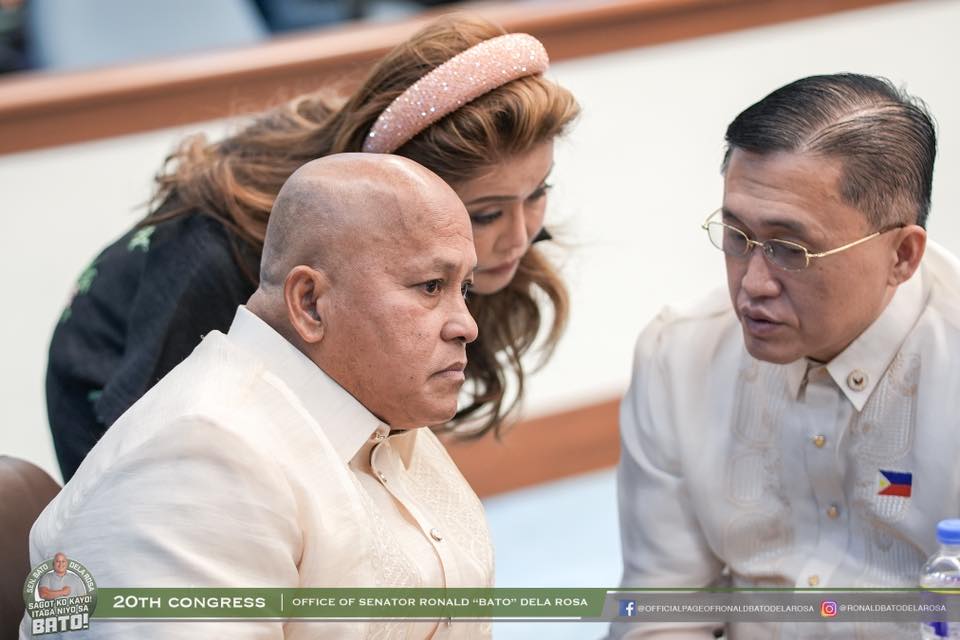

Law enforcement personnel were converging on the Senate compound on Wednesday as Senator Ronald “Bato” dela Rosa, holed up inside since Monday, declared that he believed his arrest was imminent — and called on Filipinos to stand in the way of his transfer to The Hague.

Senate Sergeant-at-Arms Mao Aplasca confirmed the gathering of agents outside the building, even as the chamber’s protective custody order over the senator remained in force. The National Bureau of Investigation also made a public appeal Wednesday for dela Rosa to turn himself in voluntarily, given the outstanding ICC arrest warrant.
The standoff has its roots in a chaotic scene Monday, when dela Rosa surfaced at the Senate after months in hiding — resurfacing specifically to cast a vote that installed Senator Alan Peter Cayetano as Senate president, ousting Vicente Sotto III. NBI agents were waiting for him upon arrival, and security camera footage captured dela Rosa fleeing through the building’s corridors before reaching the Session Hall, sustaining an injury to his left hand in the process.
The ICC Pre-Trial Chamber I found reasonable grounds to believe that dela Rosa is “allegedly criminally responsible as an indirect co-perpetrator for the crime against humanity of murder.” The warrant was issued under seal on November 6, 2025, and covers killings committed between July 2, 2016, and the end of April 2018, during which no fewer than 32 people were killed.
Dela Rosa told fellow senator Robin Padilla during a livestream: “They want to fly me to The Hague, to be surrendered there. So please support me. I became Philippine National Police chief to work, then this is what they will do to me?”
On Tuesday, a visibly emotional dela Rosa described the situation as “the lowest point of my life,” while maintaining that the ICC cannot legally arrest him without clearance from the Philippine Supreme Court. “I will face it, as long as they follow the proper process. If there is a legitimate warrant of arrest, they should bring it before the local court. Let’s discuss it, and we will face it,” he said.

His legal counsel, Torreon & Partners, filed a petition asking the Supreme Court to issue a Temporary Restraining Order against any arrest, detention, transfer, or surrender of dela Rosa without a valid Philippine judicial warrant.
Senate President Cayetano and NBI Director Melvin Matibag reached an agreement Monday night that the NBI would recognize the Senate’s protective custody arrangement, despite the ICC warrant still standing. The nine NBI agents who pursued dela Rosa inside the building were cited in contempt by the Senate but were subsequently released to NBI custody, with Matibag committing to present them to the Senate whenever required.
Amnesty International Philippines executive director Ritz Lee Santos III called on the government to move immediately. “Dela Rosa held a key role in the implementation of the so-called ‘war on drugs’ under the administration of former President Duterte, responsible for command and direction over the police,” Santos said. He added that dela Rosa’s Senate seat should not function as a shield against the ICC process.
Malacañang said Tuesday that President Marcos is aware of the warrant and has directed all law enforcement agencies to follow what the law requires. “The president heard about what happened yesterday. And the president’s order to all enforcement agencies at all times, not only with regard to Senator Bato, is to follow what the law says,” Presidential Communications Office Undersecretary Claire Castro said.
Five senators from the minority — Francis Pangilinan, Vicente Sotto III, Panfilo Lacson, Risa Hontiveros, and Bam Aquino — filed a resolution citing precedent for lawmakers facing legal proceedings, including the voluntary surrender of the late former Senator Juan Ponce Enrile and the judicial remedies pursued by former senator Leila de Lima.
The Philippines was originally a signatory to the Rome Statute but Duterte withdrew from the ICC after the court opened its investigation. Under the ICC’s withdrawal rules, however, the court retains jurisdiction over crimes committed during the period of membership, which covers 2016 to 2019 when the withdrawal formally took effect.
