



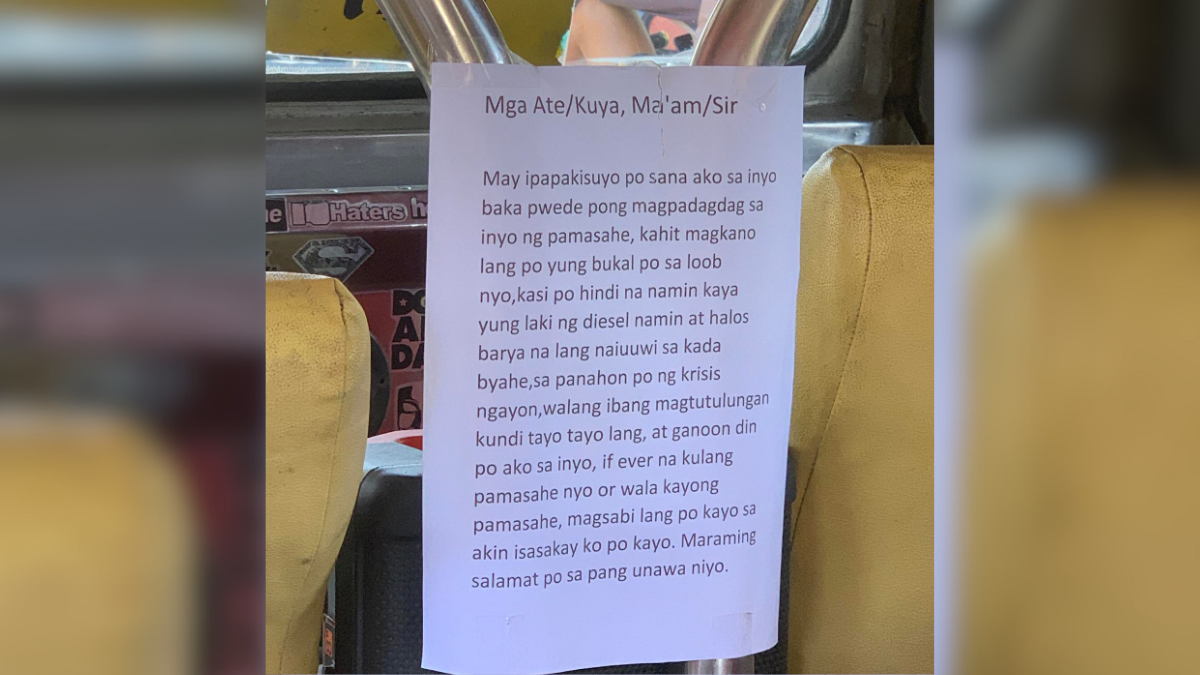

A handwritten message inside a jeepney in Zambales has struck a nerve online, cutting through the noise of economic data and government announcements to lay bare what rising fuel prices actually feel like for the people behind the wheel.

The sign, captured in a photo by Renz Salonga, a student from President Ramon Magsaysay State University, read: “Sa panahon po ng krisis ngayon, walang ibang magtutulungan kundi tayo, tayo lang.”
Salonga was on his way home from school when he spotted the message and took a photo. He told GMA News that seeing it forced him to confront the reality that drivers are carrying a burden far heavier than most passengers realize — one that has worsened sharply since the Middle East conflict erupted on February 28 and sent global oil markets into a spiral.
“This post was never meant to blame anyone, gusto ko lang magbigay ng awareness and hopefully inspire kindness and willingness to help, kahit sa simpleng paraan,” Salonga said.

The timing of the post reflects conditions on the ground that have deteriorated rapidly. Public utility vehicle operators and drivers have seen fuel costs consume as much as 80 percent of their take-home pay since pump prices crossed ₱100 per liter — a threshold analysts warned about weeks ago when the Strait of Hormuz, through which a fifth of the world’s oil passes, effectively shut down to commercial traffic.
President Ferdinand Marcos Jr. declared a national energy emergency on March 25, activating the government’s UPLIFT framework to protect transport workers and other vulnerable sectors. The Land Transportation Franchising and Regulatory Board and the Department of Transportation have been tasked with rolling out direct fuel subsidies for PUV operators, though many drivers say relief has yet to reach them at the level they need.
Train fares in Metro Manila have been slashed in half as part of the government’s response, a move that has drawn more commuters to the rail network — exposing just how limited that system remains for a country of over 100 million people.
The jeepney driver’s sign, however, asked for something no government program delivers: solidarity.
