



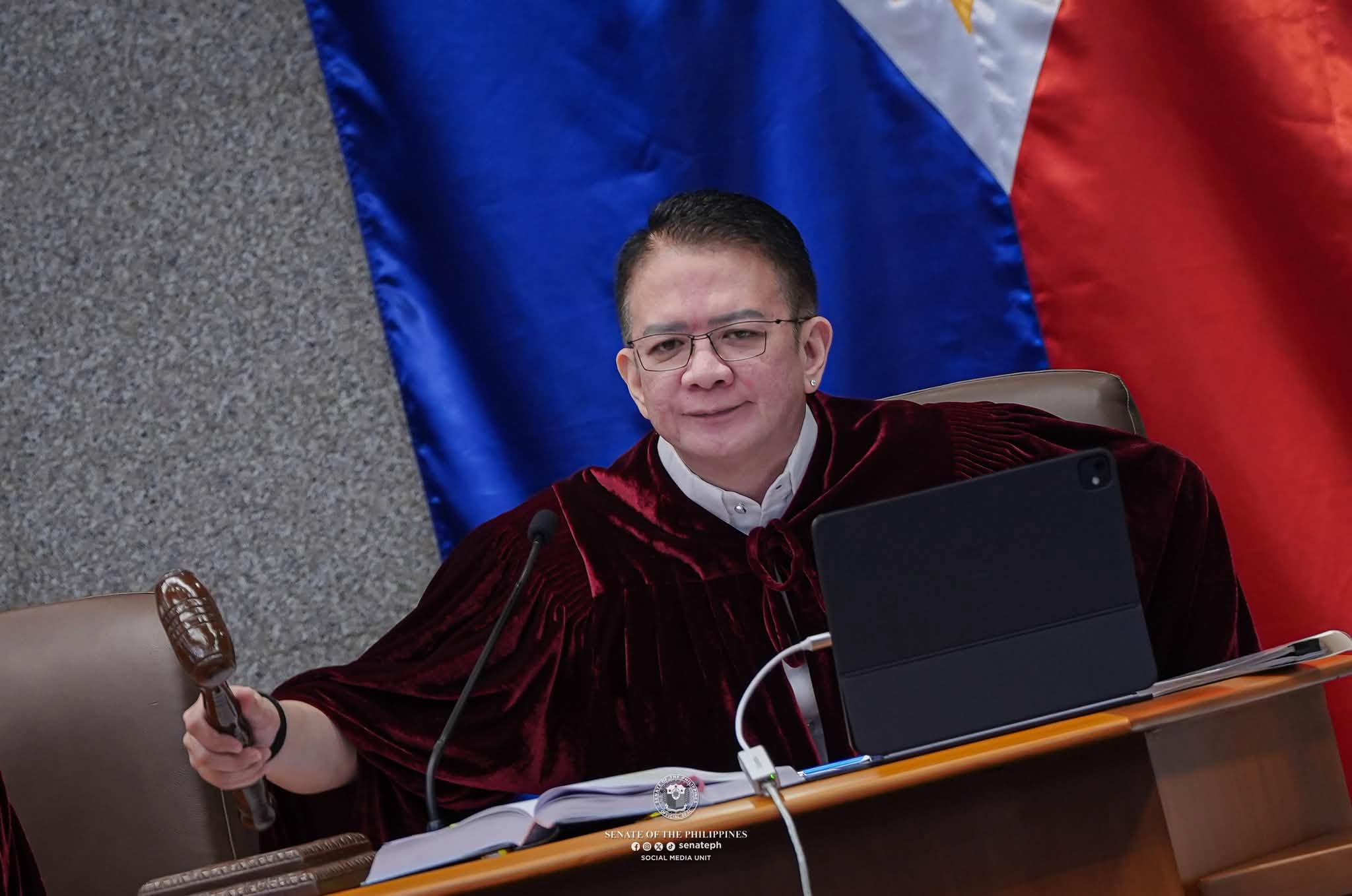

Reports suggesting that Senator Chiz Escudero had been quietly lobbying opposition-aligned senators to reach the number of votes needed to convict Vice President Sara Duterte were shot down Sunday by the impeachment court’s spokesperson, who characterized the accounts as nothing more than idle talk.

Atty. Reginald Tongol pushed back sharply when asked about the matter. “First of all, let’s not dignify that article or whatever it is that you call it if it is even an article,” he said. He argued that the reporting rested on flimsy ground, stating the claims were “based on conjecture, suppositions, speculations and gossip, [and] it should not be dignified so there will be no oxygen leak.”
According to Tongol, the framing of Escudero as a vote-counter was both “totally untrue” and “preposterous.” He explained that the presiding officer had been occupied with going over witness testimony and case documents, and that tallying votes at this point in the proceedings would be premature. The senator, Tongol noted, simply laughed off the allegations.
The controversy traces back to a Saturday gathering that put Escudero in the spotlight. After visiting the Department of Health–JBL Children’s Medical Center in Clark, Pampanga, he shared breakfast with former Vice President and Naga Mayor Leni Robredo and DPWH Secretary Vince Dizon. Tongol characterized the get-together as an ordinary extension of Escudero’s legislative work, adding that the senator and Robredo have maintained a personal friendship for years, rooted in their shared Bicolano background.

The optics of the meeting invited political interpretation. Robredo sits with the opposition, Dizon serves in the administration’s Cabinet, and Escudero has charted an independent course since May, several months after being ousted from the Senate presidency the previous September. Observers read the breakfast as a possible signal of shifting alignments ahead of the 2028 presidential race. Speculation about a Robredo-Dizon ticket has circulated since early in the year, though both figures have waved off the chatter. Escudero, for his part, also played a role in brokering the reconciliation between President Marcos and Robredo, who had faced each other in the 2016 vice presidential contest and again in the 2022 presidential election.
Underlying the dispute is a live question over how many votes a conviction actually requires. The prosecution has revived its argument for reducing the threshold, pointing to recurring absences among the senator-judges and the detention of Senators Jinggoy Estrada and Rodante Marcoleta. Senator Bato dela Rosa, separately, has gone into hiding over an International Criminal Court warrant.
The constitutional standard is set out in Article XI, Section 3(6), which calls for a two-thirds vote of the 24-member Senate—16 senators—to remove an impeached official. Prosecutors contend that the circumstances surrounding three senators have effectively changed the chamber’s makeup. Legal scholars have not reached consensus on whether the bar can be moved, but most senators, Senate President Win Gatchalian and Escudero among them, hold that 16 votes stand as the requirement no matter how many judges are present on any given day.
Tongol cautioned that altering the count partway through would be “dangerous,” since it would force the court to rewrite its own rules mid-proceeding—something he said is “not allowed” because it would compromise due process. That position echoes the ground Escudero staked out when the trial opened on July 6, 2025, when he leaned on the Supreme Court’s 2000 ruling in Bayan v. Zamora to affirm that the Senate is composed of 24 members.
