




Four thousand two hundred forty-one overseas Filipino workers have been brought home from the Middle East through commercial and chartered flights arranged by the government, but the Department of Migrant Workers says a significant portion of them are not planning to stay.

An Overseas Workers Welfare Administration survey cited by DMW Secretary Hans Cacdac shows that roughly half of the repatriated workers intend to resume their jobs once the security situation in the region improves. Cacdac attributed this to the orderly way many OFWs departed.
“Many of our returning OFWs, just about 50 percent, still plan to go back (to work abroad)… Why? Because they have valid employment visas. There is no problem with that. It only means they were able to properly ask permission from their employers to go home,” he said.
He said the crisis appeared to have left employer-worker relationships largely intact. “The OFWs and their employers have a very good relationship, that is why it is just right for them to go back there and work,” Cacdac added.
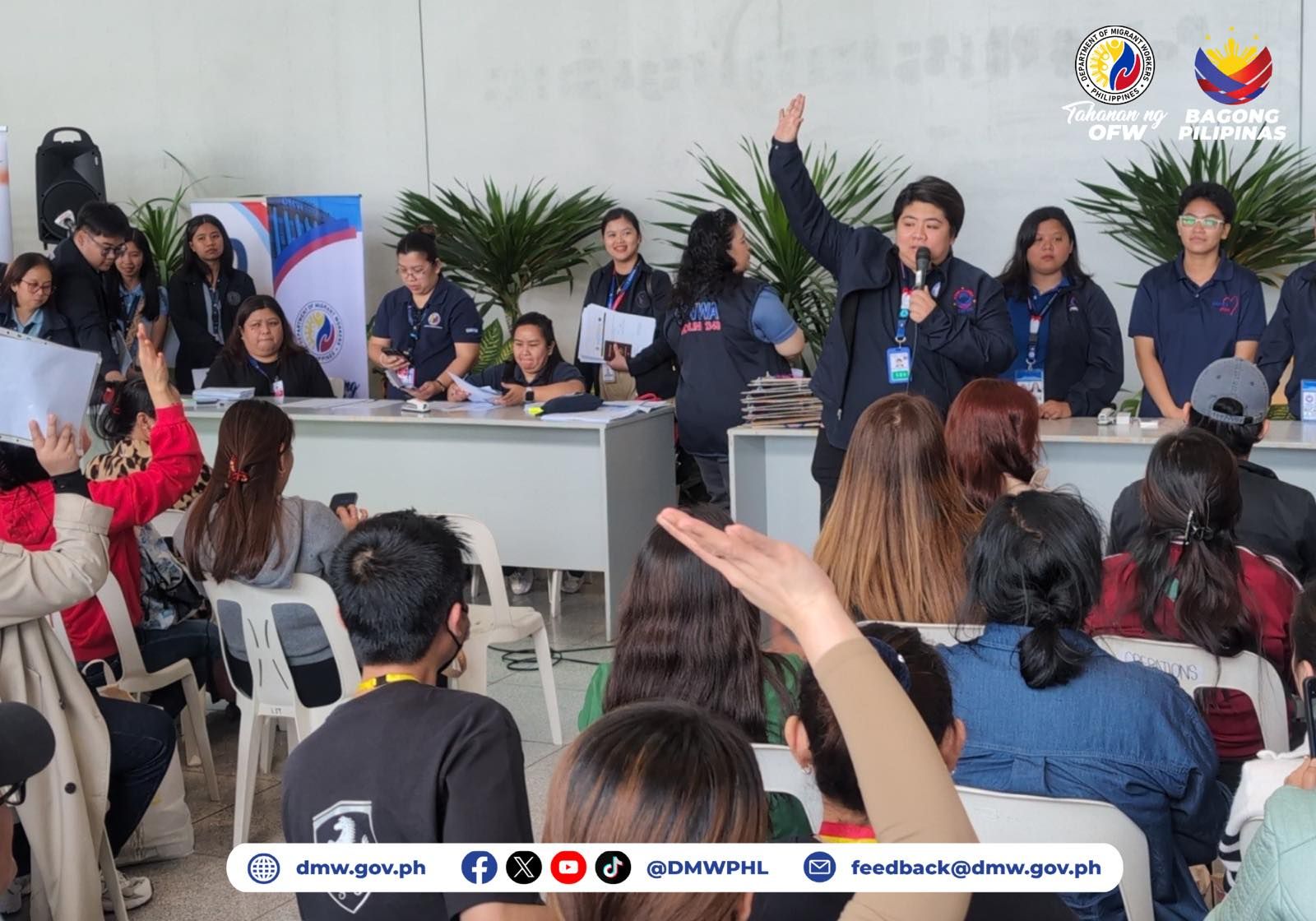
Cacdac spoke at the “Bayanihan para sa Balikbayang Manggagawa: A National Reintegration Fair” held in Quezon City, where some 500 repatriated OFWs were expected to receive assistance ranging from financial aid and psychosocial support to skills training and employment referrals.

For those choosing to remain in the Philippines — the other half of returnees — the DMW said it has at least 200,000 job orders available, with both in-person and virtual job fairs being organized to connect displaced workers with opportunities. “To our OFWs, you are not stranded. Together with your families and loved ones, we will give you services so that you can start again here in the country,” Cacdac said.
A separate government pathway is being offered through the Department of Education’s “Sa Pinas, Ikaw ang Ma’am at Sir” program, which channels returning OFWs with teaching licenses into public school positions. Since its launch in 2014, SPIMS has facilitated the shift of 11,056 licensed teachers from overseas employment into the local school system. Under the current administration, 8,047 teachers have received employment and financial support through the program, while another 521 completed online refresher courses.
Education Secretary Sonny Angara said the process is being streamlined. “Under the leadership of President Marcos, we would not let you face these challenges alone. We make the process for SPIMS simpler and faster,” he said.
At the fair, DepEd also made available on-site registration for Accreditation and Equivalency tests, the Philippine Educational Placement Test for OFW children, a senior high school voucher program for private school students, and 720 scholarship slots under the Teacher Education Scholarship Program for qualified family members of returning workers. Review incentive packages for OFWs preparing for the teachers’ licensure exam were also on offer.
Approximately 15 recruitment agencies and 12 companies took part in the event, collectively presenting around 8,000 local and overseas job openings.
