



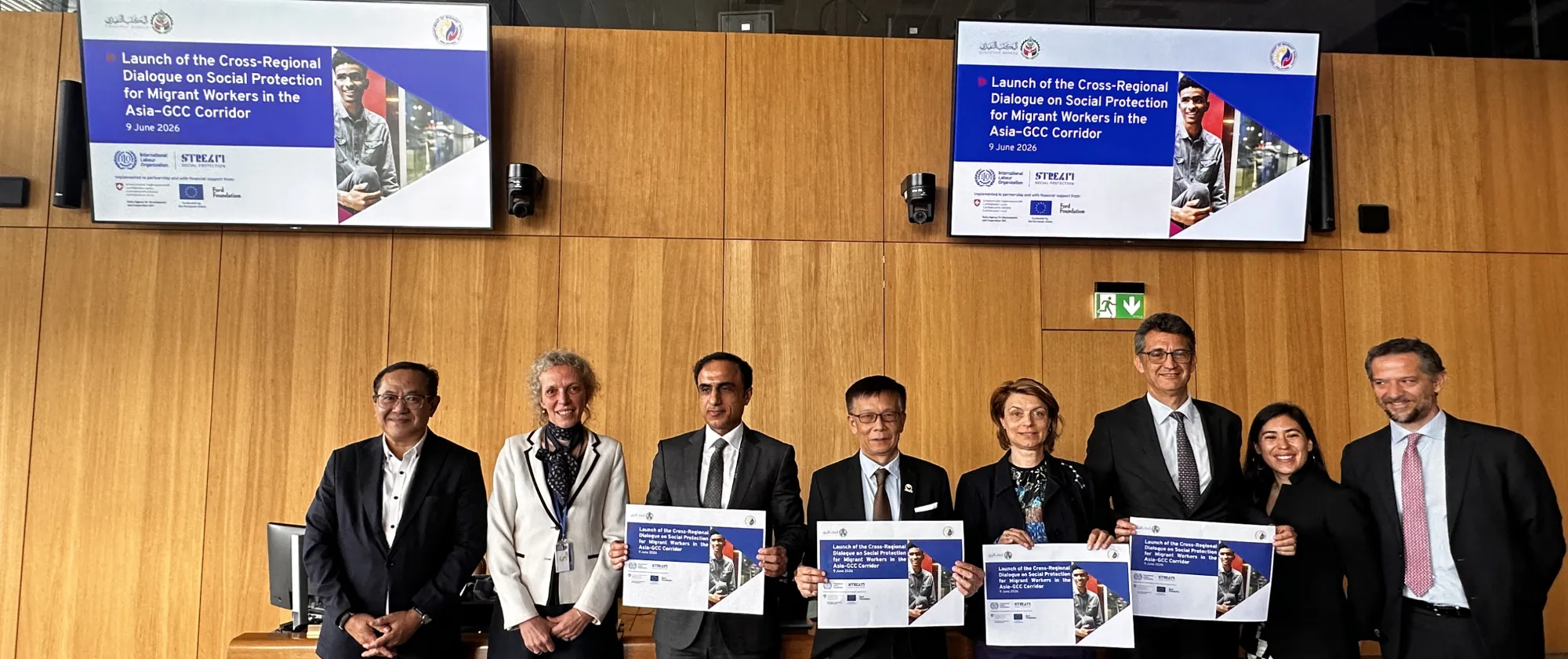

Governments from Asia and the Gulf have agreed to build a shared mechanism aimed at closing the gaps that leave migrant workers without adequate social protection when they cross borders. The initiative, formally called the platform for Cross-Regional Dialogue on Social Protection for Migrant Workers along the Asia–GCC corridor, was unveiled during a high-level meeting held alongside the 114th International Labour Conference.

The arrangement is jointly led by the Philippine government and the GCC Executive Bureau for Ministries of Labour and Social Affairs, with technical backing from the International Labour Organization through its STREAM Programme. Its purpose is to give sending and receiving countries a standing venue to coordinate how protections are extended to workers who move between the two regions.
Officials framed the joint leadership structure as the platform’s defining feature. “The fact that this platform is jointly steered by countries of origin and destination is perhaps its greatest strength,” said Valerie Schmitt, Deputy Director of the ILO Social Protection Department. “The two co-chairs bring something unique: leadership from both sides of the migration corridor. This sends a powerful message: effective social protection can only be achieved through partnership, dialogue and shared responsibility.”
The problem the platform is meant to address stems from a structural mismatch: although Gulf states have overhauled labour governance rules and Asian origin countries have built out welfare funds, insurance products and overseas worker protections, these systems still operate almost entirely within national borders. Existing regional forums such as the Abu Dhabi Dialogue and the Colombo Process have raised the issue, but officials say there has been little sustained exchange on the practical side—how coverage actually carries across jurisdictions.
For the Philippines, the gap is precisely where the work lies. “Strengthening social protection for migrant workers inherently requires inter-regional engagement, as protection gaps often arise at the intersection of origin and destination systems,” said Hans Leo J. Cacdac, Secretary of the Department of Migrant Workers. He added that the country, set to take over as Chair of the Abu Dhabi Dialogue, is “committed to advancing this agenda” and hopes the platform will surface “concrete ways in which social protection systems can be better coordinated across border to ensure coverage and portability of social security rights.”

From the Gulf side, H.E. Mohammed bin Hassan Al-Obaidli, Director General of the Executive Bureau of the Council of Ministers of Labour and Social Affairs in the GCC States, described the platform as a vehicle for trading proven approaches and showcasing regional initiatives. “The Executive Bureau remains committed to backing programmes that foster collaborative efforts and long-term partnerships,” he said.
The donors funding STREAM tied the launch to a broader question about how protection keeps pace with mobility. Patricia Barandun, Head of Section Migration and Forced Displacement at the Swiss Agency for Development and Cooperation, said the goal is to make national systems as interconnected as the economies the workers already link. “Migrant workers connect our economies across borders. The challenge is to ensure that our systems of protection become equally connected,” she said.
The European Union pointed to its own track record as a resource for partners in both regions. Michele Cervone, Ambassador and Deputy Permanent Representative of the EU to the United Nations, said that “integrating social security systems across borders is a defining challenge for modern labour markets,” and noted that European states have decades of experience coordinating social security that they intend to share with counterparts in Asia and the GCC.
In practice, the platform will convene technical sessions on implementation and cross-border coordination, with the longer-term ambition of widening into a global exchange on migrant worker protection. STREAM itself is a multi-country effort run by the ILO and financed by the Swiss agency, the EU’s Foreign Policy Instrument, and the Ford Foundation, built to extend rights-based and gender-responsive coverage across the South Asia–Gulf corridor.
Gladys Cisneros, who heads the ILO’s Labour Migration Branch, cast the launch as a starting point rather than a milestone. Progress along the corridor has been real over the past decade, she said, but efforts on each side have advanced separately—the reason a permanent channel for coordination was needed in the first place.
