





The math of a Philippine public school teacher’s life rarely adds up the way it should. More than a decade of service, a wall of recognition certificates, thousands of students shaped along the way — and still the dream house stays a dream, the car stays parked in someone else’s driveway, and the rising cost of everything keeps outrunning the paycheck. Aljun Araneta Desoyo knew that math intimately. He had lived it for thirteen years, and by 2025 he decided the equation needed a different variable.

Today, the 34-year-old stands in front of a middle school class in Bullhead City, Arizona, a remote desert town on the Colorado River, teaching English Language Arts to American students who need extra help learning to read. It is a long way from the fish stalls of his childhood, and the distance is exactly the point.
The stall before the classroom
Before there was a teacher, there was a boy helping his parents sell dried fish. That detail is not a decorative backstory Aljun keeps in a drawer for inspirational speeches. It is the foundation of how he understands work, sacrifice, and the slow business of getting ahead.


“My parents worked as dried fish vendors, and when I was growing up, I also helped them with the business,” he shares with TGFM. “Because of our financial situation, I learned the value of hard work, perseverance, and sacrifice at a very young age.”
It is tempting to romanticize humble beginnings, to sand them down into a clean origin story. The former English teacher does not do that. He speaks about his upbringing plainly, as a set of conditions that taught him things a classroom could not. The market taught him that nothing arrives without effort. It also planted a stubborn conviction he now repeats to his own students: where you start does not decide where you end.
“My humble beginnings have always been a strong motivation for me to work hard and pursue a better life,” he says. And later, returning to the same idea like a refrain he cannot let go of: “Humble beginnings should never limit a person’s dreams.”
That belief carried him out of the market and into the Department of Education, where he would spend the better part of his adult life.
Thirteen years in DepEd, and the ceiling above them
For more than thirteen years, the Bicolano educator taught English to junior high and senior high school students in the Philippine public school system. On paper, it was a career going well. He collected the kind of recognition that suggests a teacher operating near the top of his craft — named Most Outstanding Senior High School Teacher in his school and municipality for two consecutive years, and honored as Most Outstanding English Teacher in Research and Innovation.
He was also, by his own account, the person the school called when an event needed a host. Programs, ceremonies, division-level gatherings — he emceed them, and in doing so built a reputation that traveled beyond his campus.
“I was frequently invited to host various school events, which helped me gain confidence and become known not only within my school but also in our municipality and even at the Schools Division level,” he says.
The work spilled past the classroom walls, too. Through JCI Tanauan Pasaka, a civic organization focused on helping less fortunate families, he took on community projects that had nothing to do with lesson plans and everything to do with the kind of teacher he wanted to be.

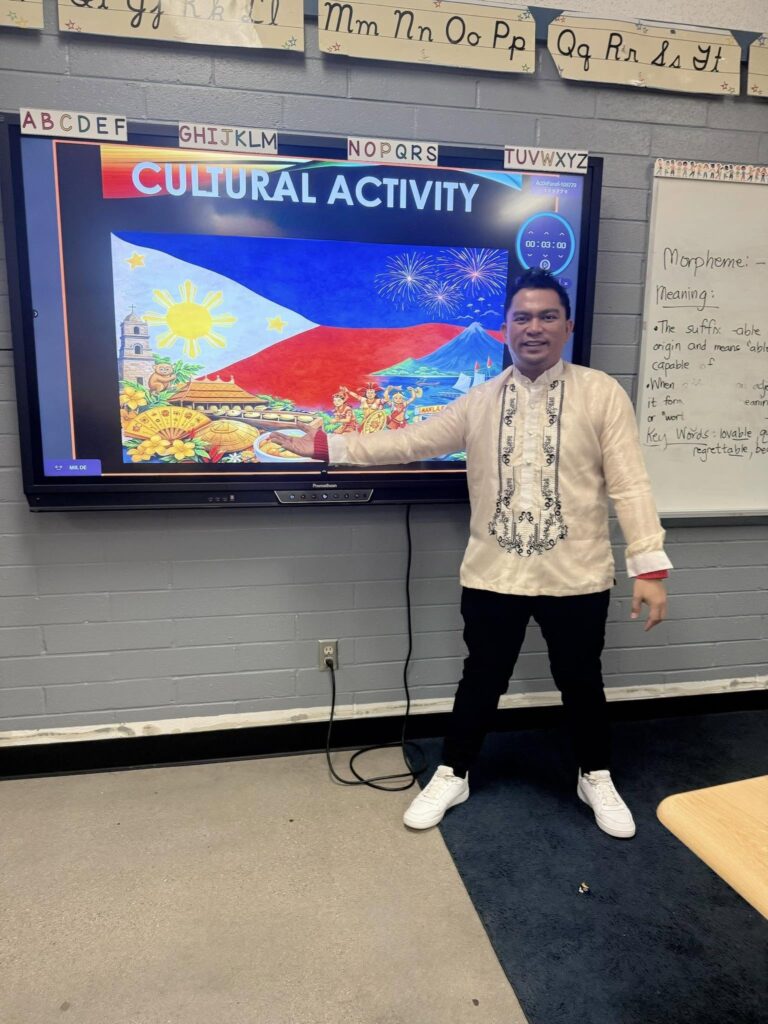
“These experiences strengthened my belief that education and service can create positive change in people’s lives,” he says.
And yet. After thirteen years of awards, hosting duties, and community service, the ceiling was still there — financial, immovable, indifferent to how hard he worked beneath it.
“After more than 13 years of service, I also experienced financial challenges,” he admits. “The rising cost of living and inflation in the Philippines made it difficult to achieve some of my personal and financial goals despite my years of hard work.”
This is the part of the Filipino teacher’s story that rarely makes it into the tribute posts. Excellence and financial security are supposed to travel together. For many educators in the Philippines, they do not. Recognizing that gap — and refusing to accept it as permanent — is what set the next chapter in motion.
Leaving, and everything leaving costs
In August 2025, Aljun boarded the life he had been building toward and left almost everything familiar behind. His first job overseas was also, in a sense, the culmination of the previous thirteen years: an international teaching post at a public middle school in Bullhead City, Arizona, in the Bullhead City School District in Mohave County. His subject was English Language Arts, his specialty reading intervention — targeted support for students struggling with comprehension, fluency, and decoding.
The role suited him. The transition did not come free.
“Moving abroad and starting a new life in another country was not easy,” he says. “I had to leave my family, my familiar environment, and the community where I had spent more than 13 years teaching.”
The desert did not welcome him with familiarity. A new culture, a new educational system, a new workplace, a new way of being alone — all of it arrived at once. He names the feeling without dressing it up.
“There were times when I experienced homesickness, uncertainty, and the challenges of adjusting to a new environment,” he says. “I had to learn how to become more independent and adapt to unfamiliar situations.”
His strategy for surviving the hard stretches was not complicated. When the loneliness pressed in, he returned to the reasons he left. He reminded himself of the dream house, the car, the family he was working for, the students still waiting to be taught. And he reached back, again, to the market stall.
“I look up to my parents because they taught me that success does not come easily,” he says. “Their hard work and sacrifices shaped my character and motivated me to pursue a better future.”
The reward is watching a child read

Ask him what makes the distance worth it, and he does not lead with the salary or the dream house. He leads with a kid finally understanding a sentence.
The reading intervention teacher works with students in small groups and one-on-one, the students who have been flagged as needing more than a standard classroom can give them. It is unglamorous, patient work, measured in increments most people would not notice.
“The most satisfying part of my work is seeing students make progress,” he says. “Even small improvements, such as a student becoming more confident in reading, understanding a text better, or finally mastering a skill they once struggled with, are very rewarding for me.”
He is clear-eyed about what teaching is and is not. For him, it was never only the delivery of content.
“Teaching is not only about delivering lessons; it is also about inspiring students, building their confidence, and helping them realize their potential,” he says.
There is a through-line here that connects the boy at the fish stall to the man at the whiteboard. He tells his students what he had to learn the hard way himself — that today’s struggle is not a verdict.
“My goal is to inspire my students to become the best versions of themselves and to remind them that their struggles today do not define their future,” he says.
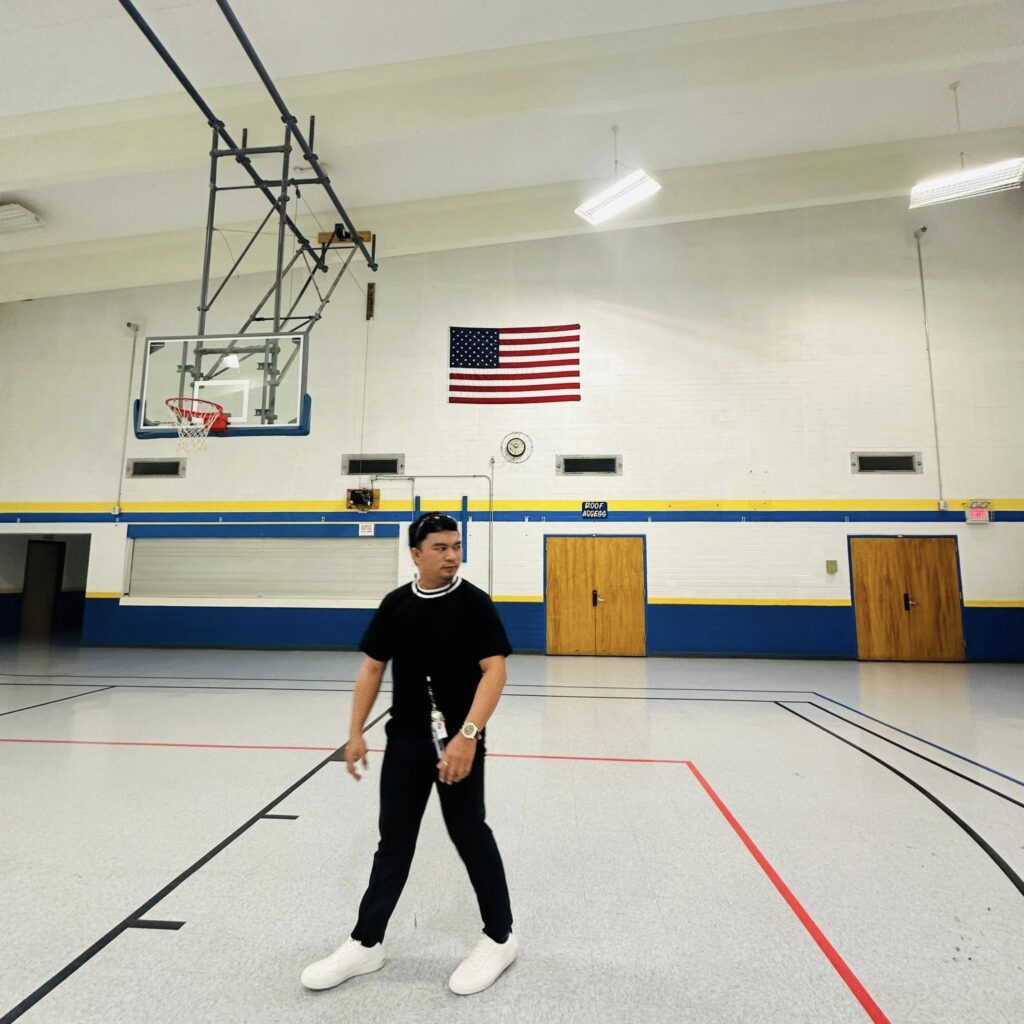


Working abroad has sharpened him professionally, too. A different system means different methods, and he has treated the American classroom as a place to keep learning rather than a place where his learning stops. There is also something he carries into the room that has nothing to do with pedagogy — a sense of who he represents.
“It has also given me the opportunity to represent Filipino teachers and show the dedication, skills, and compassion that Filipino educators bring to the international community,” he says.
What the dream house actually means
He is candid about wanting things. A house of his own. A car. He does not pretend these desires are beneath him or that a teacher should be too high-minded to name them. But he is careful to explain what they actually stand for.
“For me, these dreams are not simply about material possessions,” he says. “They represent years of hard work, sacrifice, and progress from the humble life I experienced growing up.”
The house is not just a house. It is the visible proof that the market boy’s math finally worked out — that the effort added up to something you can stand inside. That is why he talks about it the way he does, as a milestone rather than a luxury.
His plans do not end at the property line, though. When his time abroad is done, the veteran educator wants to bring what he has gathered back home, using his international experience to strengthen literacy education in the Philippines and to mentor other teachers in the reading intervention methods he has been immersed in.
“I would like to continue teaching, mentoring other educators, and sharing effective strategies in reading intervention and English Language Arts,” he says. He also intends to return to the kind of community advocacy that shaped him, the work he first tasted through JCI Tanauan Pasaka.
What he’d tell the ones who followed him out
For the millions of Filipinos who, like him, packed their lives into a suitcase and chased a better future abroad, he offers advice that sounds less like a motivational poster and more like something learned the hard way.
Remember why you left, he says, because the loneliness will try to make you forget. Manage your money, because earning it is only half the work. Choose the people around you carefully.
“Not everyone who comes into your life has the same intentions, so we must learn to be careful while remaining kind and respectful,” he says.
And when work turns difficult, he wants his kababayans to know that reaching out is not a failing.
“It is also important to remember that asking for help is not a sign of weakness,” he says.
Underneath all of it runs the same conviction that carried a boy from a fish stall to an American classroom — that where you come from is nothing to hide.
“I grew up helping my parents sell dried fish, and that experience taught me the value of hard work and perseverance,” he says. “We should never be ashamed of where we came from.”
He measures success, in the end, by something other than a job title or a bank balance.
“True success is also about the people we help, the lives we touch, and the positive impact we leave behind,” he says.
The math of a teacher’s life, it turns out, was never only about the numbers. He just had to travel halfway around the world to prove the rest of the equation — and to stand in front of a room of American children, teaching them the same thing his parents’ fish stall once taught him: that a hard beginning is a beginning, and nothing more.
