



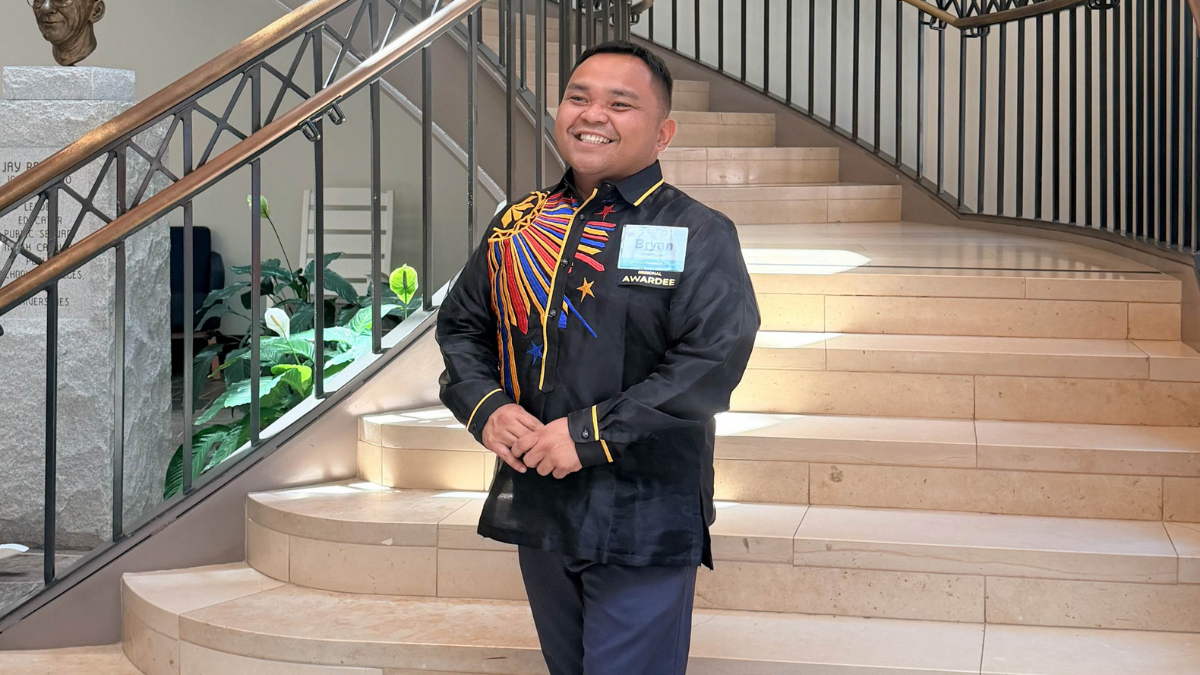

The airport arrival is supposed to be the easy part — the paperwork cleared, the flight survived, the new life finally beginning. For one Filipino teacher stepping off his flight at John F. Kennedy International Airport in August 2023, it was the moment everything he had sacrificed for collided with everything he had feared losing. Bryan Mendoza Luzon had come to the United States to help save his mother. He landed to the news that she was already gone.

He would learn later how to talk about it. That first day, there were no words — only the impossible arithmetic of grief and distance, the knowledge that going home was not financially possible, that the hospital bills already waiting for his family made an emergency flight a luxury he could not justify. “It was the most painful moment of my life,” he says. He stayed. He unpacked. Within days, he walked into a second-grade classroom in North Carolina and began to teach.
Three years later, the 37-year-old educator from Hoke County Schools has built a career abroad that reads like a highlight reel — grants, national committees, a published children’s book, an award shelf that keeps growing. But the through-line of his story isn’t achievement. It’s a promise he made to a woman who never got to see him keep it.
The teacher who almost stayed home
Before North Carolina, Bryan was a Master Teacher in the Philippines — a rank earned through years of classroom work and the mentoring of other teachers, and one he still names as among the proudest of his life. He loved the work. He had built something real at home. Leaving was never the plan.
What changed was his mother’s health. During his application process, he noticed she was growing weaker; consultations confirmed a serious decline. As the second child, he felt the pull of responsibility — the medical costs were mounting, and a teaching salary abroad could cover what one at home could not. “Although my mother did not want me to leave,” he recalls, “she also understood why I felt I had to take this opportunity.”
That understanding is what makes the timing so cruel. He left to help her. He arrived too late to say goodbye. Every milestone since has carried that weight, and he doesn’t pretend otherwise. The grants, the presentations, the books — none of it, he says, has ever been about recognition alone. “It has always been about honoring my mother’s sacrifices, supporting my family, and making the most of the opportunity she wanted for me, even if she was no longer here to witness it.”
There is a temptation, in stories like this, to move quickly past the pain toward the triumph. Bryan doesn’t let himself do that. He describes the grief as the start of a season that tested him, not a hurdle he cleared and forgot.
A year of being misunderstood
The first year in an American classroom was harder than the résumé suggests. Beyond the private grief, he was adapting to a new educational system, a new culture, a new set of unwritten rules — and there were stretches when he wondered whether he belonged at all.
One incident cut especially deep. He had prayed privately with a student who was going through a difficult time, meaning only to offer comfort. It was read very differently than he intended. He was called into meetings, told he would be placed under evaluation, warned that Human Resources might become involved. For someone still learning the policies and expectations of a new country, it was frightening. “I remember feeling anxious every time my principal entered my classroom,” he says, “wondering if I had done something wrong.”
He is careful, now, not to frame the episode as an injustice done to him. Instead he treats it as a lesson in cultural difference and professional boundaries — the kind of understanding no orientation packet can hand you. But at the time, it shook his confidence badly enough that he quietly attended a teacher job fair, looking for a place where his way of teaching might fit.
That quiet decision is where his story turns. At the fair, he found Hoke County Schools — and, for the first time abroad, a place that felt less like a test and more like a home. The leaders and colleagues there recognized his strengths and, crucially, encouraged him to chase things he might not have attempted alone. Nearly everything that followed grew out of that welcome.
When the right room believes in you
What Bryan describes about the United States isn’t simply that opportunities exist there. It’s that someone encouraged him to reach for them. “Perhaps the biggest difference I experienced was not simply the number of opportunities available,” he explains, “but the encouragement to pursue them.”

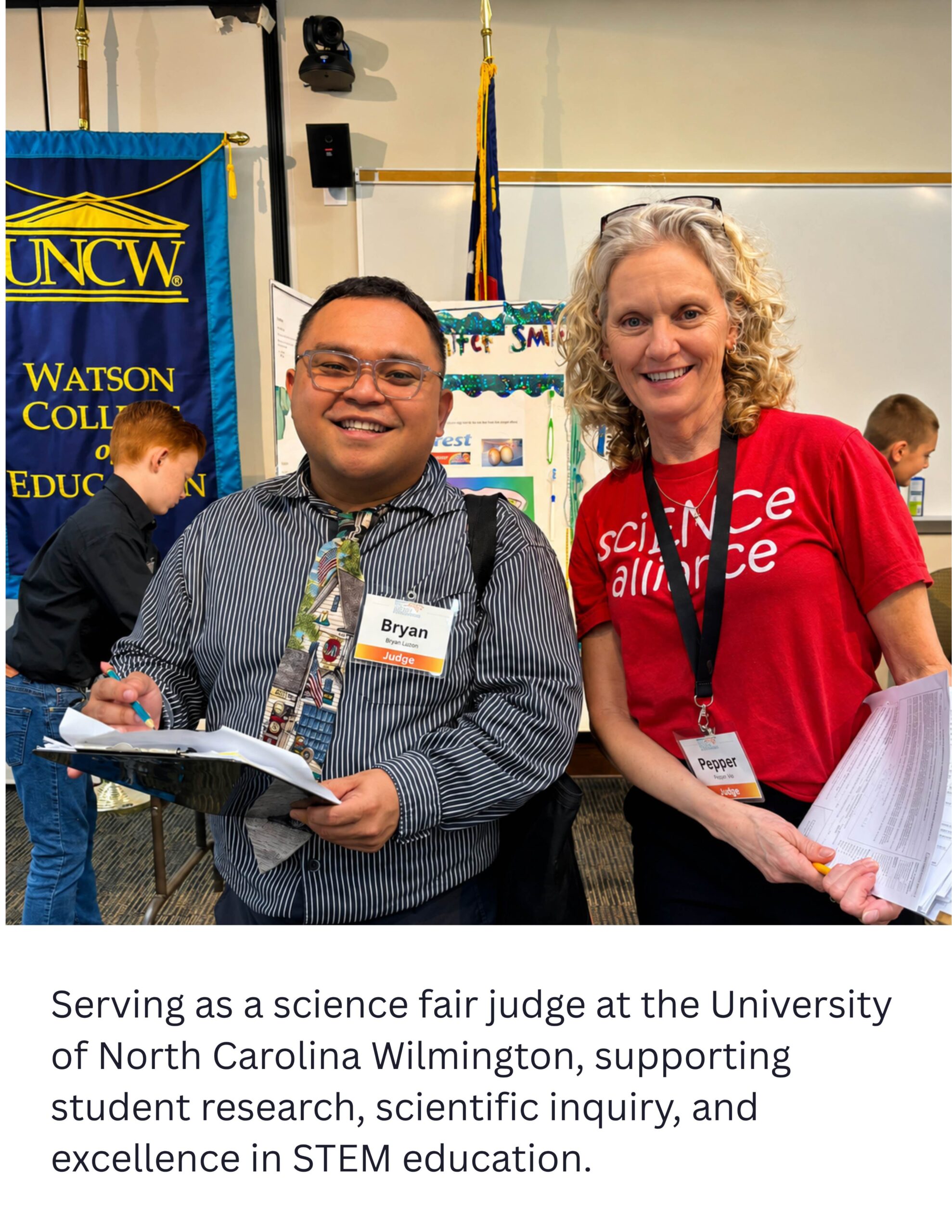
The evidence piled up fast. He secured more than $3,000 in competitive STEM grant funding to build an outdoor learning space he calls the EcoSySTEM Garden Lab, where second-graders get their hands dirty doing real science. He was named a Regional Awardee for Project CLIMATE and a finalist for the Excellence in Education Program Teacher of the Year. He now serves on a National Science Teaching Association national committee for the 2026–2028 term and has judged a national science fair, work that puts him in rooms with educators and scientists across the United States and Canada.
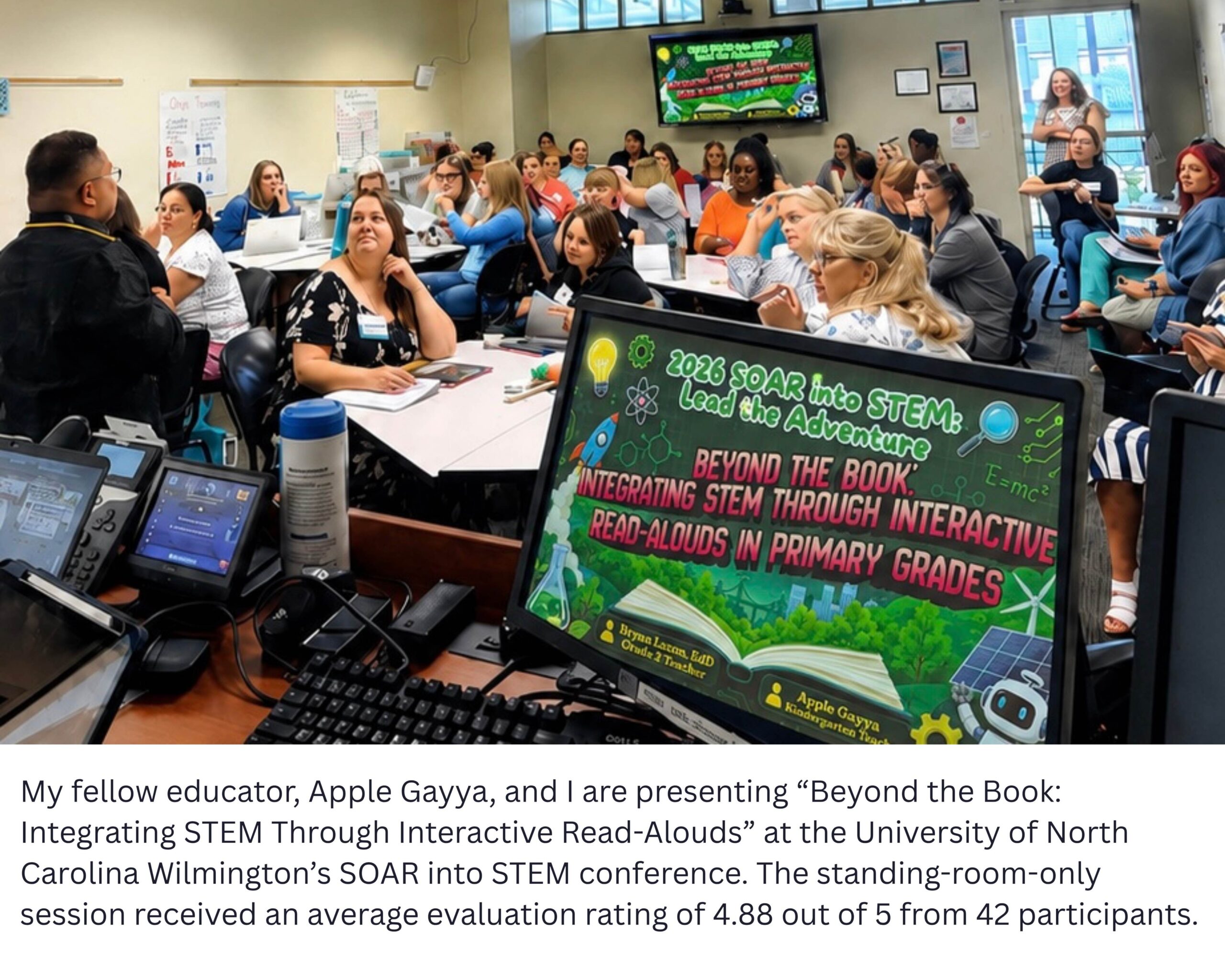
One afternoon captures the shift better than any title. Presenting alongside fellow educator Apple Gayya at the University of North Carolina Wilmington’s SOAR into STEM conference, his session on integrating STEM through interactive read-alouds drew a standing-room-only crowd and one of the highest ratings of the entire conference — an average of 4.88 out of 5 across 42 evaluations. Organizers, he was told afterward, were already scouting a bigger room for next time.
He is quick to point out that the door didn’t open the first time he knocked. He had written grant proposals before, back home, where funding was thin. He kept applying with the same determination, and this time several were funded. The pattern, he believes, is the point: sometimes the right environment lets an idea finally breathe. “That experience taught me that sometimes the right environment can help ideas flourish.”
The book, the promise, and Jolly Makers
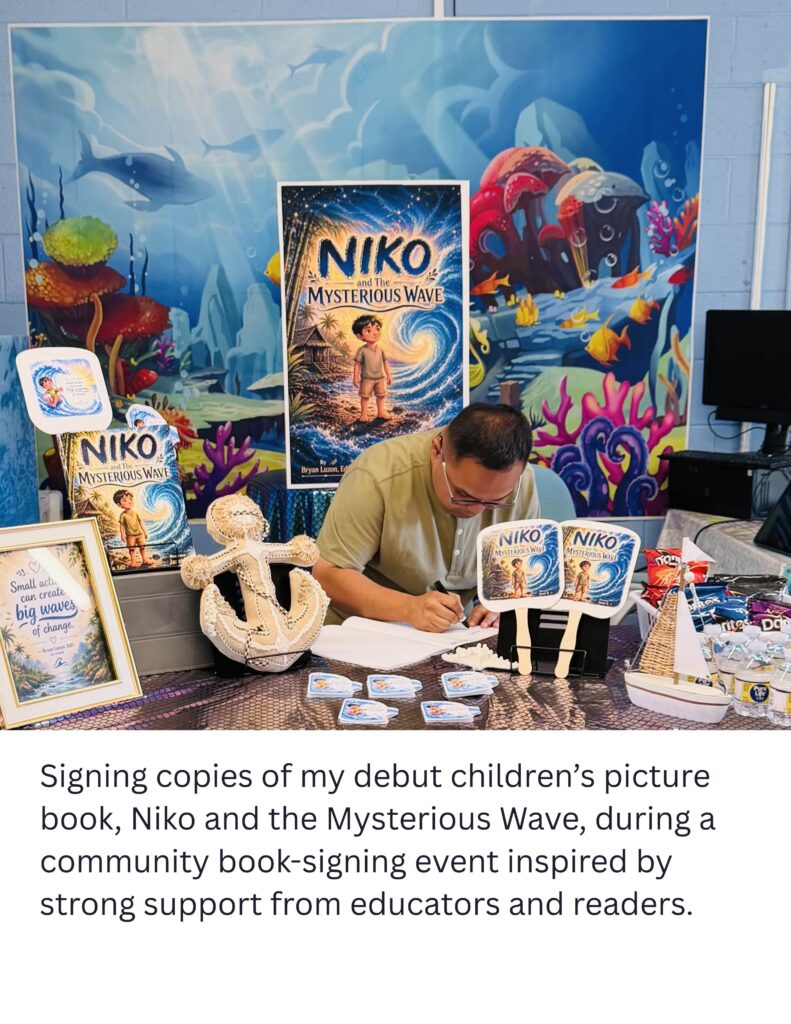
The same stubbornness produced a book. Before his debut picture book, Niko and the Mysterious Wave, reached readers, it collected its share of rejections. He kept revising, kept searching for the right fit, and eventually found organizations and readers who judged the story on its own merits and embraced it as a classroom resource.
The payoff was concrete. At launch, the book hit number one in Amazon’s Children’s Gardening and Children’s Environmental categories, drew five-star reviews, and anchored a community book-signing packed with families and young readers. On July 14, 2026, it earned the Silver Award from the Readers’ Choice Book Awards. It has since been released in hardcover through Barnes & Noble Press, and he is already deep into a second title, When the Forest Needed Me. To him, the storytelling is teaching by other means — a way to plant kindness and environmental stewardship in children who may never sit in his classroom.
But the initiative closest to his heart isn’t a book at all. It started, years ago, with a quiet promise to himself as a young public-school teacher in the Philippines: every December, he would give his students a small Christmas gift — food, slippers, school supplies, toys — not for the value of it, but as a thank-you. “Without these children, I would not have this opportunity,” he remembers telling himself.
He posted the idea on Facebook and invited others to share their blessings. The response overwhelmed him. Friends, former classmates, colleagues, and strangers sent food, backpacks, supplies, and money; a contact from the Department of Labor organized donations of school supplies. Out of that generosity, Jolly Makers was born. Even now, teaching an ocean away, he keeps it running every December through family and volunteers back home — proof to children in the Philippines that someone believes in them.
Ask him who taught him the most across all of it, and the answer flips the usual script. Teachers change students, he allows, and he hopes he has. But he insists the reverse is truer than people admit. “My students have taught me resilience, gratitude, kindness, and the importance of seeing the world through a child’s eyes.”
The ripple he’s chasing
He is not finished. He is working toward a doctorate at the University of the Cumberlands in Kentucky, still presenting, still writing, and openly curious about teaching one day in places like New Zealand or Japan — not to collect passport stamps, but to keep learning systems different from his own and carry the ideas back to whatever classroom he lands in next.
What he refuses to measure his life by is the trophy count. “I do not measure success by awards, titles, or recognition,” he says. “I measure it by the smiles I see, the confidence my students gain, and the lives I have the privilege to touch.” His advice to fellow Filipinos abroad flows from the same well — that rejection is not the end of a story, that no one should measure their timeline against anyone else’s, that the values which earn Filipinos respect worldwide are worth carrying into every new room.
He often tells his students that every wave begins with a single ripple, and he means it as more than a classroom slogan. It’s the shape of his own life — one painful arrival, one quiet job fair, one funded grant, one small book — each ripple widening into the next.
And beneath all of it runs the message he still carries for the woman who set him on this path, the one who wanted this for him and never saw where it led. Three words, offered to her across the distance she can no longer feel:
“Ma, I kept going.”
