



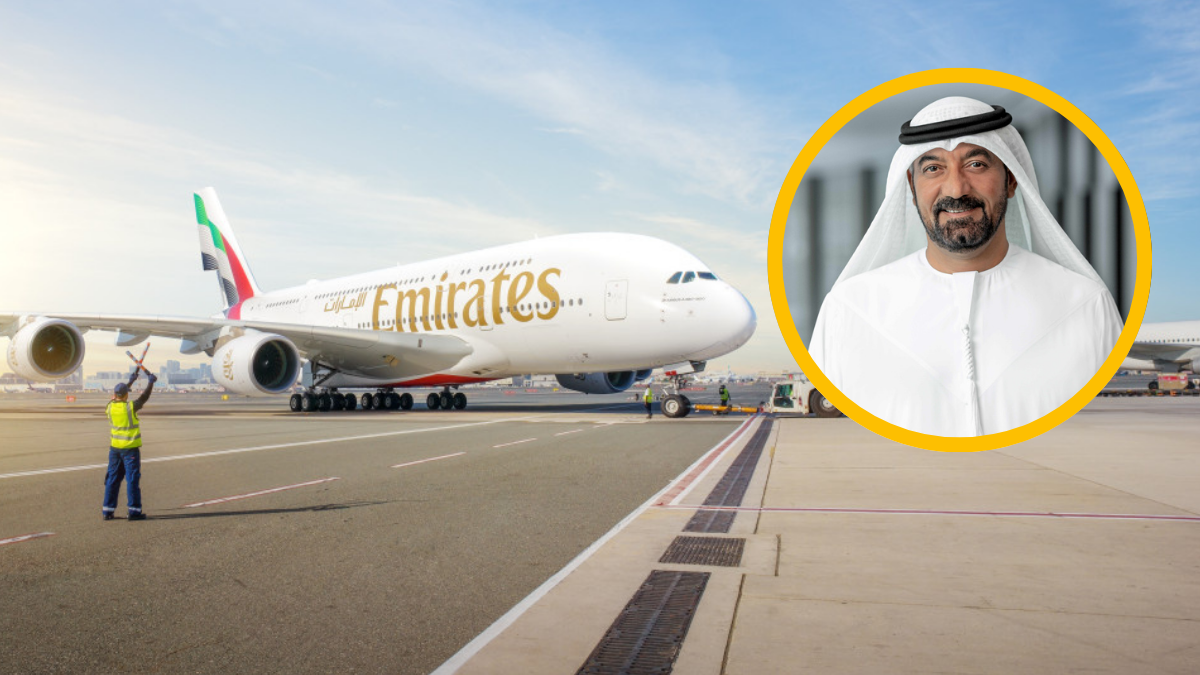

The Emirates Group closed its 2025-26 financial year with record highs across profit, revenue, and cash reserves, even as regional turbulence during the final weeks of March weighed on operations.

Profit before tax reached AED 24.4 billion (US$6.6 billion) for the year ending 31 March 2026, a 7% increase over the previous financial year. Group revenue climbed to AED 150.5 billion (US$41.0 billion). Emirates airline itself posted a record pre-tax profit of AED 22.8 billion (US$6.2 billion), keeping its standing as the world’s most profitable carrier.
Despite the disruption, Emirates said it maintained services to key markets throughout the period. Ninety-six percent of its global network has since been restored, with the airline working to return to pre-disruption capacity. In the Philippines, Emirates currently operates 32 weekly flights across Manila, Cebu, and Clark, and has added four more weekly Manila services since April to bolster cargo links to Europe, the United States, the Indian subcontinent, and Dubai.
HH Sheikh Ahmed bin Saeed Al Maktoum, Chairman and Chief Executive of Emirates airline and Group, pointed to the airline’s financial positioning as a buffer against external pressures. “The Emirates Group enters 2026-27 with very strong cash reserves, which enable us to progress with our plans to strengthen our business without knee-jerk cost control measures,” he said.

On fuel — a persistent concern for carriers across Asia and the Middle East — Sheikh Ahmed said the airline has locked in coverage well into the coming years. “From a fuel perspective, Emirates is well-hedged until 2028-29; and we have worked with our suppliers to secure the volumes required to support our current operations and our scaling up to pre-disruption levels,” he said.
The airline carried 53.2 million passengers over the financial year, while Emirates SkyCargo moved 2.4 million tonnes of freight globally. The network now spans 152 destinations across 80 countries, supported by 32 codeshare and 117 interline partnerships giving passengers access to more than 1,700 additional cities.
Fleet investments continued on multiple fronts. Emirates took delivery of 15 Airbus A350 aircraft during the year and pressed ahead with a US$5 billion cabin retrofit programme — 91 aircraft have completed full interior upgrades so far. The airline also accelerated the rollout of Starlink high-speed Wi-Fi, with 21 aircraft fitted by 31 March, alongside the continued expansion of its Premium Economy product.
“Our fundamentals are strong. The Emirates Group’s proven business model is unchanged. Dubai’s place at the nexus of global commerce, trade and travel flows is unchanged,” Sheikh Ahmed said.
