



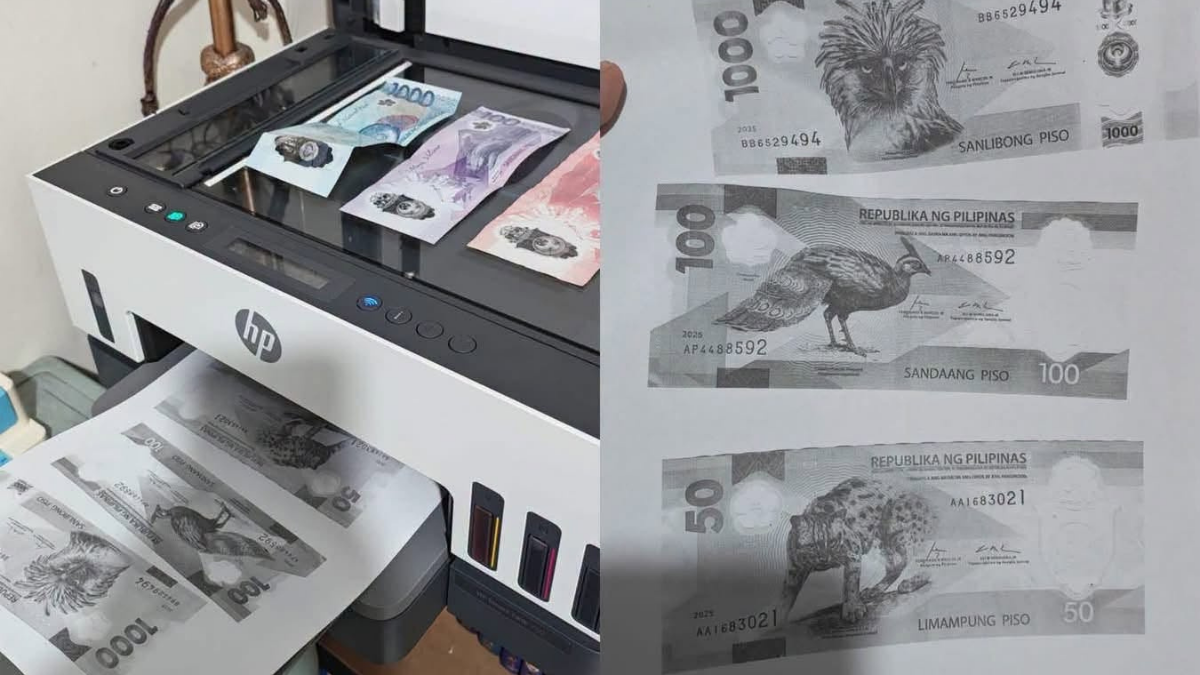

Some supporters of Vice President Sara Duterte have taken to social media to mock the Senate impeachment court, printing images of peso bills and joking that if prosecutors can call a photocopy an “original,” then a photocopied banknote should be just as valid as real cash. The stunt is meant as ridicule. Legally, it is also a crime, and the two matters have nothing to do with each other.

Reproducing the image of Philippine currency without authorization is prohibited under Bangko Sentral ng Pilipinas (BSP) Circular No. 829, issued in 2014. The circular prescribes imprisonment of five to 10 years for anyone found guilty of reproducing the image of any legal tender Philippine banknote, or any part of it, whether in black and white, in color, or in a combination of colors, without approval from the BSP. Printing, scanning, or photocopying a peso bill therefore falls squarely within the prohibited act, regardless of whether the person intends to spend it.
The BSP has enforced this before. In January 2022, the regulator reminded the public that printing photos or images of Philippine banknotes without permission is punishable by jail time. The reminder followed the arrest, by the National Bureau of Investigation working with the BSP Payments and Currency Investigation Group, of an individual suspected of selling cash envelopes bearing the image and design of the 1,000-peso New Generation Currency note. The BSP has repeatedly warned that reproducing or imitating the facsimiles of its notes without prior authority is unlawful.
A separate law, Presidential Decree No. 247, penalizes anyone who defaces, mutilates, tears, burns, or destroys currency notes and coins with a fine of up to P20,000 and imprisonment of up to five years. In September 2022, the BSP filed charges against five individuals who were recorded willfully tearing and destroying banknotes in videos posted online, pursuing them under PD 247 in relation to Article 154 of the Revised Penal Code and Republic Act No. 10175, the Cybercrime Prevention Act. That last point matters for the current wave of online stunts: posting the act on social media can add a cybercrime dimension to the underlying offense.

The comparison driving the online mockery collapses on inspection. The impeachment court’s ruling addressed the rules of evidence, not the rules on currency. On July 7, 2026, the second day of trial, defense lawyer Carlo Narvasa objected to the prosecution’s submission of printouts used to authenticate a November 2024 video of Duterte, arguing they were mere photocopies rather than the original electronic data. The court overruled the objection, holding that accurate printouts of digital files are admissible as originals. That conclusion rests on Rule 130, Section 4(c) of the 2019 Revised Rules on Evidence, in force since 2020, under which a duplicate that accurately reproduces an original is admissible to the same extent as the original. The Supreme Court affirmed the same principle in People v. Lastimosa in February 2025.
An evidentiary duplicate and a photocopied banknote are governed by entirely different bodies of law. One concerns whether a document may be admitted in a proceeding; the other concerns the state’s exclusive authority to issue currency and protect it from imitation. A court accepting a printout of a video record as evidence confers no license to manufacture money, and no argument raised inside the impeachment trial alters the criminal exposure of anyone who prints a peso bill.
Filipinos who wish to protest the proceedings remain free to do so through lawful means. Turning a banknote into a prop for that protest carries a penalty that can reach a decade behind bars.
