





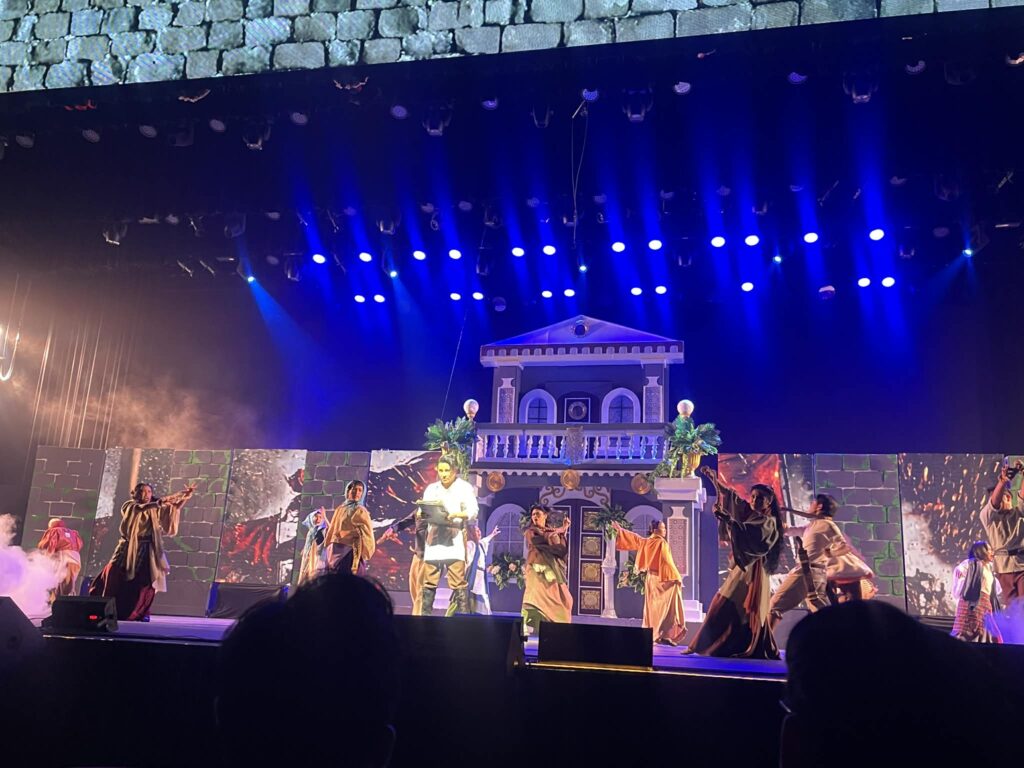
On April the 13th, 2026, something far greater than a curtain call unfolded at the Newport Performing Arts Theater. What audiences witnessed was not simply the final performance of ‘Bonifacio: Ang Supremo, Isang Musikal’, it was the culmination of a cultural awakening that had swept across the nation.

After an extraordinary run of over 722 performances in just nine months, the production did not quietly exit the stage. It roared into history.


That final evening carried an almost sacred weight. The theater pulsed with anticipation, but beneath the excitement was something deeper, a shared awareness that this was the end of a once-in-a-generation phenomenon. When the curtain finally fell, it did not feel like a farewell. It felt like the sealing of a legacy.
At the heart of this theatrical revolution was Vince Tañada, whose portrayal of Andres Bonifacio transcended performance and became embodiment.
His interpretation rejected the safety of spectacle, instead grounding itself in emotional truth and historical weight. This Bonifacio was not a distant hero cast in bronze, but a living, breathing force, fierce in conviction, yet vulnerable in the face of betrayal and sacrifice.
In the production’s final moments, Tañada’s performance reached a level of intensity that felt almost otherworldly, as if he carried with him the collective spirit of every audience who had witnessed the show before.

His philosophy remained clear and unwavering…
“We really need to create our own play… based on our culture, our history.”
And through that vision, he achieved more than artistic success, he sparked a movement.
Alongside him stood Johnrey Rivas, whose portrayal of Emilio Jacinto provided a powerful counterbalance. Where Bonifacio burned with intensity, Jacinto resonated with quiet strength. Rivas delivered a performance marked by restraint and intellectual depth, elevating the role beyond mere support into something essential.
On that final night, his presence carried a reflective gravity, as if honoring not only the character he portrayed, but the journey of the entire production.
As President of the Philippine Stagers Foundation, Rivas articulated a mission that clearly found its mark…

“Our goal is to teach, entertain… the youth do not find themselves bored.”
Judging by the thunderous applause that echoed through Newport Performing Arts Theater that evening, the mission had not only succeeded, it had resonated across generations.
What made ‘Bonifacio: Ang Supremo’ extraordinary was not merely its scale or endurance, but its courage. It dared to confront uncomfortable truths: internal divisions, the true cost of revolution, and the enduring relevance of Bonifacio’s ideals in a modern, complex Philippines.
It resisted the temptation to romanticize history, choosing instead to humanize it.
And in doing so, it transformed history into something urgent, alive, and deeply personal.
From classrooms to grand stages, the musical ignited a renewed sense of national identity, particularly among young Filipinos. It proved that when history is told with conviction, it does not belong to the past, it demands engagement in the present.
Even in its closing moments, the production refused to stand still. The announcement of ‘Rizal 3000’, a bold upcoming work inspired by José Rizal and set to premiere in August 2026, electrified the audience. It signaled that this was not an ending, but an evolution, a continuation of a mission to reimagine Filipino stories for a new era.

As the cast assembled for their final bow, the atmosphere was not one of loss, but of transformation. Because ‘Bonifacio: Ang Supremo, Isang Musikal’ does not simply conclude, it lingers. It lives in the minds it awakened, the conversations it ignited, and the pride it rekindled.
Through the vision of Vince Tañada and the commanding artistry of Johnrey Rivas, the production has secured its place as a defining force in contemporary Philippine theater.
And as the lights dimmed inside Newport Performing Arts that unforgettable night, one truth stood clear above all…
The stage may have gone dark,
but the revolution it sparked burns brighter than ever.
