



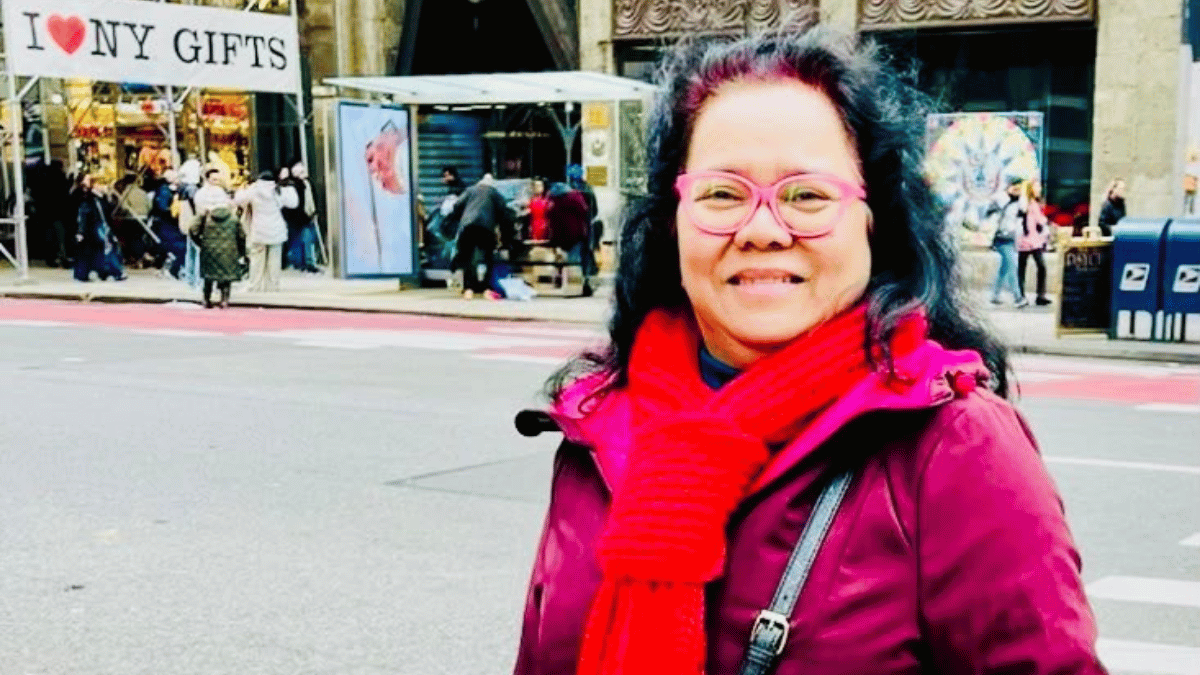

The compliment Filipino nurses hear most often abroad can also be the one that quietly boxes them in. Their patience, their warmth, and their stamina through punishing shifts have made them a fixture in hospitals from the Gulf to North America, and with that reputation has come an unspoken assumption that the bedside is where they belong. Christine Liquigan-Manalili has spent more than three decades in Saudi Arabia taking that assumption apart, one appointment at a time.

At 58, Christine is a nurse manager and supervisor at the Emergency Care Center of King Abdulaziz Medical City in Riyadh, a Level 1 Trauma Center under the Ministry of National Guard Health Affairs (MNGHA). Her remit covers the most critical patients who come through the doors, those classified under the top two tiers of the triage scale, along with the center’s trauma and disaster nursing operations. She manages multidisciplinary teams, keeps clinical compliance tight, and holds the department to the standard its trauma designation demands.
It is a long way from where she started. When she landed in the Kingdom in August 1990, she was a staff nurse in MNGHA’s emergency department, one of thousands of Filipinos who had left home for a reason that needed no elaboration.
A promise made to family
“My primary motivation for pursuing employment abroad was to provide financial stability and a comfortable life for my family,” Christine shares with TGFM.
That family was a single mother and a set of siblings who depended on her. Working overseas, the young nurse reasoned, was the surest way to lift their quality of life and open doors that would otherwise have stayed shut. The commitment, she says, became the engine behind everything that followed.
Before the move, she had already learned to carry several loads at once. In Cagayan de Oro City, she trained and served as a volunteer general nurse at the Army Station Hospital, an environment that sharpened her critical thinking and taught her to adapt under pressure. At the same time, she worked as a general nurse at Maria Reyna Hospital, run by the Sisters of St. Paul of Chartres, whose standards she describes as both rigorous and compassionate. And she taught. As a clinical instructor and faculty member at Capitol University, then known as Cagayan Capitol College, she was already shaping the next generation of Filipino nurses.
Care, discipline, and teaching ran on parallel tracks in those early years. All three would follow her to Riyadh. What she did not yet know was how hard she would have to push before anyone let her use all of them.
The only one at the table
The international healthcare system she entered in 1990 was demanding in ways a nursing license does not prepare you for. The former clinical instructor found herself navigating unfamiliar communication styles, rigid institutional hierarchies, and, at times, open doubt about what a Filipino nurse could be trusted to do.
Christine went on to become, by her account, the first Filipino nurse appointed as Clinical Resource Nurse, an educator role, and as Nurse Manager at MNGHA. Neither appointment came easily.
“I had to consistently outwork doubts and prove that Filipino nursing capability extends far beyond bedside care into executive clinical leadership,” she says.
Her approach was blunt. “My strategy was simple, speak through exceptional results, absolute clinical competence, and unwavering professionalism,” the nurse manager explains.
She paired that with something harder to teach: cultural intelligence. Christine traveled to the home countries of the colleagues she worked with, studying the backgrounds of her multinational team so she could adjust her leadership style and build mutual respect instead of friction. At an institution where, in her words, it felt as if “the entire universe is represented under one roof,” that effort mattered. Working shoulder to shoulder with Western and international peers, she says, repeatedly confirmed what she already believed about the skill and resilience of Filipino nurses.
Her reach soon extended past her own ward. For 11 years, Christine sat on MNGHA’s International Nurses Recruitment Team, a role she saw as a platform to champion and mentor Filipino nurses on a global scale. As a course director and faculty member for Advanced Trauma Care for Nurses (ATCN), she represented Saudi Arabia at a national congress in Washington, D.C. Closer to home, she taught and mentored health professionals in Bahrain, Qatar, and Kuwait, and was entrusted with reviewing, establishing, and signing off outreach ATCN centers in those countries, work she calls one of her most deeply rewarding contributions.
Looking back, the Filipina nurse leader frames that period as a lesson in what it costs to be first. Leadership, she says, “requires the courage to sit at tables where you are the only one who looks like you, and to speak with an authority backed by flawless execution.”
The cost was also personal. Constant travel for teaching and recruitment kept her away from home, and she credits her husband, whom she describes as understanding and kind, and her children for carrying her through it with their care. The thought of the family who depended on her, including her mother and siblings, gave her, she says, “the strength to endure the toughest days of homesickness and professional stress.”

Calm in the middle of the storm
Ask Christine why she stayed in emergency and trauma nursing for so long, and the answer comes without hesitation. “I chose this field because I genuinely believe that emergency trauma care is in my DNA,” she says.
She thrives in the moments most people would rather avoid, when a split-second clinical decision determines whether a patient lives. The part of the job that never stops rewarding her is watching a patient brought in on the brink of death leave the unit alive because her team moved quickly and precisely.
That work carries a steady weight. Running a Level 1 Trauma Center means facing human tragedy, intense pressure, and chaos every day. “A true trauma leader must be the calm center in the middle of a storm,” the trauma nurse says. That composure, she adds, is not something anyone is born with. It is built over years of discipline, faith, and a firm belief in the value of every human life.
Yet her greatest joy lies away from the resuscitation bay. Over the years, Christine has guided scores of novice nurses into proficiency, and she has watched some of them rise into senior leadership roles of their own. Seeing that happen, she says, is “a reward that no amount of money can buy.”
It is also, in her view, the real measure of the job. “My greatest realization is that clinical competence is only half the battle; true leadership lies in creating pathways where none existed before,” she says. Her decade on the recruitment team taught her that her highest calling was not simply to succeed on her own, but “to actively pull others up behind me.”
Lessons for the long haul
More than three decades abroad have given Christine firm opinions on what separates overseas workers who thrive from those who struggle, and she does not soften them.
On careers, her message to fellow Filipinos is to refuse the limits others set for them. “Overcome the fear of the glass ceiling,” she says. That means delivering excellent work, stepping forward when leadership opportunities appear, and continually upgrading skills, certifications, and credentials. “Your knowledge is your greatest leverage,” the veteran nurse adds.
On money, she is even more direct. Financial management, she believes, is where many OFWs fail, caught between the needs of family back home and the temptations of life abroad. She has watched friends, former colleagues, and distant relatives return to the Philippines without enough to live on, and find themselves alone. “When you don’t have money all your friends or even family members are gone,” she says.
She and her husband, who also worked overseas, took a different path. With the guidance of financial advisers, the couple put their earnings into real estate, trust funds, and jewelry so that their eventual return home would be secure.
Relationships, she warns, deserve the same discipline. “Do not mistake proximity for loyalty,” Christine says. Her advice is to build a relationship with God first, then surround yourself with a close, God-fearing community of kababayans who lift you up during homesickness rather than drag you into workplace drama.
Bringing the Kingdom’s lessons home
Christine already knows what comes after Riyadh. She plans to return to the Philippines and open her own independent healthcare training center, focused on advanced clinical skills, specialized trauma care, and leadership development. The aim is to carry decades of Level 1 trauma experience home and narrow the gap between Filipino nursing education and what hospitals abroad expect.
At the heart of the project is mentorship, particularly for young nurses from humble backgrounds like her own. She wants to give them the skills, confidence, and clinical judgment to compete anywhere, and to change how the world sees them. Filipino nurses, she insists, are “not just meant for the bedside, but is fully equipped to lead, educate, and innovate at the highest levels of global healthcare.”
The road from a volunteer post at an army hospital in Cagayan de Oro to a podium in Washington, D.C., was long, and the time away from family was real. Christine does not dwell on the price.
“Every drop of sweat and every sacrifice made away from my family was entirely worth it,” she says. And she is clear about where the credit belongs: “To God be the Glory Alone.”
