



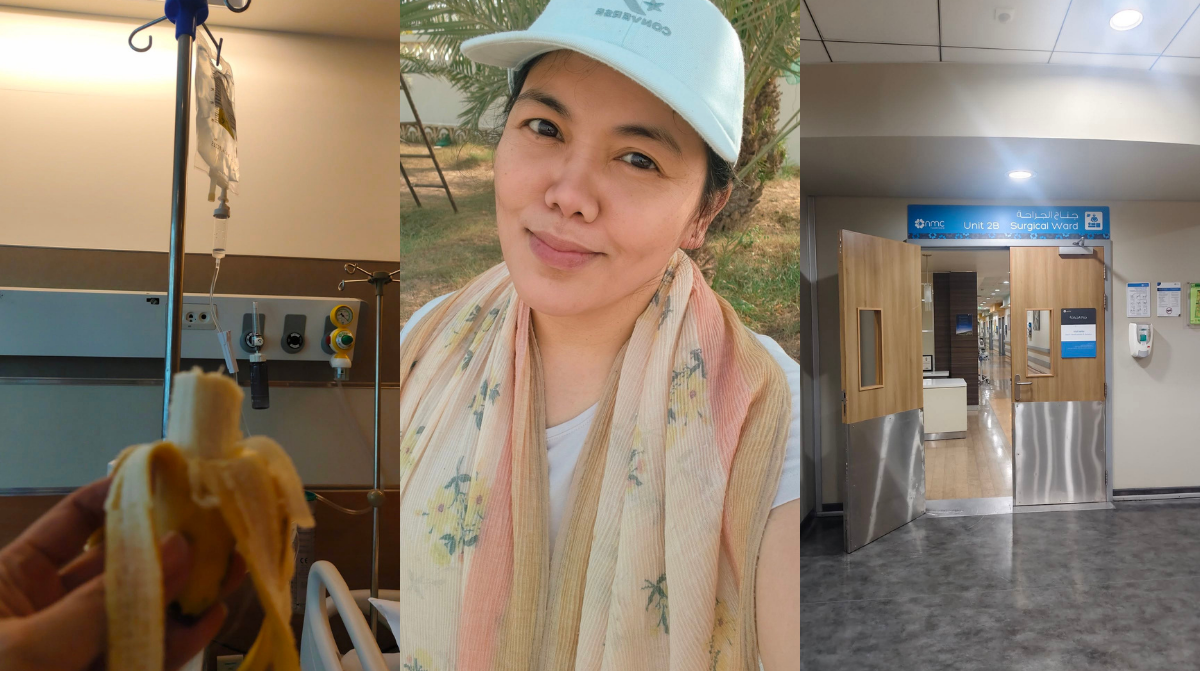

When a viral post by the content creator known as Anne in the Emirates set off a wave of healthcare stories from overseas Filipinos, one comment stood out. “Totally agree, that’s why I didn’t go back home matapos yung contract ko. I stayed, found a new employer then started my treatment here,” wrote Marjorie Anne Roco, adding that she had been diagnosed with breast cancer and now owed her life “to the government of the UAE.”

Behind that short comment was a story she agreed to tell in full.
Roco, 43, is from General Santos City and has been in the UAE for two years and eight months, working as a private driver. Separated, she has three sons back home “who is waiting for my return.” She came to the Emirates alone. “I have friends back home who are working here for years. And that friends are my family here,” she said, crediting them with holding her up emotionally through the hardest months of her life while her family in the Philippines “always keep me in their prayers battling this C Monster.” Last month, when a friend flew home for vacation, her family sent back herbal supplements for her to take.
A diagnosis caught between contracts
Roco first felt a lump in her breast in January 2026, but she did not go for a check-up right away. Her two-year contract with a previous employer was ending, and her visa and insurance had already been cancelled. She used her grace period to look for a new employer without luck, then took a two-month visit visa, exited the country, and returned. It was only after she found a new employer in May 2026 — and with it, health insurance — that she went through a series of check-ups, lab tests, and screenings. The final diagnosis: breast cancer, stage 3b.
Her first thoughts turned homeward, and to fear. “If I go home knowing how healthcare in our country was, I will just be waiting to die,” she said, describing a family without the means to fund treatment. “Where will we get the money for my treatment?”
Because her insurance was new, it covered her lab tests and medicines during work-up, but her chemotherapy claim was rejected under a standard six-month waiting period for pre-existing conditions. For a patient with an aggressive cancer, the timing was cruel. “I needed to do the treatment right away because the type of my c-monster is aggressive,” she said during an interview with TGFM. Rather than leave her stranded, her oncologist at NMC Royal Hospital in Khalifa City connected her to a charity — the Cancer Patient Care Society – Rahma, an Abu Dhabi public charitable society established in 2015 that funds cancer treatment for patients of all nationalities.
Help that arrived on schedule

What struck Roco most was the speed. Her doctor called on a Tuesday to say her Rahma application had been approved; the funds were sent to the hospital by Wednesday, and her treatment was set for Friday. She said she was overjoyed, cried, and immediately told her family, friends, and eldest son.
The reliability moved her as much as the money. “In our country when we ask for help from government or charity and if they say we will update you and give you a timeline we will wait months for it,” she said. “But Rahma, when they say we will update you in 10 days. They will, and help was given.” Roughly ten days after her interview at their office, the society covered her first cycle of chemotherapy and immunotherapy.
Her first chemo session was the day before she spoke. She admitted she was scared going in — unsure whether her body could take the medicine, whether she could keep working, what the side effects would be. “But Alhamdulillah all is well. I have just a light heaviness in my head, but everything is fine,” she said.
Roco even found room for humor about her medical history, calling herself a cat lover who has burned through her nine lives — three Caesarean surgeries, a laparoscopic cholecystectomy, and a port-a-Cath procedure among them. “And this life I owe it to UAE. They have given me a fighting chance to live,” she said, invoking a line from UAE President Sheikh Mohamed bin Zayed Al Nahyan, who said in a March 2026 address that “in the UAE, everyone is Emirati through their love for this land and their contributions to it.”
‘This country will heartily and genuinely help you’
Her gratitude was specific. She thanked her oncologist for stepping in the moment her insurance fell through; Rahma, which she said gave her “a chance to fight for my life”; and her local employer, who at first worried about the disruption and asked her to find a replacement driver but, after returning from Umrah, changed course. “You stay here with us until your treatment,” Roco recalled her saying.
To fellow OFWs facing illness far from home, she offered this: “Don’t be afraid. We may be alone in this country, but this country will heartily and genuinely help you. I am one just one of the many this country has helped and given a fighting chance to live.”
Roco’s account is one person’s experience, but it plays out within a real system. The UAE runs a mixed public-private healthcare model, with the Ministry of Health and Prevention (MOHAP) overseeing the federal level and individual emirates such as Abu Dhabi and Dubai operating their own health authorities. Health insurance is mandatory in Abu Dhabi and Dubai, though access and costs vary by emirate, coverage, provider, and treatment, and emergency services are reachable nationwide via the 998 ambulance number. The country also has a well-developed health workforce — 29.1 physicians and 61.9 nurses and midwives per 10,000 people in 2022, according to the World Health Organization — and life expectancy reached 83 years in 2024, per the World Bank, even as noncommunicable diseases remain a leading cause of death. For residents and expatriates alike, the cost of care and gaps in insurance coverage remain real considerations. For Roco, the difference was decisive. As she put it: “Always remember in this country, ‘We are Emirati.'”
