



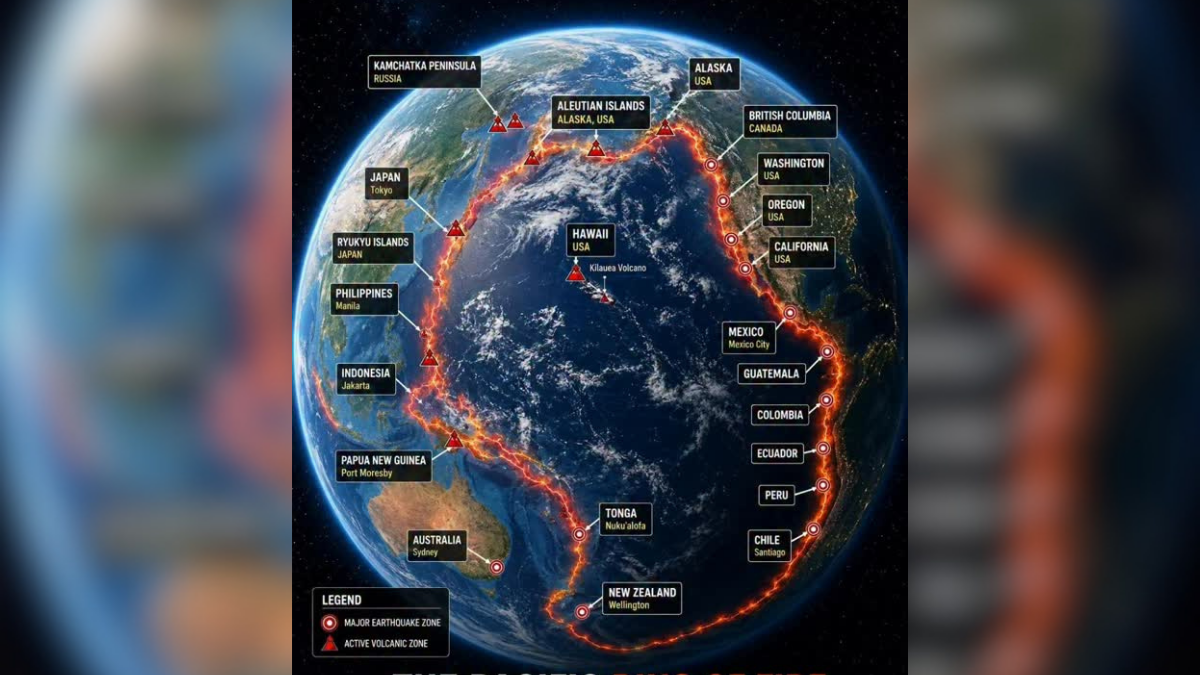

The planet is violently clearing its throat, and the world is forced to listen. Across 2026, a series of high-magnitude earthquakes has rattled human settlements around the globe, leaving an undeniable trail of devastation. From the shattered infrastructure in Colombia and Venezuela to coastal tsunami scares in the Philippines and Japan, roughly a dozen nations have found themselves locked in a terrifying dance with the Earth’s crust. For the casual observer tracking real-time alerts on modern seismic maps, it can feel as though an interconnected fuse has been lit — a literal chain reaction rippling around the volatile Pacific Ring of Fire.

Balancing human anxiety with geological fact
Yet, as we craft the narrative of this restless year, we must balance visceral human anxiety with cold, hard geological fact. It is easy to construct an apocalyptic story of a global “domino effect,” but seismologists from organizations like the U.S. Geological Survey (USGS) strongly caution against it. The truth is far more humbling: our planet isn’t suffering a sudden synchronized breakdown; it is behaving exactly as it always has, indifferent to our borders.
A roll call of tectonic hot zones
The list of impacted nations reads like a global roll call of tectonic hot zones. In South America, Colombia was struck on August 10, 2026, by a magnitude 7.4 tremor — the country’s strongest in a century — that killed more than 280 people. Less than two months earlier, on June 24, neighboring Venezuela was hit by back-to-back quakes of magnitude 7.2 and 7.5, striking just seconds apart and killing thousands. Crossing the Pacific, the Philippines endured a magnitude 7.8 offshore event near Mindanao on June 8, while Indonesia and other Ring of Fire nations recorded their own strong ruptures through the year. When you factor in moderate-to-strong tremors in places like Mexico, China, and New Zealand, plus the ongoing aftershock sequence following Russia’s massive July 2025 Kamchatka quake, the geographic scope easily spans a dozen nations.
However, labeling this a single “chain reaction” is a seductive myth. Tectonic plates are massive, largely independent blocks of rock. The stress that triggered the Venezuela quakes belongs to a completely different, localized fault system than the subduction forces driving the deep trenches off Japan. Science tells us that an earthquake in South America cannot physically trigger a tremor in East Asia. What we are witnessing is not a connected wave of cosmic malice, but a statistical clustering — a run of independent geological timers going off within the same window of months.

But does the lack of a scientific link make the situation any less urgent? Absolutely not. Connected or not, the human toll is real. Tens of thousands have been displaced, critical infrastructure has crumbled, and emergency-response networks have been pushed to their limits.
A necessary wake-up call
Ultimately, this run of global shaking serves as a brutal, necessary wake-up call. The Ring of Fire is simply living up to its name, reminding us that humanity builds its greatest cities on the fragile, shifting skin of a restless giant. Rather than panicking over a fictional global chain reaction, the global community must channel that fear into action. Structural engineering, early-warning networks, and localized community preparedness are our only real shields. The Earth will continue to shake; our only choice is whether we are ready when the ground moves beneath our feet.
Where and what is the Pacific Ring of Fire?
The Pacific Ring of Fire is a roughly 40,000-kilometer (25,000-mile) horseshoe-shaped belt around the Pacific Ocean basin, marked by frequent volcanic activity and earthquakes. The region contains hundreds of volcanoes — a large majority of the world’s active and dormant ones — and is where about 90 percent of the world’s earthquakes occur, including many of the most devastating. The activity is driven by plate tectonics: the continuous movement, collision, and subduction of oceanic plates beneath lighter continental ones.
The Philippines sits squarely within this belt, where frequent plate collisions cause intense seismic and volcanic activity. Because of this placement, the country ranks among the most disaster-prone nations on Earth, regularly experiencing earthquakes, volcanic eruptions, and tsunamis.
