



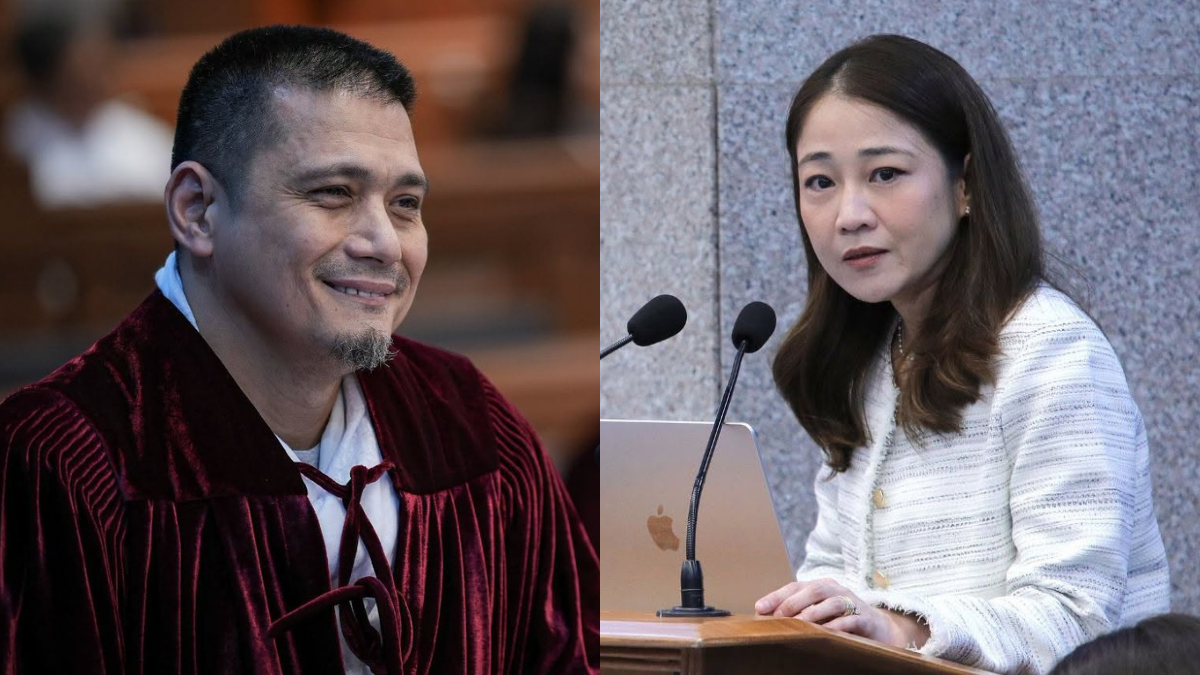

The signatures on the acknowledgment receipts at the heart of the confidential funds controversy — among them the widely mocked “Mary Grace Piattos” and “Antonio Pagong” — became the focus of a pointed exchange over Philippine history on the 19th day of Vice President Sara Duterte’s impeachment trial Wednesday.

Private prosecutor Atty. Mae Divinagracia told the impeachment court that the country’s Anti-Alias Law does not ban assumed names outright. What the statute requires, she explained, is that a person’s true identity be revealed alongside any alias they adopt. On her account, whether someone used a pseudonym was never the real question; what mattered was the manner in which those names surfaced in the documentation for the Office of the Vice President’s confidential spending.
That legal point came in reply to Senator-judge Robinhood Padilla, who spent a lengthy stretch of the session drawing on the country’s revolutionary past. He walked Divinagracia through a roster of assumed names carried by figures from the fight against Spanish rule — Andres Bonifacio’s “Maypagasa,” Jose Rizal’s “Dimasalang,” Marcelo H. del Pilar’s “Siling Labuyo,” and Emilio Aguinaldo’s “Magdalo” among them — asking whether she was aware that such names were used and why. His argument was that covert work, by its nature, forces those involved to shield their identities and withhold their real signatures.
Divinagracia acknowledged familiarity with several of the names but drew a sharp line between the two situations. The heroes operated under foreign occupation, in a nation formally at war, she said — conditions she described as fundamentally unlike whatever produced the disputed receipts. According to a report from Philstar, when Padilla pressed the analogy toward the present by invoking the government’s continuing conflict with communist insurgents, Divinagracia distinguished internal armed conflict from a conventional war between states, though the senator held that both amount to a “clear and present danger.”

Padilla extended his historical survey to a more recent name: the late Senator Benigno “Ninoy” Aquino Jr., who traveled home from exile in 1983 under the passport alias “Marcial Bonifacio.” The senator offered it as proof that even a celebrated democracy figure had reason to move under a false name.
The rebuttal came from within the chamber. Senator-judge Bam Aquino, Ninoy’s nephew, confirmed the detail about his uncle’s alias but stripped it of the weight Padilla had assigned it. As Inquirer reported, he noted plainly that Ninoy never received confidential funds and never signed any acknowledgment receipt for them — severing the parallel the senator had tried to build.
The debate unfolded against the testimony of Lemuel Ortonio, an OVP assistant chief of staff appearing as a hostile witness, who had earlier been asked directly whether aliases belonged in confidential fund handling. Ortonio would not commit to a yes or no, saying he had no direct knowledge of how such operations run on the ground and that protecting informants’ identities can be a legitimate concern. He drew the court’s attention to a gap in the governing Joint Memorandum Circular: it lays down no rule for how names are to be written in the paper trail for these payments. Ortonio also disclosed that he never checked the acknowledgment receipts himself, because the documents reached him already sealed inside a box.
