



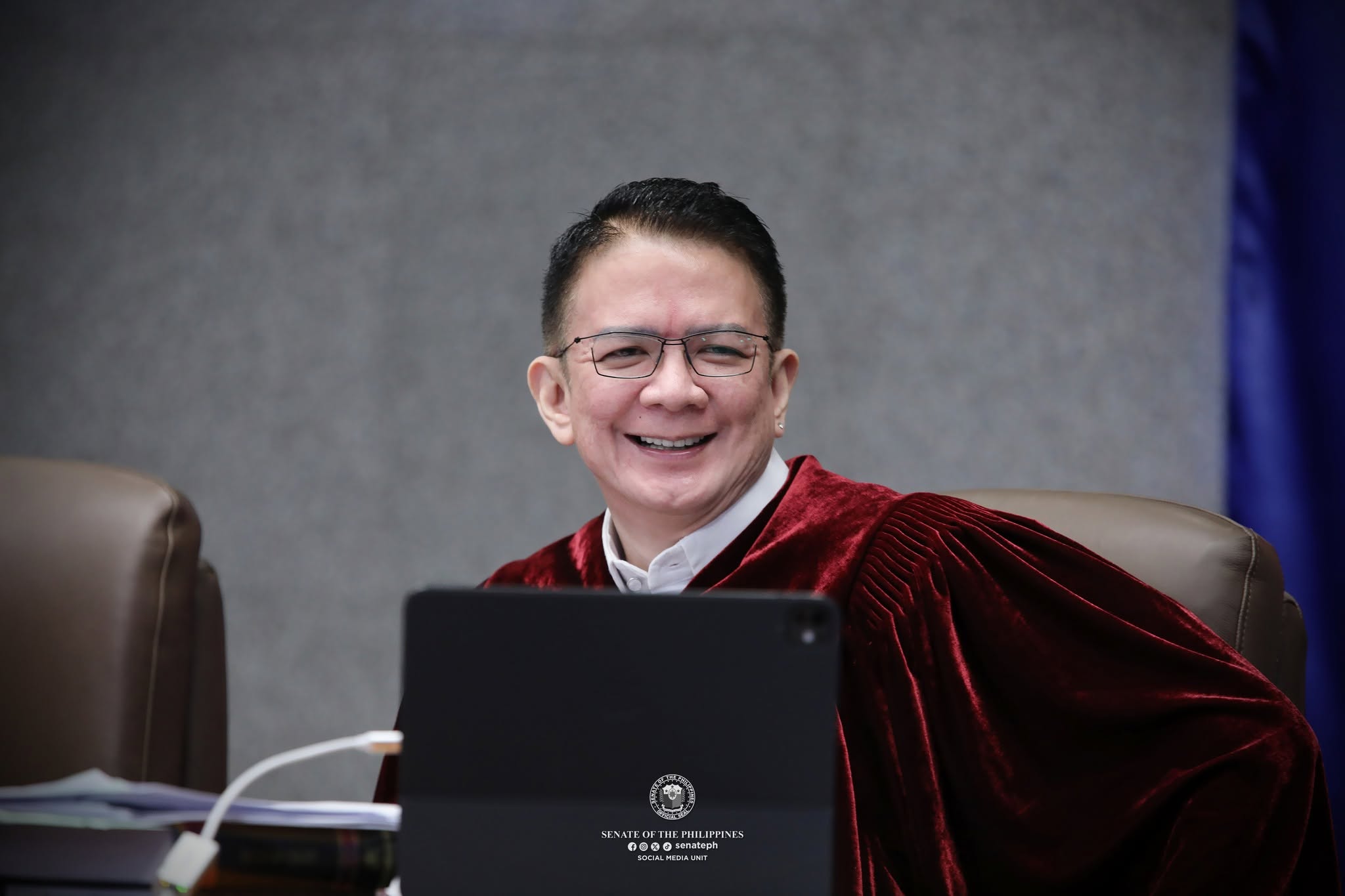

Impeachment court presiding officer Chiz Escudero laid down a two-strike system on Wednesday, August 26, 2026, warning that lawyers, parties, and senator-judges who publicly discuss the merits of Vice President Sara Duterte’s impeachment case now risk reprimand, fines, and restrictions on the floor.

Anchoring his order in Rule 18 of the impeachment rules, Escudero spent more than half an hour spelling out how the court means to protect its impartiality, decorum, and integrity. He directed that no party may make public comments, statements, insinuations, or rhetorical questions that prejudge the case, challenge the court’s rulings, “substitute media pressure for evidence,” or erode confidence in the tribunal’s neutrality.
Under the framework, a first violation draws a “severe reprimand and stern admonition in open court, placed permanently on the record as a final warning.” A repeat breach carries a penalty of up to P30,000 for each offense, and the offender may additionally be barred from “speaking, objecting, or examining witnesses on the floor.”
For members of the Bar, the stakes extend past the courtroom. Escudero said any lawyer found in breach would have the record forwarded to the Office of the Bar Confidant, the Integrated Bar of the Philippines, and/or the Supreme Court “for possible disciplinary sanction regarding the person’s license to practice.” He drew the professional line plainly, noting that attorneys are “prohibited to comment or publicize opinion pertaining to a pending proceeding in a manner that may cause prejudgment, sway public perception, influence the tribunal, or create a widespread perception of guilt or innocence.”
He turned the same rule on the senator-judges, appealing to them to “refrain from unparliamentary remarks, personal attacks, invitations of improper motive, and other language incompatible with the dignity of these proceedings and of parliamentary courtesy to other people.” The caution carried over to online conduct, with Escudero invoking the “professional responsibility” of participants on social media and forbidding “the dissemination of false or unverified claims or disinformation.”

The ruling grew out of a string of charged exchanges in the weeks before it. One flashpoint traced to August 4, when prosecution counsel Atty. Lorna Kapunan questioned Commission on Audit state auditor Roderick Wamil about whether the OVP’s alleged misuse of public funds amounted to prima facie evidence. “Ang tawag ko lang doon, hindi prima facie evidence. Kung ako ang tatanungin, scam ito,” Kapunan said — a characterization defense counsel Atty. Michael Poa moved at once to strike.
A separate dispute surfaced on August 12, when Kapunan and defense counsel Atty. Kristine Ferrer clashed as Ferrer cross-examined state auditor Xylene del Campo. Kapunan told her, “Leading…misleading questions are not allowed,” and Ferrer shot back, “It is allowed.” Later that day, prosecution counsel Atty. Amando Ligutan posted on Facebook that every lawyer and law student knows “misleading questions are not allowed even on cross-examination.” Lead defense counsel Atty. Sheila Sison raised a manifestation over the post before adjournment, arguing that Ferrer’s “It is allowed” reply had concerned whether a witness could be directed to answer yes or no — not misleading questions as such. Reviewing the transcript on August 26, Escudero suggested the counsels may simply have been talking past each other on which terms they meant.
The most recent friction came from the August 25 session, when prosecution counsel Atty. Mae Divinagracia labeled Duterte the “architect and mastermind” behind the alleged misuse of the OVP’s confidential funds, and afterward told reporters, “We just want to call a spade a spade. To us, it was a scam that was masterminded by the Vice President.” Ferrer branded the language “inappropriate.”
Duterte weighed in the next day, pressing the House prosecution panel to lean on proof rather than showmanship. “Prosecutors and members of Congress who want to legitimize the two impeachment complaints—filed without a shred of evidence—should be confident in the strength of the case. They should not be fishing for evidence during the trial or desperately try to turn something they wish to be true into a wild story of alleged wrongdoing,” she said, adding: “A strong case does not need the adornment of theatrics. Insults reveal the need to feign confidence in the face of a weak presentation.”
Escudero was careful to note that the restrictions apply only from the date of his ruling forward, meaning none of the statements he read into the record will draw a penalty.
