



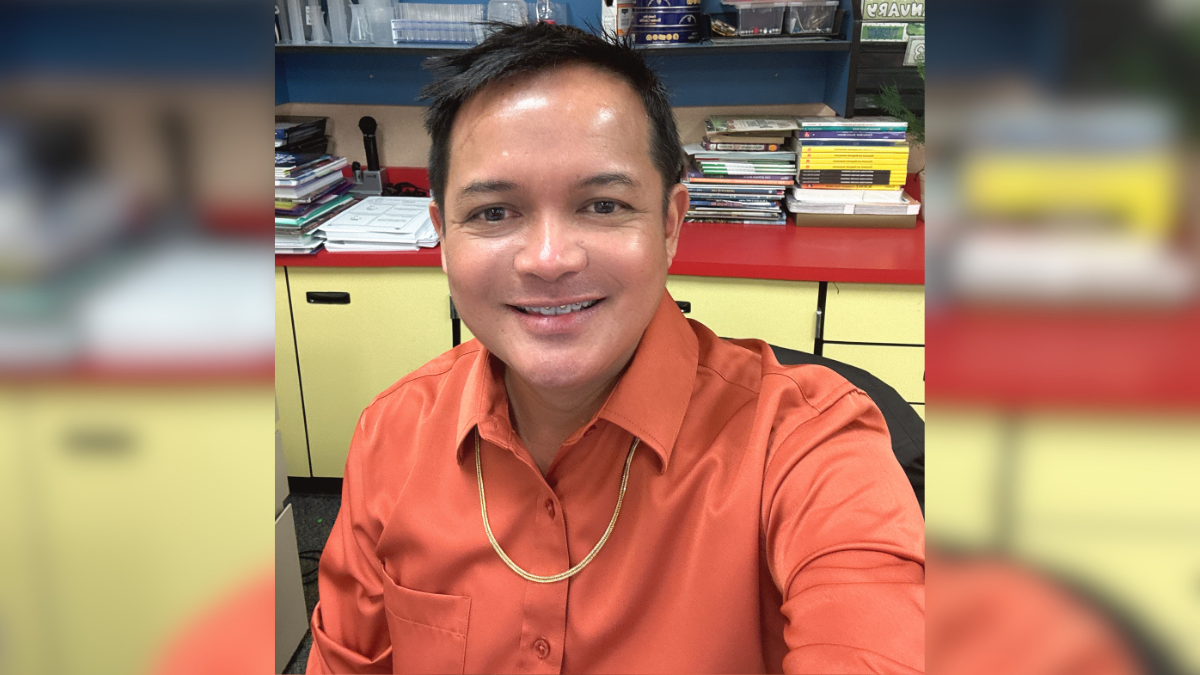

From principal to fifth-grade teacher — that’s the kind of career move that raises eyebrows in staff rooms. Most people climb toward administration and stay there; the corner office, the title, the authority. Antonio A. Maderal spent nearly eighteen years earning that seat in the Philippines, then walked away from it to stand in front of a classroom again in a small town in Arizona.

He doesn’t frame it as a step down. He frames it as a homecoming.
A leader who missed the classroom
For more than two decades, Maderal built a career most educators would consider a summit. As a public school principal, he collected recognition from the Department of Education at the division, regional, and national levels — awards for leadership, for dedication, for the kind of quiet institution-building that rarely makes headlines. He led teachers, strengthened school programs, and shaped the direction of an entire school community.
Then, three years ago, he traded all of it for a fourth- and fifth-grade classroom at Fredonia Schools in Arizona, where his days now run through Math, English Language Arts, Science, and Social Studies.

The distance between those two roles is wider than it looks. A principal manages systems; a teacher manages thirty individual futures at once. And for the former administrator, that direct contact turned out to be the point.
“I have found renewed fulfillment in working directly with students and helping them discover their abilities and potential,” he shares with TGFM. It’s a telling word — renewed. The fulfillment had been there all along, buried under the paperwork and the meetings and the weight of running a school. Returning to teaching gave it back to him.
Why he left the summit behind
The obvious question is why. Why leave a position of authority and respect, built over eighteen years, to start over in an unfamiliar system halfway across the world?
His answer is refreshingly free of restlessness or dissatisfaction. He wasn’t running from anything. He was running toward growth.
“I chose to pursue employment abroad because I wanted to expand my professional experience, embrace new educational perspectives, and challenge myself in a different cultural and educational environment,” he explains. After so many years leading from the principal’s office, he saw the move as a chance to keep evolving rather than settle into the comfort of a title he’d already mastered.

There’s a philosophy underneath the decision, and he states it plainly: he considers education “not simply a profession, but a lifelong commitment.” For someone who genuinely believes that, staying still would have been the real risk. The classroom in Arizona wasn’t a demotion — it was the next lesson.

That reframing carries into how he measures a career at all. “Success is not measured only by titles or awards,” he reflects, “but by the lives we touch and the difference we make.” Coming from a man whose walls could be lined with commendations, it lands as earned wisdom rather than a slogan.
The cost of starting over
None of this came easily, and he doesn’t pretend otherwise. Moving abroad meant adjusting to a new culture, a new education system, and an entirely new way of life — all while an ocean away from family and everything familiar.
He leaned on old-fashioned virtues to get through it. “I overcame these through patience, adaptability, perseverance, and an open mind,” he says, crediting his family, friends, colleagues, and a supportive community for carrying him through the hardest stretches. The former principal, used to being the one others turned to, learned to lean on the people around him.
His mantra reads like a map of that whole arc: My past shaped me, my purpose drives me, and my courage leads me forward. Each clause points to a different chapter — the experience he built in the Philippines, the sense of mission that keeps him teaching, and the nerve it took to cross an ocean and begin again at forty-five.
Advice from someone who has done it
Three years into the American experiment, the fifth-grade teacher has counsel for other Filipinos weighing a similar leap — and it’s strikingly practical. He doesn’t traffic in vague inspiration. He talks about money, relationships, and rights.
“Live within your means, save wisely, and avoid unnecessary debt,” he urges on finances. On work: “Work with integrity, know your rights, and continue improving yourself.” On love, he’s just as direct — choose someone who respects and values you. Threaded through all of it is a plea to stay connected. “Remember that asking for help is not a weakness,” he says, the words of a man who learned that lesson firsthand.
He returns, again and again, to a single anchor: purpose. “Be patient, stay strong, and never lose sight of your purpose,” he tells his kababayans. “Wherever you are, stay humble, resilient, and proud to be a Filipino.”

Looking ahead, he has no intention of stepping away from education, whether he stays abroad or eventually returns home. He wants to share what he’s gathered overseas with fellow teachers and students, and to champion the causes he’s always cared about — quality education, teacher development, student empowerment, community service.
It’s the same work, really, that he’s been doing all along. The setting changed, the title changed, but the mission never did. For Antonio, the classroom in Arizona isn’t the end of a distinguished career — it’s proof that the most meaningful work sometimes means going back to where you started, with everything you learned along the way.
