



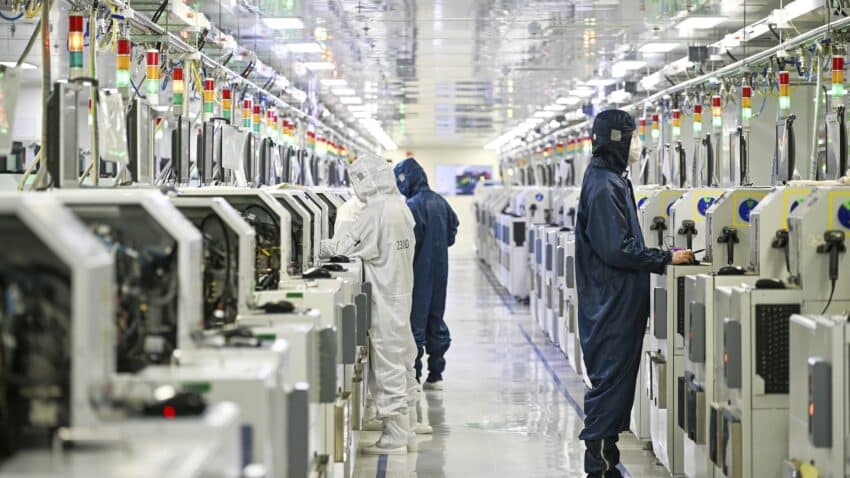

The artificial intelligence manufacturing complex planned for New Clark City would consume between 65 and 90 million liters of water each day, officials confirmed Friday, August 15, 2026 — a volume that dwarfs the roughly 20-million-liter capacity now serving the area and marks the first time authorities have quantified the project’s demand.

Bases Conversion and Development Authority President Joshua Bingcang told the Senate environment committee that the supply would be captured from Central Luzon rivers and stored in detention tanks rather than pulled from aquifers. “This is not ground extraction. We will not take from there, because that is for residential use,” he said in mixed English and Filipino. “What we are looking at are the waterways, the rivers, because the water there just flows.”
The Bangut River, nearest to the 1,600-hectare site, is the intended primary source, with the O’Donnell and Abacan rivers as backups. Bingcang cited a dry-season study indicating the Bangut alone could supply more than the hub requires. A preliminary agreement to pipe desalinated seawater about 70 kilometers from Subic offers a third option.
Committee chair Sen. Raffy Tulfo questioned the reliance on rivers during dry spells, noting that utilities in nearby provinces already field complaints. “What if there’s an El Niño and the rivers dry up? Your requirement is daily,” he said. Bingcang responded that the study had been conducted during the dry season but did not address what would happen if flows dropped further.
The complex is the first venture under Pax Silica, a US-led bloc formed to build AI and semiconductor supply chains outside China’s reach. The Philippines joined in April as one of two Southeast Asian members alongside Singapore. Officials have framed the project as a path beyond low-margin electronics assembly, citing potential investment of up to $70 billion (P4 trillion) and as many as 190,000 jobs. Critics among farmers’ groups, scientists, and Indigenous advocates counter that impacts on land and water remain unexamined.

Sen. Kiko Pangilinan drew out the scale of the gap: current deep-well capacity tops out near 20 million liters daily against demand below three million. “So, you have a demand of three, you have a capacity of 20, but you are anticipating 65 to 90, which means you need to build about five times more,” he said. Bingcang pointed to a build-out target of 30 million liters by 2030 and 100 million by 2036, calling investor participation essential.
Senate President Sherwin Gatchalian observed that the agency’s budget falls short of its requirements, with nothing allocated for 2027, leaving it functioning mainly as a landowner. Trade Undersecretary Ceferino Rodolfo said infrastructure work could start in the second half of 2027, prioritizing power, water, and roads, with commercial tenants unlikely to operate before 2028.
Capas Mayor Roseller Rodriguez, whose town holds most of the site, said no public consultation preceded the announcement. She described a June meeting the council was invited to by text without explanation, where Pax Silica surfaced only briefly among other projects. “What we are asking of BCDA now is a meaningful public consultation with the presence of all affected stakeholders,” she said. Pressed by Pangilinan, Bingcang said a scheduled meeting had been postponed because of the inquiry, with a broader session set for later this month.
The number of households on the land remained unsettled, with four figures presented. Bingcang cited 14 on record, possibly now around 30. National Commission on Indigenous Peoples Commissioner Nancy Catamco said 40 houses belong to Indigenous families and that a community representative reported 75. “Your numbers don’t match,” Tulfo said. “How many really? You haven’t done a census and survey?” Rodriguez said the counts could be reconciled: roughly 40 permanent homes, climbing toward 75 when scattered structures used seasonally by farmers are included, across a mixed Indigenous and non-Indigenous community.
Wastewater drew separate concern. Semiconductor production generates effluent laced with heavy metals, solvents, and toxic compounds. Michael Matias of the DENR’s Environmental Management Bureau said a shared on-site treatment facility would be the ideal safeguard but conceded the specifics still had to be settled with the agency. Bingcang acknowledged that while treatment exists in the master plan and can be scaled up, the hub’s actual requirement has not been computed — a lapse Tulfo said should already have been addressed.
