



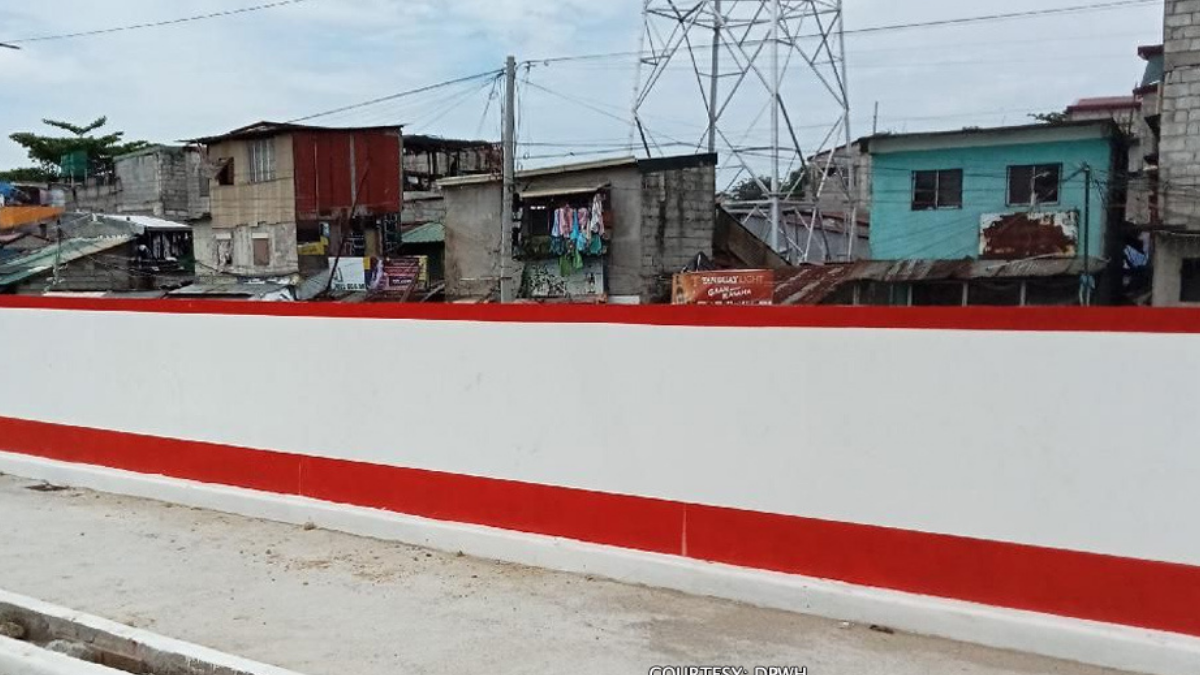

A stretch of red-and-white flood-control wall running beside Taguig City’s C-6 Open Channel might look like a single continuous barrier, but government records tell a more fragmented story. Documents from the Department of Public Works and Highways (DPWH), examined by the Bilyonaryo News Channel, show the structure was built through 39 distinct contracts carrying a combined value of roughly P3.1 billion.

That figure grew as the review deepened. BNC’s earlier reporting on August 13, 2025 had counted 30 contracts. A closer look at the records surfaced nine more, pushing the tally to 39 slope-protection and bank-improvement jobs spread across various sections and phases of the channel. One of those contracts went to a joint venture formed by Alpha & Omega General Contractor & Development Corp. and Elite General Contractor & Development Corp., firms both owned by the Discayas. BNC separately traced two bridge projects and a drainage project along the same channel to companies connected to the Discaya couple.
The work stretched across several years. The oldest contract BNC located dates to 2016, and a rotating cast of contractors carried out the different phases.
Alongside the sheer number of contracts, BNC flagged a documentation pattern worth noting: photographs meant to verify separate projects appear to have been recycled. Records for the 2022 Phase 2 and Phase 3 bank improvement work along the channel share an identical progress-and-completion photo, and each of those two contracts was valued at close to P90 million. The 2024 records repeat the pattern. Phase 3 of the slope-protection construction, worth over P141 million, and Phase 4, worth more than P94 million, were handled by different contractors yet show the same imagery. Phase 7 and Phase 8, each priced around P94.5 million and awarded to Topnotch Catalyst Builders and Beam Team Developer Specialist respectively, carry photos that are not perfectly identical but appear shot from the same or a nearby vantage point despite belonging to separate records.
BNC cautioned that duplicate photographs alone do not prove any project went unbuilt. What they do is raise questions about how contractors documented their accomplishments.

The concern does not rest on BNC’s review alone. Records obtained by the outlet show the DPWH Quality Assurance Team, in observations forwarded to Senator Panfilo Lacson’s office, likewise identified duplicate images in billing paperwork. The reviewing office noted it did not have the progress billing documents on hand, but the Quality Assurance Team’s findings pointed to repeated photos across several billing records. One observation reads: “Photos attached to the Final Billing of Contract ID No. 22OB0152 were duplicates of those attached to the Final Billing of Contract ID No. 22OB0153.” Another states: “Photos attached to the Final Billing of Contract ID No. 22OB0153 were duplicates of those attached to the Final Billing of Contract IDs 22OB0151 and 22OB0152.” A third adds: “Photos attached to the Final Billing of Contract ID No. 22OB0151 were duplicates of those attached to the Final Billing of Contract ID No. 22OB0153.” Because these observations concern final billing documents, the issue stands apart from photographs uploaded to the DPWH Transparency Server.
Lacson has publicly criticized the recurring photos. Speaking on July 31, 2025, he suggested the reuse could mean images from finished jobs were being submitted to justify billing on newer ones. “So ibig sabihin, for the longest time, ito na yung sinusunod na template. Parang trabahong tamad. Yung litrato na ginamit para makapaningil nung isang taon or nung nakaraang ilang buwan, gagamitin pa uli para sa proyekto na maniningil,” he said, adding, “Ibig sabihin, walang bagong photographs o litrato itong bagong ginagawa. So ghost.” Even so, duplicate imagery does not on its own confirm a ghost project. Confirming what was actually built would require checking the approved plans, quantities, billing papers, inspection reports, and the physical works themselves.
Cost is another point of scrutiny. In a 2024 press release, the DPWH billed the C-6 slope-protection effort as one of its flagship flood-control undertakings in Metro Manila, describing a 6.89-kilometer scope meant to curb erosion and stormwater runoff while keeping the open channel stable and functional. The plan folded in site-development touches such as a jogging lane. Set against BNC’s P3.1-billion total, the spending works out to about P450 million for every kilometer of the 6.89-kilometer run. When BNC inspected the site, it measured a concrete wall standing under two meters tall and roughly six to seven inches thick, with construction photos showing excavation around the base of some segments. The agency has defended the undertaking as essential to the channel’s stability and to managing erosion and runoff.
Yet what lies beneath the surface remains unverified by a visual check alone. The specifications of the foundations, drainage systems, and other subsurface elements could only be confirmed against the approved plans and Program of Works. Residents who spoke with BNC offered a further complication, saying the C-6 channel rarely overflowed even before the slope-protection structures went up.
Senator Alan Peter Cayetano has pushed back against the scrutiny of the Taguig projects, which fall within his political stronghold. He has dismissed Lacson’s allegations as hearsay and insisted that no ghost projects exist in the city.
