



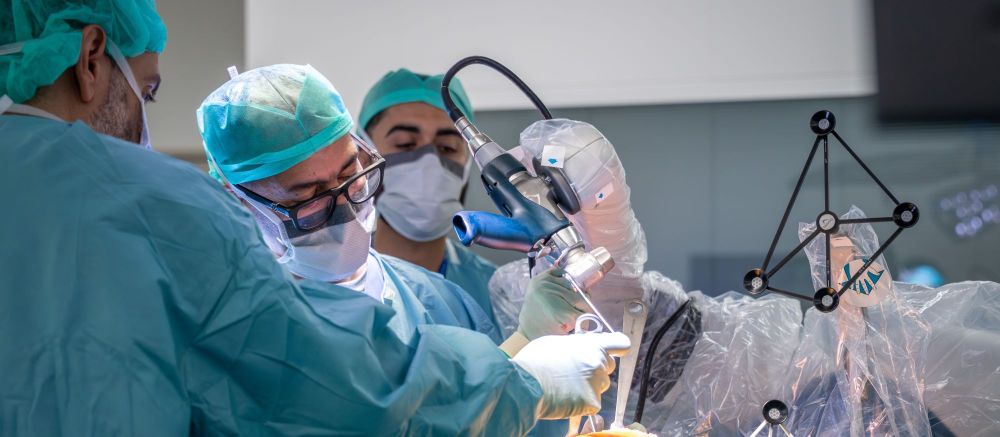

A woman who had endured knee pain for three decades was walking on her own within ten days of surgery — an outcome that Sheikh Shakhbout Medical City points to as it broadens its robotic orthopaedic offering in Abu Dhabi.

The Abu Dhabi hospital, a PureHealth subsidiary that handles serious and complex cases, has brought in two additional robotic platforms dedicated to joint replacement. The move widens access to precision orthopaedic treatment across the UAE and pushes the hospital’s wider robotic program to four systems operating across several specialties.
Surgeons using the new equipment can shape each operation around an individual patient’s anatomy and functional requirements. According to the hospital, this kind of robotic assistance tends to lower blood loss during surgery, sharpen joint alignment, place implants more accurately, and shorten the road to recovery.
Kafahallah became the first patient to receive a robotic-assisted knee replacement at the facility after more than 30 years of chronic pain and dwindling treatment options. “I suffered from knee problems for more than 30 years and tried many treatments over the years, but eventually even the injections stopped working. My mobility became severely limited, and there was a time when I could barely walk. Dr. AlSousou performed my surgery, and it truly changed my life. After the surgery, I gradually regained my ability to walk and today I can walk comfortably without any support. I feel very grateful for the care I received,” she said. She was on her feet without assistance within ten days.

Dr. Joseph Alsousou, Consultant and Chair of the Orthopaedics Division, said the patient had been dealing with severe osteoarthritis that stripped away much of her independence. “Many patients who come to us for joint replacement surgery have been living with pain and reduced mobility for years. In this case, the patient was experiencing severe osteoarthritis that had significantly affected her ability to walk and carry out daily activities. Robotic technology allows us to plan and position the joint replacement with a high degree of accuracy based on each patient’s anatomy and functional needs. For us, success is not just about replacing a joint. It is about helping patients regain mobility, reduce pain and return to their daily lives with greater confidence and independence,” he said.
The upgrade also covered hip surgery, where the team relied on the robotic platforms to fit implants and align the joint according to the specific structure of each patient’s body. On that side of the program, Alsousou pointed to gains in efficiency alongside accuracy: “Robotic-assisted surgery enables us to position the hip implant with exceptional precision while streamlining the procedure. This leads to less blood loss, shorter operating times and hospital stays, improved implants longevity, and ultimately better long-term outcomes for our patients, including optimal restoration of function.”
Chief Medical Officer Dr. Abdulqader Almessabi framed the additions as part of a steady buildout of the hospital’s surgical technology. “Building on the success and continued growth of SSMC’s robotic surgery programme, the introduction of two new robotic systems for hip and knee replacement represents an important expansion of our capabilities within orthopaedics. As we continue to broaden robotic-assisted surgery across multiple specialties, we are investing in technologies and clinical expertise that support greater precision, consistency and improved patient outcomes. This allows us to offer patients access to advanced surgical options closer to home while continuing to strengthen our orthopaedic services,” he said.
PureHealth, which owns SSMC, stands as the largest healthcare group in the Middle East, and the hospital positions its growing robotic capacity as a way to keep advanced procedures available to patients within the region rather than abroad.
