



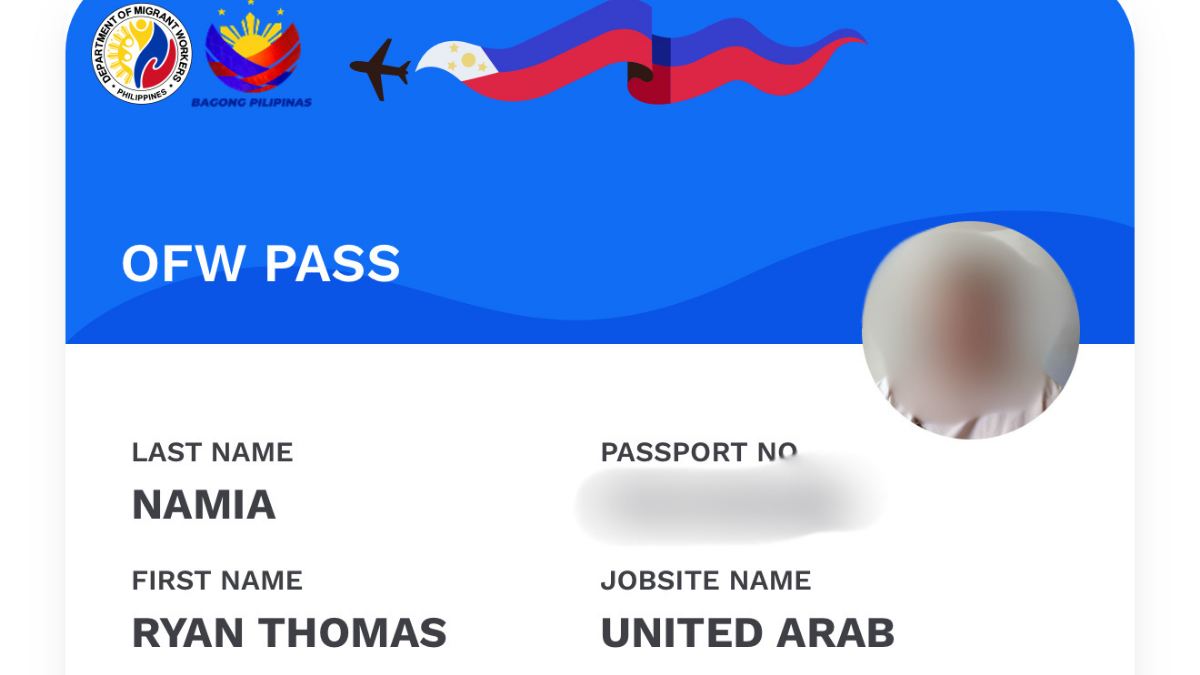

Airline counters at Ninoy Aquino International Airport have quietly changed how Filipino workers clear their departure for jobs abroad. Twenty-four international carriers operating out of the Manila gateway now recognize the digital OFW Pass, meaning a QR code pulled up on a phone can stand in for the printed overseas employment certificate that migrant workers once had to bring to the airport.

Verification happens through the Department of Migrant Workers’ e-verify platform. When an eligible worker reaches check-in, airline staff scan the pass displayed in the government’s eGovPH application and confirm the clearance electronically. Passengers are asked only to present a passport alongside the pass on the app.
The agency framed the shift as part of a wider push to move its services for overseas Filipinos online. “The electronic process reduces the need for printed OECs and supporting airline documents. It also enables participating airlines to reconcile terminal fee exemption records with their remittance reports electronically,” the DMW said.
Underneath the new label, the pass carries the same legal weight as the certificate it replaces. The OEC has long served as the official exit clearance confirming that a worker’s employment was registered with the DMW before leaving the country. That requirement applies only on departure for work; returning Filipinos and those staying on with the same overseas employer do not need it.

There is a practical difference in how long each version lasts. A pass generated through eGovPH holds for 90 days from issuance, while a certificate obtained through the DMW’s e-registration portal expires after 60.
The list of participating carriers reaches well beyond Philippine routes. Philippine Airlines, Cathay Pacific, China Airlines, Gulf Air, Oman Air, Ethiopian Airlines, Air Niugini, Kuwait Airways, Qatar Airways, Etihad Airways, Singapore Airlines, Saudia, AirAsia, Air Canada, Air India, Asiana Airlines, Korean Air, Japan Airlines, Malaysia Airlines, Cebu Pacific, Thai Airways, ANA, Starlux Airlines, and Air Macau are all on board. For Filipinos moving between Manila and the UAE, the presence of Etihad, Qatar Airways, Gulf Air, and Oman Air among them carries particular weight, given how many workers rely on those routes to reach the Gulf.
Officials overseeing the airport described the aim as stripping friction out of the departure sequence. “Our aim is to make the departure process as seamless as possible for OFWs. Every unnecessary step we remove makes the airport experience more convenient and allows passengers to move through check-in more efficiently,” said Lito Alvarez, general manager of New NAIA Infra Corp.
