



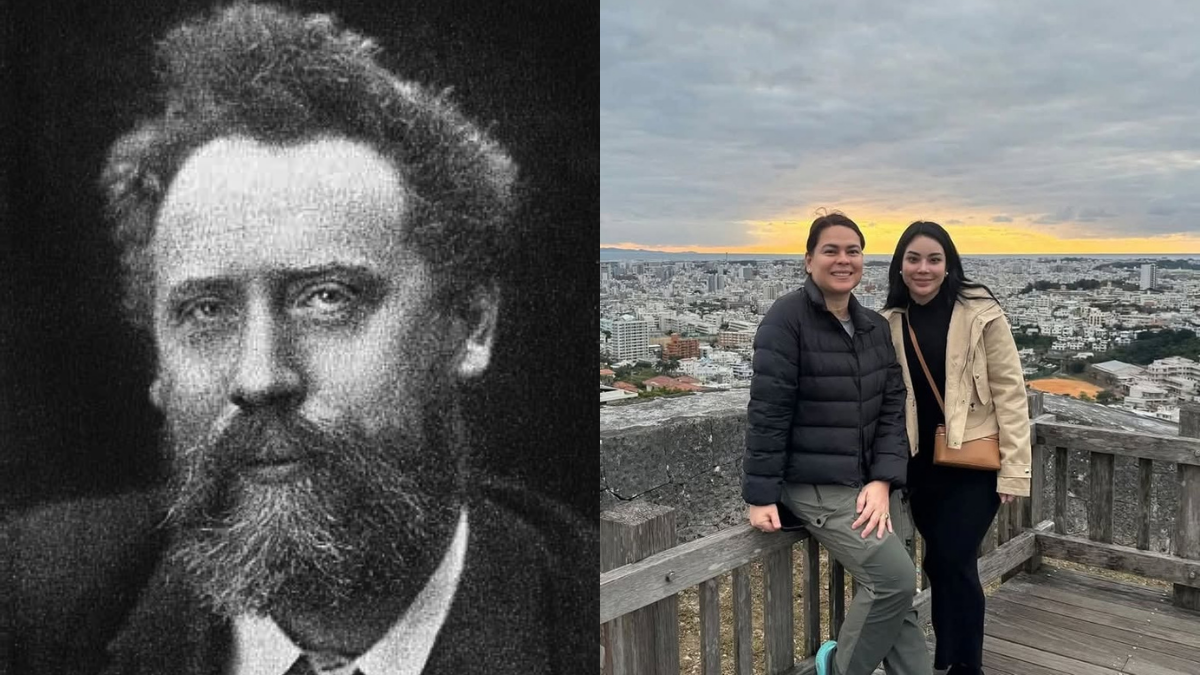

When Vice President Sara Duterte arrived at the Senate on July 7, 2026, on the second day of her impeachment trial, she skipped the proceedings and delivered a single line to reporters: “In this bloodbath and bludgeoning, I will be bloodied but unbowed.” The phrase was not her own. It echoes the second stanza of “Invictus,” an 1875 poem that has become the Duterte family’s literary weapon of choice through more than a year of legal reversals.

The man who wrote it was an English poet named William Ernest Henley, and the poem he is now remembered for was born out of physical suffering that shaped his entire life.
Henley was born in Gloucester, England, on August 23, 1849, the eldest of six children of a bookseller who died in debt. As a boy he contracted tuberculosis of the bone, a disease that ate into his joints and forced the amputation of one leg below the knee while he was still a child. In his mid-twenties, doctors told him the other foot would have to go as well. Refusing to accept a second amputation, he traveled to Edinburgh to seek out Joseph Lister, the surgeon then pioneering antiseptic methods, who managed to save the leg. Henley spent roughly 20 months confined to the Edinburgh infirmary between 1873 and 1875, and it was from that hospital bed that he wrote “Invictus.”
The poem is a short, defiant declaration of self-possession in the face of pain. Its opening lines — “Out of the night that covers me, / Black as the pit from pole to pole, / I thank whatever gods may be / For my unconquerable soul” — give way to its famous closing couplet: “I am the master of my fate, / I am the captain of my soul.” The title is Latin for “unconquered.” Some readers have taken the poem as a statement of defiance not only against illness but against the idea of a higher power, given the reference to “whatever gods may be.” Henley lived through an era when Darwinian science was unsettling Victorian faith, though he left no definitive statement pinning down his intent.
In his own lifetime, Henley was far better known as an editor and critic than as a poet. He ran a series of London literary journals — among them the Magazine of Art and the National Observer — and used them to publish early work by Thomas Hardy, Rudyard Kipling, H.G. Wells, George Bernard Shaw, and William Butler Yeats. Younger writers described him as a generous champion of unknown talent and a fierce opponent of inflated reputations. He was also a close friend of Robert Louis Stevenson, whose one-legged pirate Long John Silver in “Treasure Island” was drawn in part from Henley’s own figure. In a stranger twist of literary history, Henley’s daughter Margaret, who died at the age of five, is credited with inspiring the name “Wendy” in J.M. Barrie’s “Peter Pan.” Henley died of tuberculosis in Woking, England, on July 11, 1903, at the age of 53.
“Invictus” long outlived its author, and its afterlife is where the Duterte family enters the picture. The poem is most famously associated with Nelson Mandela, who is said to have recited it during his imprisonment on Robben Island and drew strength from its message of endurance. Winston Churchill and Barack Obama have both quoted it. But the poem also carries a darker history: it was used as a final written statement by Oklahoma City bomber Timothy McVeigh before his 2001 execution, and it appeared at the close of the manifesto written by the gunman who killed 51 people in two Christchurch, New Zealand, mosques in 2019, as Rappler noted in a July 2026 examination of the poem’s use by the Duterte clan. Its meaning, in other words, has always depended heavily on who is invoking it.
For the Dutertes, the poem has functioned as shorthand for defiance since their father’s detention began. Davao City Mayor Sebastian “Baste” Duterte recited it in full at a prayer and protest rally at The Hague in March, telling supporters that former president Rodrigo Duterte had quoted the poem since childhood, according to Rappler. In April 2026, after the International Criminal Court’s Appeals Chamber affirmed jurisdiction over the crimes against humanity case against the former president on April 22, his daughter Veronica “Kitty” Duterte invoked the poem outside the tribunal, relaying a message that her father remained “unconquered” and had chosen the single word “Invictus” to describe his state of mind. Manila Bulletin reported she quoted the poem’s closing lines — “I am the master of my fate, I am the captain of my soul” — as her father’s words, and closed her own remarks with the line, “If you think you will win, no, you will not, because either way — Invictus.”
Sara Duterte has now taken up the same language as her own trial unfolds in Manila. Her defense spokesman, Robert Ace Barbers, acknowledged that while it is the Vice President’s right to make such statements, her July 7 remark “did not answer the allegations against her.” Written a century and a half ago by a bedridden poet fighting to keep his leg, “Invictus” has traveled a long way to become the recurring refrain of a Philippine political dynasty facing the courts.
