



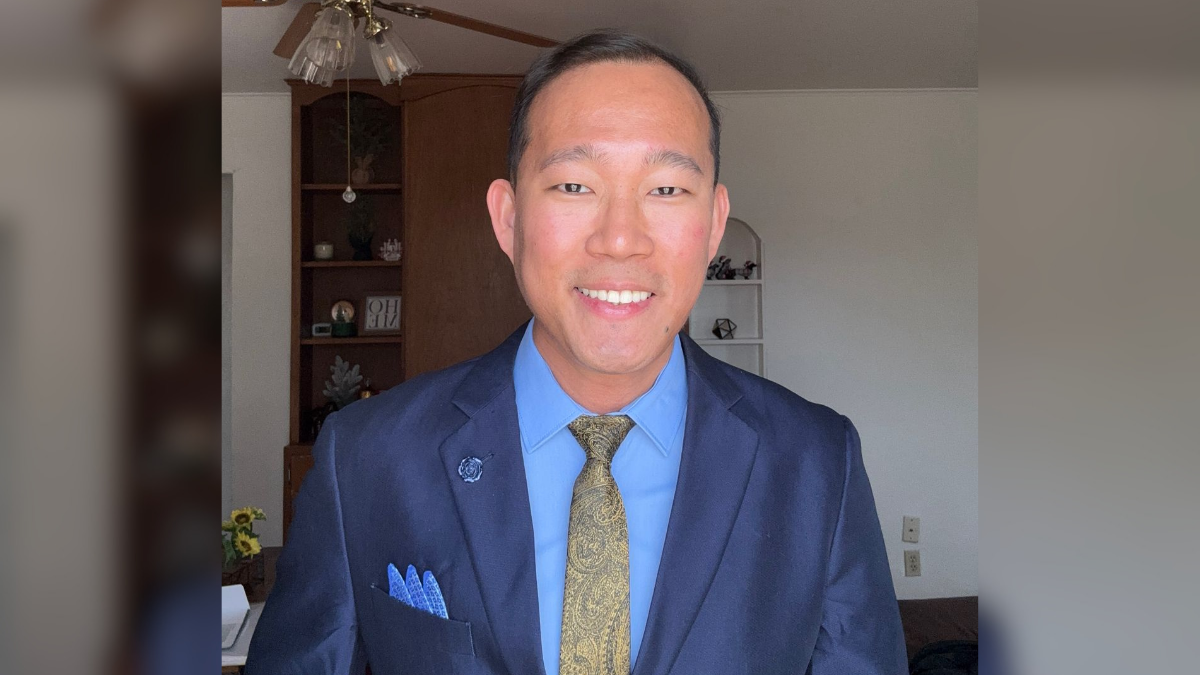

Math has a way of humbling even the people who teach it. There is always a harder problem, a more elegant proof, a student who asks the one question you cannot immediately answer. Kenneth D. Sibal has spent seventeen years standing at that intersection of confidence and humility, and at thirty-seven, the high school mathematics teacher has carried it across three countries and into competition halls in four others.

Today he teaches at Stanton County Junior-Senior High School in the United States, coaching alongside his classroom work for international math competitions. But the path that brought him here started in a far smaller room, in a country he left behind not because he wanted to, but because he had to.
Leaving in order to lift
The reason Sibal first boarded a plane in 2021 was the same one that has propelled generations of Filipino workers abroad. “I wanted to help my family and cease the cycle of poverty,” he says. The separation was hard, but there was something else pulling at him too — a restlessness that salary alone does not explain. “I knew deep inside me the urge to learn more outside my comfort zone. I wanted to grow and discover my potentials as a teacher and an educator at large.”
That first overseas posting was at an international school in Saudi Arabia, where he arrived as a math teacher and quickly became much more. Within a year he was promoted to Head of the Mathematics Department, guiding colleagues through curriculum, mentoring newly hired teachers adjusting to an unfamiliar culture, and working with administrators on accreditation. In his final year there, he took on the role of high school coordinator, managing programs and supervising both staff and students. Four years in the Kingdom, each one heavier with responsibility than the last.
The long apprenticeship
What is easy to miss in the steady climb is how long the foundation took to lay. Sibal did not arrive in Saudi Arabia as a finished product. He graduated in 2010 and took his first job at Lyceum of Aparri, teaching mathematics while leading the Office of the Coordinator of Student Affairs for the junior high school — a post he held for eight years. It was there that the second half of his identity took root. He began coaching, first locally, then nationally, and eventually internationally, accompanying students to competitions in Hong Kong, China, Thailand, and Singapore.

He moved to St. Paul University Philippines in 2019, teaching there for two years before the pandemic reshaped everyone’s plans and pushed him to apply overseas. The recognitions accumulated quietly over that span, and recently he was named a board member of an international math organization based in Macau that organizes the very competitions he once traveled to as a young coach.
For all the titles, the part of the job he returns to when asked what he loves is strikingly small in scale. “I feel accomplished when I see one timid student becoming a better version of himself,” he says. “I knew it was a job well done.” Seventeen years in, that single transformation still measures success for him more than any departmental promotion.
What the distance teaches
Working abroad was not the clean reward it can look like from the outside. Homesickness came in waves. “It didn’t curtail me to focus on what matters most,” he says of those moments, crediting colleagues who understood exactly what he was going through. Living and working among other expatriates produced its own friction, the small collisions of personality and circumstance that come with shared accommodation and shared deadlines. His remedy was unglamorous and effective: “Dialogue is very important to overcome this kind of situation.”
Ask him what he wants next and the answer points back toward others rather than himself. He hopes to teach part-time at the college level eventually, to work with NGOs focused on lifting young people through education, and to speak to future teachers about the road he has walked.
His advice to fellow Filipinos abroad reads almost like a quiet manifesto — be financially wise, stay open to criticism while remaining grounded, never stop learning, and protect the boundaries of professional relationships even while staying warm. But it is his closing thought that captures the man most completely, the line he lives by. “Achievements may open doors, but humility keeps them open. Be proud — but never forget who you were before the applause.”
