



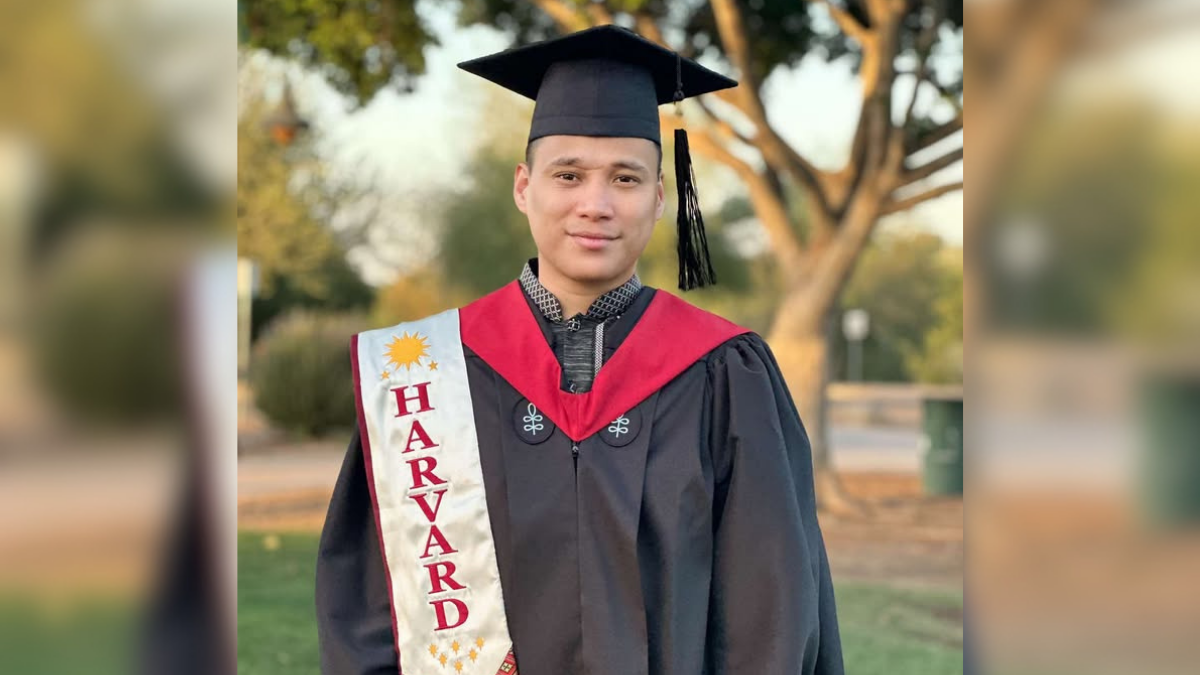

A Filipino educator who turned a science classroom with no laboratory into a launchpad for first-generation Latina scientists has been recognized with one of the Harvard Graduate School of Education’s most distinguished honors.

Alfred Santos, who earned his Ed.M. in 2026 through HGSE’s Online Master’s in Education Leadership Program, was named this year’s recipient of the Phyllis Strimling Award. The honor is given annually at Convocation to a graduating student who works to advance society by advancing women, demonstrates inclusive leadership, and inspires others. It is one of only three individual honors presented by the Ed School, and was conferred at the HGSE Convocation ceremony held Wednesday, May 27.
Santos arrived in the United States nine years ago from the Philippines as a foreign exchange teacher, expecting to find the gleaming science facilities he had seen in American movies and television. Instead, he was assigned to a charter school in Yuma, a rural Arizona town where 90 percent of students are Latino and many cross the border from Mexico each day to attend class. There was no science lab waiting for him, only basic glassware and a sink.
His first year did not go as planned. His lesson plans fell flat, and his students, particularly the girls, showed little interest in STEM. The turning point came during a conversation with a student named Ana, who explained why so many of her classmates seemed disengaged.
“She told me they had multiple teachers for the past few years because nobody wanted to stay and teach in our area,” Santos said in the Harvard Graduate School of Education’s interview. “We know you’re going to leave next year anyway,” she had told him.
The exchange convinced him that his students needed more than instruction. They needed consistency and adults who believed in them. Santos responded by creating a STEM research program, beginning with a single participant: Ana.
“Both of her parents live and work in Mexico, and Ana, being the eldest child, is expected to help her family. I saw a lot of potential in her, especially her love for health and medicine. So, I encouraged her to do STEM research with me as her mentor,” Santos told the Strimling award committee in his application. “It was also the first STEM research conducted in our district.”

Ana went on to win top prizes at science fairs and regional research competitions and secured a full scholarship to medical school. Her success drew more young Latina students to Santos, four of whom became national STEM champions, with many earning full college scholarships. The momentum eventually produced a district-wide initiative called Adopt a Little Scientist, launched by two of his former students alongside Santos, which pairs experienced high schoolers with younger children interested in research.
That record of mentorship is what set him apart, according to Neal Yanofsky, who co-created the award in 2000 with Holly Weeks and Rob Scalea while teaching in the Radcliffe Seminar Management Program under Phyllis Strimling.
“The committee was impressed by Alfred’s clear dedication to his students, and particularly to his creation of programs designed to advance female students in the traditionally male-dominated STEM field,” Yanofsky said. “We found the combination of his classroom teaching, one-to-one mentoring, and programmatic expansion and management to be compelling, and a clear fit for the ideals of the Phyllis Strimling Award.”
One former student, Eveleen Velarde, wrote a recommendation letter to the committee crediting Santos not only for bringing scientific concepts to life but for changing how she saw her own future. He gave her experiences that “dismantled my belief that science was an unreachable field as a first-generation Latina, paving the way for the journey I am on today,” she wrote.
Velarde, who grew up between Mexico and the United States, said higher education once felt out of reach. “My perspective on healthcare was shaped by the barriers a lot of families faced, like living an hour away from the nearest hospital and navigating a system where low-income, minority families are rarely prioritized,” she said. “These systemic inequalities, including physician shortages and limited access to education, initially made a career in STEM seem impossible. My journey from those early experiences to becoming a second-year undergraduate at Stanford University was made possible because I had a mentor who saw my potential before I could see it myself.”
The Phyllis Strimling Award is named for Phyllis Strimling, who earned her Ed.M. in 1989 and served as longtime director of the former Radcliffe Seminars. The award recognizes the character and achievement of an HGSE graduate with strong academic performance who has used, or is preparing to use, the HGSE experience for the advancement of women and society. It moved from the Harvard Extension School to HGSE in 2010, and recipients receive a certificate and a cash prize.
