




The news spread quickly, and so did the grief.

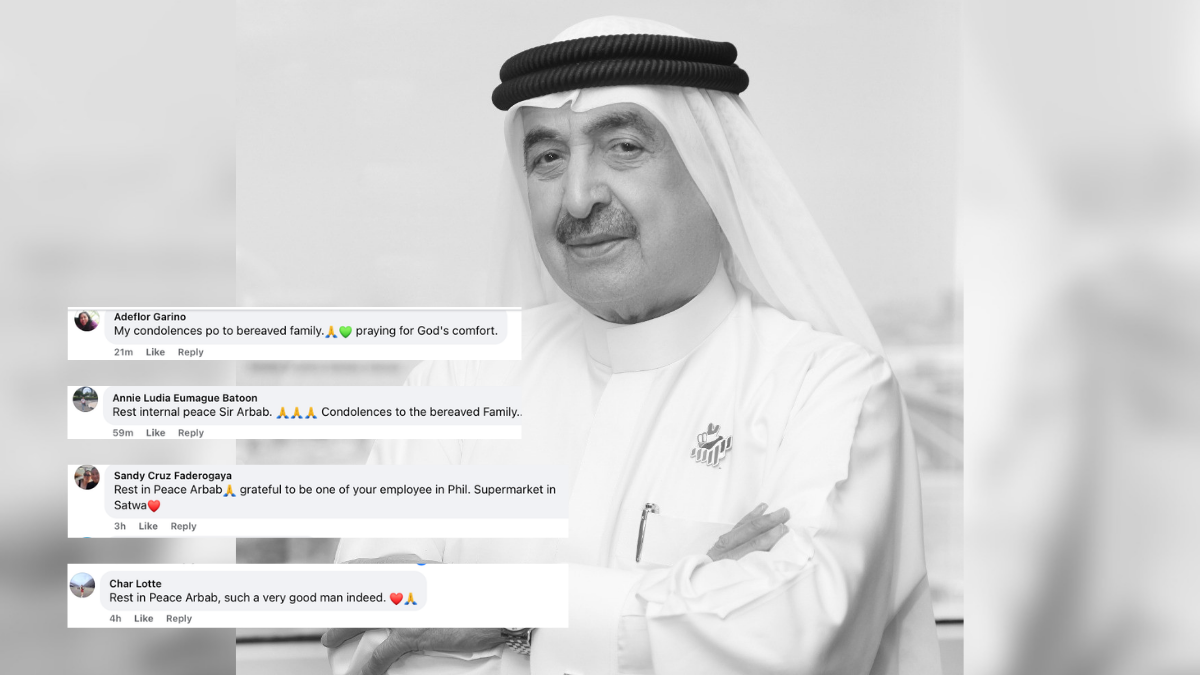
Within hours of the Philippine Embassy in the UAE announcing the passing of Abdul Razagh “Abu Nader” Mohammadi, the comment sections of posts shared by the Embassy and The Global Filipino Magazine filled with hundreds of messages — not just of condolence, but of memory, of personal debt, and of a love that only deepens when something is finally, irreversibly gone.
For the Filipinos who lived and worked in Dubai across four decades, Abu Nader was not a figure they knew from a distance. He was the man at the supermarket. The arbab who remembered your face. The ninong who showed up when no one else did.
“I still can’t believe this news,” wrote Vhan Halwani. “My heart stopped when I heard it. It is so painful to say goodbye to someone so dear to us. Thank you for being part of our family and for always treating us with kindness every time we visit Philippine Supermarket — since I was young, for inviting my parents and me to all your events and parties. The Filipino community is truly blessed to have someone like you in our lives. You are not just a UAE national — you also have the heart of a Filipino. Your kindness, generosity, and genuine care made everyone feel welcomed and loved.”
Others were more brief, but no less felt. “RIP Arbab — he is a Filipino by heart,” wrote Mylene Agustin Cabra. “Rest in Peace Arbab, such a very good man indeed,” added Char Lotte. Sandy Cruz Faderogaya recalled her own chapter of that story: “Grateful to be one of your employees in Phil. Supermarket in Satwa.”
The name Arbab — an Arabic term of respect, roughly meaning “boss” or “master” — appeared again and again in the tributes, sometimes alongside Abu Nader, sometimes alone. It was the word his Filipino staff used for him, and it carried in it the particular tenderness of people who had worked beside him and found something more than an employer.
Some remembered him in Tagalog, the language of home. “Napaka bait sa bawat Pinoy nyan,” wrote Joseph Ojerio Parado — he was so kind to every Filipino — adding that he remembered him selling at the Muraqqabat store during his own years in Dubai. Joy Umpay mourned simply: “Nakaka sad naman. Wala na yong baba sa Philippines Supermarket” — it’s so sad. The old man at the Philippine Supermarket is gone.
One tribute in particular offered a window into a side of Abu Nader that predated the supermarket, the awards, and the diplomatic recognition. Ron Awa, a verified commenter who identified himself as a longtime friend, wrote that he had known Abu Nader since 1994 — more than 30 years — when the Emirati was already a fixture of Dubai’s Filipino basketball scene.

“ARM stands for Abdul Rahman, also known as ‘Abu Nader,'” Awa wrote. “He was our basketball manager, often seen roaming around Al Ahli Club during Friday games between Dubai Drydocks and his team, ARM. Fridays were official days off at the time, and Filipino basketball fans usually watched the PBA Dubai at Al Wasl Club or Ahli Club. I always looked forward to seeing him, and he joined us for the victory celebration at Kuya Disco Pub. He frequently bought me drinks and always recognised me wherever I was in Dubai. A remarkable man — though I knew both his good and less good sides — he was kind-hearted, with a special love for Filipinos. He even established a supermarket dedicated to Pinoys. Yes, I’ve known Abu Nader for over 30 years here in Dubai. Rest in peace, Abu Nader.”
It is a portrait that rounds out the public record: before he was a philanthropist celebrated by ambassadors and business delegations, Abu Nader was simply a man who showed up to Filipino basketball games on Fridays, bought rounds of drinks, and never forgot a face.
That continuity — from the basketball courts of the 1990s to the Satwa supermarket of 2005, to the Muraqqabat and Karama branches that became community landmarks — is the throughline of a life spent in voluntary, joyful proximity to a people not his own by birth, but entirely his own by choice.
The Philippine Embassy, in its official statement, described him as “a beloved friend of the Filipino community in the UAE” and said his “kindness and humanitarian spirit will always be remembered by the Filipino community he cared for so deeply.” Abu Nader, who founded the Philippine Supermarket in 2005, was 81 at the time of his death. His passing was confirmed by Expat Media, citing a source close to the family. No official cause of death has been disclosed.
He had once spoken of his plans to build the UAE’s first Filipino complex — a multi-billion-dirham development that would give OFWs decent housing, authentic food, sports facilities, and a place to gather. That dream, like the man himself, now belongs to memory.
What remains are the stores he built, the thousands he helped, and the comments still coming in — from former employees, from children who grew up visiting his aisles, from men who once watched basketball with him on a Friday afternoon and never forgot his face either.
“You will always have a special place in our hearts,” Vhan Halwani wrote.
The Filipino community in the UAE appears to agree.
