



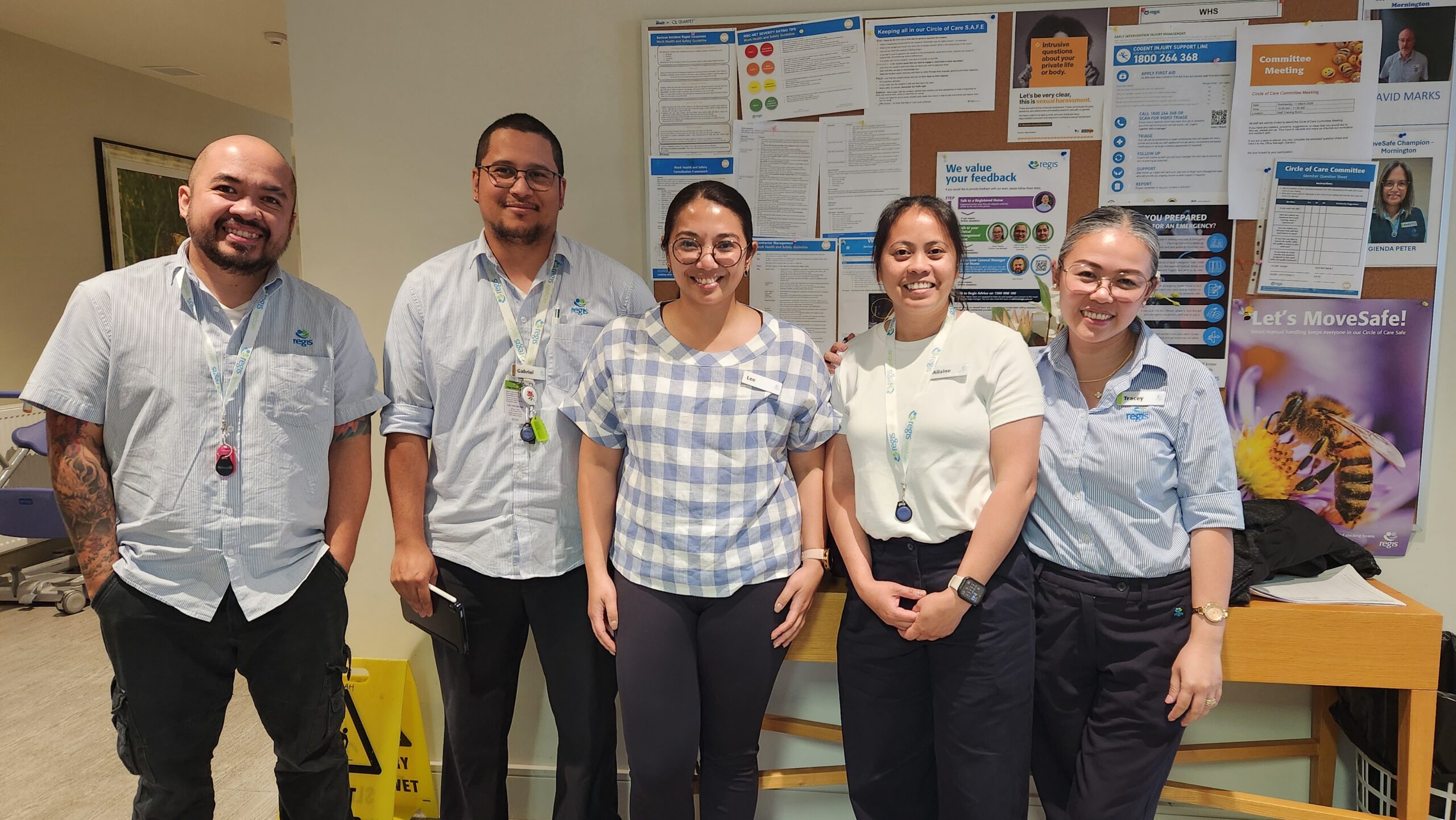

In Australia’s growing aged care sector, Filipino nurses continue to play a vital role in delivering compassionate, person-centred, and culturally grounded care. In facilities supported by providers such as Regis Aged Care, they are not only clinicians but also key contributors in shaping quality care, workplace culture, and leadership in long-term care environments.

Their work reflects a consistent strength across the profession: combining clinical competence with deep empathy, especially in caring for older adults who require dignity, patience, and continuity of care. The experiences of Filipino nurses such as Rizza Valdez, Grace Garces, and Lee de Francia Lavender show how aged care practice in Australia is shaped from within, through lived experience, cultural values, and professional leadership that directly influences both care delivery and system improvement.
𝐂𝐚𝐫𝐞 𝐑𝐨𝐨𝐭𝐞𝐝 𝐢𝐧 𝐅𝐚𝐦𝐢𝐥𝐲, 𝐂𝐮𝐥𝐭𝐮𝐫𝐞, 𝐚𝐧𝐝 𝐃𝐢𝐠𝐧𝐢𝐭𝐲
For Rizza Valdez, Clinical Care Coordinator, aged care is deeply personal and shaped by lived experience. Before moving to Australia in 2016, she helped care for her grandparents in the Philippines, an experience that shaped her understanding of compassion and responsibility in nursing. This foundation guided her decision to enter aged care, where she began as a Personal Care Attendant and later became a Registered Nurse in 2017 while continuing her journey with Regis Aged Care.
She shares, “Caring has always been at the heart of who I am, and I do not simply see residents as patients but as individuals deserving of dignity, time, patience and genuine compassion.” For her, working in aged care feels like continuing to care for her own grandparents, which gives her work a deep personal meaning.
Rizza emphasizes that Filipino cultural values strongly shape her practice. “In many ways, caring for these older people allows me to feel that I am still caring for my grandparents,” she explains. She highlights that respect for elders is deeply rooted in Filipino upbringing, and this naturally translates into how she delivers care in Australia.
She also reflects on the emotional side of aged care, explaining that “I have learned that sometimes the most powerful intervention is simply sitting beside them, holding their hand and allowing them to share their stories.” For her, aged care is not only about clinical tasks but about presence, listening, and human connection.
Now in a leadership role, she continues to guide care with the same principle that shaped her journey: “We are not just caring for residents, we are walking alongside them during one of the most meaningful stages of their lives.”
𝐒𝐭𝐫𝐞𝐧𝐠𝐭𝐡𝐞𝐧𝐢𝐧𝐠 𝐐𝐮𝐚𝐥𝐢𝐭𝐲 𝐓𝐡𝐫𝐨𝐮𝐠𝐡 𝐒𝐲𝐬𝐭𝐞𝐦𝐬 𝐚𝐧𝐝 𝐂𝐚𝐫𝐞
Grace Garces, Clinical Systems and Research Specialist, represents the growing role of Filipino nurses in shaping healthcare systems beyond bedside care. Her career in Australia has progressed from Registered Nurse to Clinical Manager and Clinical & Care Specialist, giving her a broad understanding of both frontline realities and operational challenges in aged care homes.
She explains that Filipino nurses bring strong clinical foundations combined with values like malasakit, respect for elders, and teamwork. “We build trust with residents, understand their preferences, and pay attention to the small changes that matter,” she shares, highlighting how these values naturally support person-centred care.
In her current role, she focuses on improving electronic systems such as eCMS and EMMS. She explains, “When systems are aligned with real clinical practice, we reduce errors and strengthen continuity of care.” She also adds a key insight: “Most importantly, staff gain back time—time they can spend with residents.” For Grace, this is central to quality care.
She also views system improvement as part of nursing itself. “For me, this is still nursing. I’m caring for the systems, the processes, and the people who provide care,” she explains. Her work shows how nursing extends beyond direct care into systems that shape safety, efficiency, and resident outcomes.
𝐀𝐝𝐯𝐨𝐜𝐚𝐜𝐲, 𝐈𝐝𝐞𝐧𝐭𝐢𝐭𝐲, 𝐚𝐧𝐝 𝐏𝐫𝐨𝐟𝐞𝐬𝐬𝐢𝐨𝐧𝐚𝐥 𝐂𝐨𝐮𝐫𝐚𝐠𝐞
Lee de Francia Lavender, Learning and Capability Specialist and PhD candidate, focuses on preparing Filipino nurses for aged care practice in Australia. She emphasizes that aged care is highly regulated and requires strict adherence to policies, documentation, and clinical accountability. “Safe practice is not optional,” she states firmly.
She also addresses a key challenge among Filipino nurses: self-doubt in leadership. “Many newly migrated Filipino nurses are highly capable, but sometimes hold themselves back because they feel they should stay quiet or not take up too much space,” she explains.

Her message is direct: “Do not let that stop you from stepping into leadership roles. Your background is not a weakness. It is part of your strength.” She also reminds nurses, “Do not let self-doubt make you shrink when you are actually ready to lead.”
Lee also reflects on global differences in healthcare systems. She shares a striking comparison of patient-to-nurse ratios: “I remember thinking, tayo nga sa Pilipinas, 60-to-1, here they complain about 10-to-1.” For her, this highlights how unsafe conditions can become normalized and why advocacy is important.
She encourages Filipino nurses to be both humble and courageous: To be professional, accountable, and brave enough to speak up for residents, for safety, and for nurses’ rights.
𝐅𝐢𝐥𝐢𝐩𝐢𝐧𝐨 𝐍𝐮𝐫𝐬𝐞𝐬 𝐢𝐧 𝐀𝐠𝐞𝐝 𝐂𝐚𝐫𝐞: 𝐀 𝐒𝐡𝐚𝐫𝐞𝐝 𝐒𝐭𝐫𝐞𝐧𝐠𝐭𝐡
Across clinical care, systems improvement, and education, Filipino nurses consistently demonstrate strong clinical competence, attention to detail, and deep respect for older adults. Their values, such as malasakit, respect for elders, and teamwork are not abstract ideas but are reflected in daily practice, from communication with residents to clinical decision-making.
Rizza emphasizes dignity and presence, Grace highlights system-level safety and efficiency, and Lee focuses on professional courage and leadership. Together, their perspectives show that Filipino nurses contribute to aged care in multiple dimensions: direct care, systems improvement, and workforce development.
Despite challenges such as strict documentation systems, emotional demands of long-term care, and cultural adjustment, these experiences often lead to stronger clinical judgment, leadership growth, and deeper professional confidence.
𝐑𝐞𝐝𝐞𝐟𝐢𝐧𝐢𝐧𝐠 𝐂𝐚𝐫𝐞: 𝐆𝐫𝐨𝐰𝐭𝐡, 𝐋𝐞𝐚𝐝𝐞𝐫𝐬𝐡𝐢𝐩, 𝐚𝐧𝐝 𝐑𝐞𝐬𝐩𝐨𝐧𝐬𝐢𝐛𝐢𝐥𝐢𝐭𝐲 𝐢𝐧 𝐀𝐠𝐞𝐝 𝐂𝐚𝐫𝐞
For Filipino nurses entering aged care in Australia, the journey requires discipline, adaptability, and commitment to safe practice. However, it also offers opportunities for leadership, professional development, and meaningful human connection. Aged care is not only about managing clinical conditions but about preserving dignity, listening to life stories, and supporting people in their most vulnerable moments.
As Lee states, nurses must be confident in their identity. As Rizza shows, compassion is strengthened by lived experience. As Grace demonstrates, systems are essential in supporting quality care.
Filipino nurses are encouraged to embrace both humility and leadership, recognizing that their cultural values are professional strengths that enhance care delivery.
𝐀 𝐂𝐨𝐧𝐭𝐢𝐧𝐮𝐢𝐧𝐠 𝐆𝐥𝐨𝐛𝐚𝐥 𝐍𝐚𝐫𝐫𝐚𝐭𝐢𝐯𝐞 𝐨𝐟 𝐂𝐚𝐫𝐞 𝐚𝐧𝐝 𝐑𝐞𝐬𝐩𝐨𝐧𝐬𝐢𝐛𝐢𝐥𝐢𝐭𝐲
The experiences of Filipino nurses in Australia’s aged care sector reflect a wider global story of healthcare contribution. Across countries such as Australia and beyond, Filipino nurses continue to serve in hospitals, aged care facilities, and community settings, often in roles that require both technical expertise and emotional resilience.
Their work is defined not only by skill, but by presence, empathy, and responsibility. In aged care, where every interaction matters, they consistently demonstrate that care is not only what is done, but how it is given. Their voices remind us that nursing is both science and humanity, and Filipino nurses continue to embody both in every stage of care they provide.
Disclaimer: This article is part of a special series leading up to the celebration of Filipino Nursing Diaspora Day on 7 May 2026, highlighting the global contributions, experiences, and impact of Filipino nurses worldwide.
