



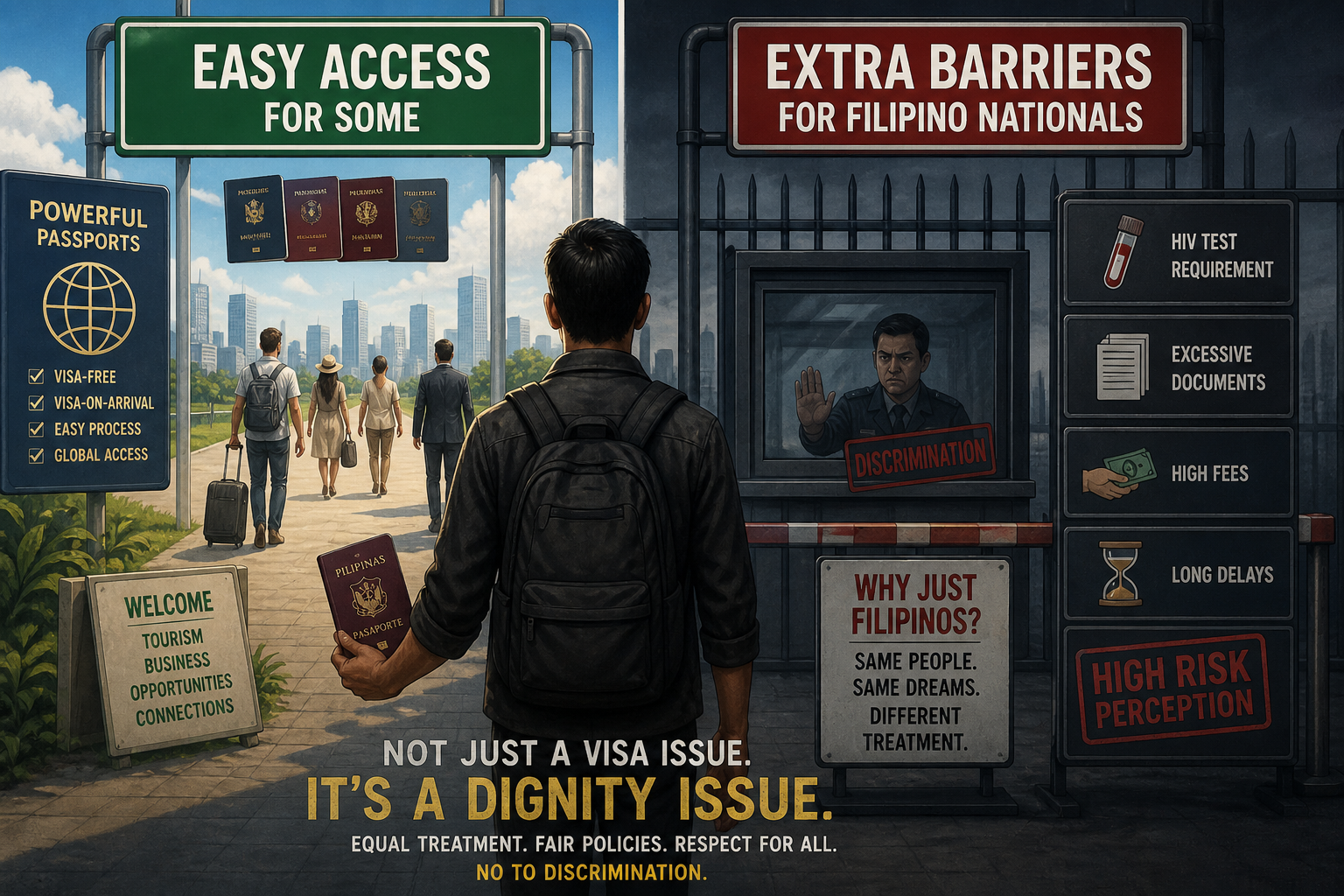

Globalization has long promised a world where borders are increasingly permeable-where people, ideas, and opportunities move with relative ease. For many, this promise has materialized through visa-free travel, digital nomadism, and transnational careers. Yet for millions of Filipino nationals, mobility remains less a right and more a negotiation, an exhausting process shaped by documentation, suspicion, and structural inequities.

Recent policy developments in Oman have once again placed Filipino mobility under scrutiny. Reports that Filipino nationals are now required to present HIV-negative test results before entry, even for tourism, have ignited widespread debate. While public health is often invoked as justification, the selective application of such requirements raises deeper questions: Why are Filipinos singled out? And what does this reveal about global mobility regimes?
This is not simply a policy issue. It is a question of dignity, equity, and the value assigned to passports, and, by extension, to people.
The Anatomy of Passport Inequality
To understand the Filipino experience, one must first grasp the concept of “passport inequality.” Not all passports are created equal. Citizens from wealthier nations often enjoy visa-free or visa-on-arrival access to dozens, sometimes hundreds, of countries. Meanwhile, those from developing nations face extensive documentation requirements, financial scrutiny, and high rejection rates.
The Philippine passport, while improving in global rankings, still occupies a middle tier. Filipino travelers frequently encounter:
- Lengthy visa application processes
- Requirements for proof of financial capacity
- Employment verification and return guarantees
- High visa fees with no assurance of approval
- Increased likelihood of rejection or secondary screening
For Filipino migrant workers, the backbone of the country’s economy, these barriers are even more pronounced. Their movement is often framed not as an opportunity but as risk: risk of overstaying, risk of illegal employment, risk of burdening host countries.
Such narratives, while not always explicitly stated, shape immigration policies in subtle but powerful ways.
The Oman Case: Public Health or Selective Scrutiny?
The recent decision by Oman to require HIV testing for Filipino nationals has sparked controversy across diplomatic, public health, and human rights circles. While the policy’s full implementation details continue to evolve, its implications are already clear.
Historically, Gulf countries have required medical screenings, including HIV testing, for long-term migrant workers. These measures, though debated, are generally framed within labor migration frameworks. What distinguishes the current situation is its reported extension to short-term visitors, including tourists, and its apparent focus on a single nationality.
This raises critical concerns:
- Selective Application
If only Filipino nationals are subject to this requirement, the policy risks being interpreted as discriminatory. Public health measures, to be ethically sound, must be applied consistently across populations or justified by transparent, evidence-based criteria. - Stigmatization of Disease
Associating a specific nationality with a communicable disease reinforces harmful stereotypes. HIV, in particular, carries a long history of stigma, and policies that single out groups may inadvertently perpetuate misinformation and fear. - Contradiction with Tourism Goals
Oman has recently sought to expand its tourism sector, including offering visa facilitation measures. Introducing additional barriers for a specific group undermines these efforts and sends mixed signals about openness and inclusivity. - Implementation Challenges
Reports of travelers being denied boarding at airlines due to missing documentation highlight the real-world consequences of such policies. These are not abstract rules; they affect livelihoods, family reunions, and personal aspirations.
A Broader Pattern: Filipino Nationals and Differential Treatment
The Oman case is not isolated. Filipino nationals have long navigated a global landscape marked by differential treatment. In many countries, they are welcomed as workers but scrutinized as visitors. This paradox reflects a broader tension: Filipino labor is in demand, yet Filipino mobility remains constrained.
Several factors contribute to this dynamic:
- Economic Perceptions: Filipinos are often associated with labor migration, leading to assumptions about intent when applying for tourist visas.
- Overstay Concerns: Immigration authorities in some countries view Filipino travelers as higher risk for overstaying visas, despite limited evidence supporting such generalizations.
- Documentation Burden: Requirements for bank statements, employment contracts, and travel histories disproportionately affect those without extensive financial or institutional backing.
These factors create a cycle where Filipino travelers must continuously prove their legitimacy, often at high emotional and financial cost.
The Human Dimension: Stories Behind the Statistics
Behind every visa application is a human story. A nurse seeking to attend a conference. A family is planning a long-awaited vacation. A student pursuing educational opportunities abroad. For many Filipinos, these aspirations are complicated by the uncertainty of visa approvals and the fear of rejection.
Consider the emotional toll:
- Anxiety and Anticipation: Weeks or months of waiting for visa decisions
- Financial Risk: Non-refundable application fees and travel bookings
- Psychological Impact: Feelings of inadequacy or discrimination following rejection
When additional requirements-such as medical testing-are imposed selectively, these burdens intensify. The message, whether intended or not, is that Filipino travelers must meet a higher threshold of acceptability.
Public Health vs. Human Rights

Public health policies are essential for safeguarding populations. However, they must be grounded in principles of fairness, proportionality, and scientific evidence. Selective measures targeting specific nationalities risk undermining these principles.
Key ethical considerations include:
- Equity: Are similar risks being addressed uniformly across all travelers?
- Evidence: Is there robust data supporting the need for nationality-specific requirements?
- Proportionality: Do the benefits of the policy outweigh its potential harms, including stigma and discrimination?
International health frameworks emphasize non-discrimination as a core principle. Policies perceived as targeting specific groups may erode trust and hinder global cooperation in addressing health challenges.
The Role of Diplomacy and Advocacy
The response to such policies requires coordinated action. Governments, civil society organizations, and international bodies all play a role in ensuring fair treatment for travelers.
For the Philippine government, this includes:
- Engaging in diplomatic dialogue to clarify and, if necessary, challenge discriminatory policies
- Providing clear guidance and support to affected travelers
- Advocating for equitable treatment of Filipino nationals abroad
For the global community, it involves:
- Promoting evidence-based travel regulations
- Addressing stigma associated with diseases such as HIV
- Ensuring that mobility policies align with human rights standards
Filipino Resilience and the Question of Dignity
Filipinos are among the most globally mobile populations, driven by a combination of economic necessity and cultural openness. Their contributions to host countries in healthcare, education, service industries, and beyond are widely recognized.
Yet mobility should not come at the cost of dignity.
When policies impose additional burdens on specific nationalities, they risk reducing individuals to stereotypes. They overlook the diversity, professionalism, and integrity that characterize Filipino travelers and workers alike.
The question, then, is not only about access but about respect.
Toward Fairer Mobility Policies
Addressing passport inequality requires systemic change. This includes:
- Transparent Criteria
Immigration policies should clearly outline requirements and apply them consistently across nationalities. - Evidence-Based Measures
Public health requirements must be grounded in robust data and aligned with international guidelines. - Regional Cooperation
Bilateral and multilateral agreements can help harmonize travel policies and reduce disparities. - Public Awareness
Challenging stereotypes and promoting accurate information about migrant populations can shift public perceptions.
Conclusion: Beyond Borders
The ability to travel, whether for work, study, or leisure, is more than a logistical process. It is a reflection of how societies value individuals from different backgrounds.
The recent developments in Oman serve as a reminder that progress in global mobility is uneven. While some passports open doors effortlessly, others encounter barriers that extend beyond paperwork.
For Filipino nationals, the journey across borders often involves navigating not only regulations but perceptions. Addressing this imbalance requires more than policy adjustments; it demands a commitment to fairness, dignity, and shared humanity.
In a world that celebrates connectivity, mobility should not be a privilege reserved for a few. It should be an opportunity accessible to all, regardless of the passport they hold.
Because in the end, the true measure of globalization is not how freely goods and capital move, but how fairly people are allowed to do the same.
