



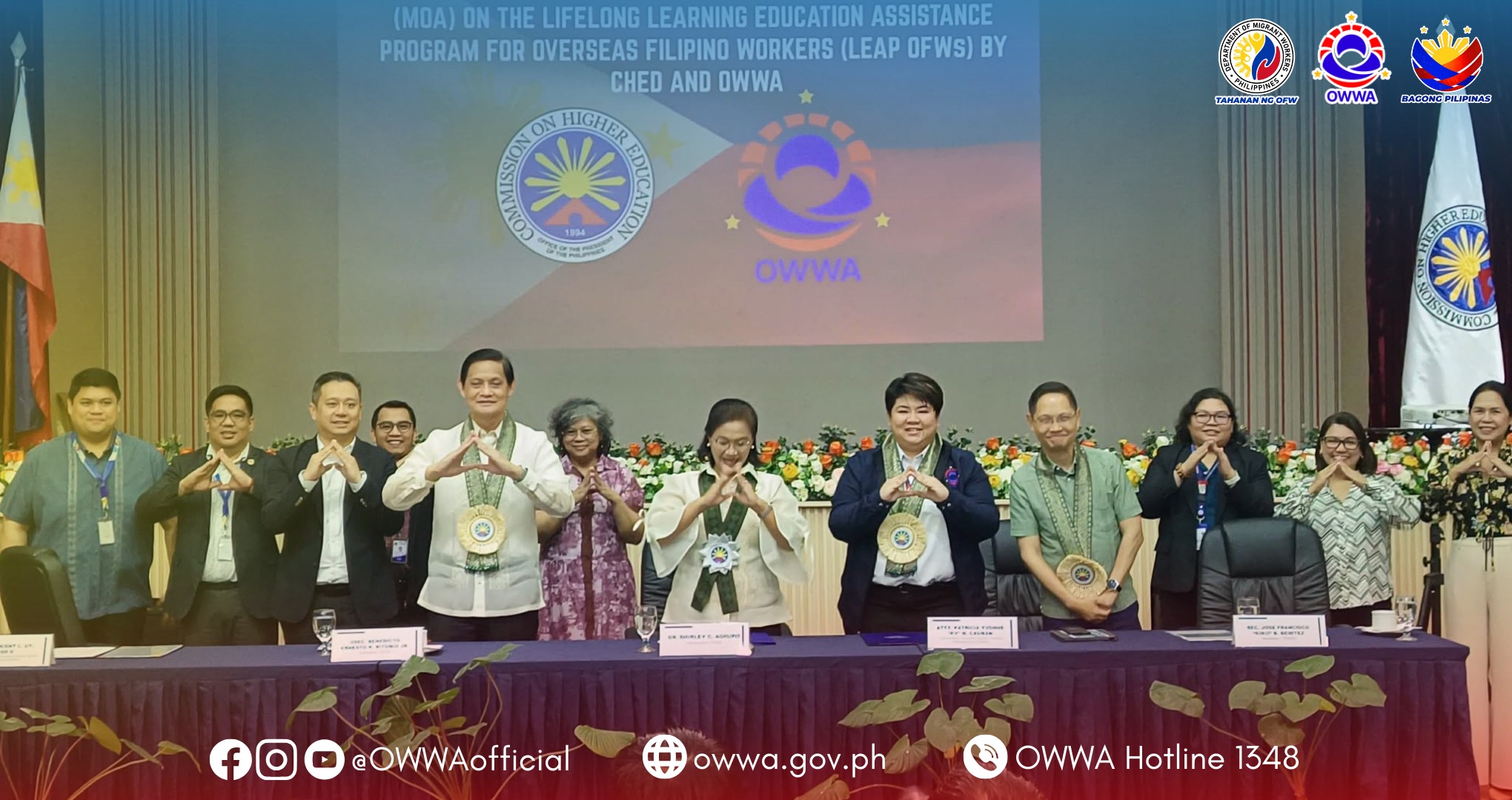

A new agreement between the Overseas Workers Welfare Administration and the Commission on Higher Education will open the door for tens of thousands more children of migrant workers to access college education, as OWWA announced it is adding 10,000 scholarship slots on the back of record-high funding.

OWWA Administrator Patricia Yvonne Caunan said the expansion brings the agency’s total scholarship reach this year to 25,000 beneficiaries — up from the 15,000 slots previously available — marking the first time the figure has reached that level in the agency’s history.
“So from 15,000 this year, for the first time, 25,000 na ang matutulungan ng OWWA pagdating po sa anak ng OFWs,” Caunan said.
The decision to expand was driven by what Caunan described as the agency’s highest funding level in 44 years. “At dahil nakamit ng OWWA ang pinakamataas na pondo sa loob ng 44 years na, kasi after Labor Day, ay OWWA anniversary naman sa May, ay nagdesisyon po ang OWWA leadership na magdagdag ng 10,000 slots,” she said.
OWWA currently runs three scholarship programs for OFW dependents: the Education for Development Scholarship Program, which provides up to P60,000 per school year for a four- to five-year bachelor’s degree; the OWF Dependent Scholarship Program, which offers P20,000 in annual financial assistance for bachelor’s or associate degree students; and the Congressional Migrant Workers Scholarship Program, which supports OFWs and their dependents pursuing priority science and technology courses.

The MOA signed Wednesday also covers the Lifelong Learning Education Assistance Program for OFWs, or LEAP-OFWs, which allows active and returning migrant workers to earn academic degrees outside the traditional classroom setup. Under the program, OFWs may have their work experience credited toward completing a college degree through the Expanded Tertiary Education Equivalency and Accreditation Program, with financial assistance and flexible learning arrangements available to fit their schedules.
Caunan said the program is designed to ease reintegration and widen opportunities for returning workers. “We are also strengthening coordination across institutions. This partnership between OWWA and CHED ensures that our OFWs receive not only scholarships or financial assistance but also guidance, monitoring, and support throughout their learning journey,” she said.
The same event hosted the signing of the implementing rules and regulations of Republic Act 11551, which mandates the integration of labor education into the tertiary curriculum. DOLE, CHED, and TESDA were signatories to the IRR.
TESDA Secretary Jose Francisco “Kiko” Benitez said the measure is intended to ensure workers understand their rights before they enter the workforce. “Sa ganito hong paraan, sinisigurado po natin na lahat po ng ating taumbayan, lahat po ng ating mamamayan ay malinaw po sa kanila ang kanilang karapatan, ang mga batas po para sa manggagawa na nasa Pilipinas,” he said. He added that embedding this knowledge into education reduces the burden on enforcement agencies to monitor compliance.
DOLE Undersecretary Benedicto Bitonio Jr. said the IRR gives academic institutions flexibility in how labor education is delivered. “Students will go through key areas such as labor standards, labor relations, basic workplace practices, and an understanding of government programs and services. These are not abstract ideas. These are the things young workers will encounter early on, often in their very first job,” he said.
