




The Philippine Embassy in the Sultanate of Oman has told The Global Filipino Magazine that it cannot yet confirm reports of a mandatory HIV test certificate being required of Filipino nationals traveling to Oman, as it has not received any official notification from the Omani government on the matter.

In a letter dated April 13, 2026, signed by Second Secretary and Consul Joanna Vi D. Arbado on behalf of the Ambassador, the Embassy acknowledged TGFM’s inquiry into the reported requirement — which has surfaced through accounts of Filipino travelers denied boarding on Oman-bound flights for failing to produce an HIV test certificate before departure.
“On this matter, however, the Embassy is unable yet to provide guidance and make announcements to confirm the reported requirement, as it is yet to receive an official notification from the government of Oman,” Arbado wrote. She added that the Embassy “proceeds with utmost diligence, prudence, and healthy caution, in publishing information across its channels.”
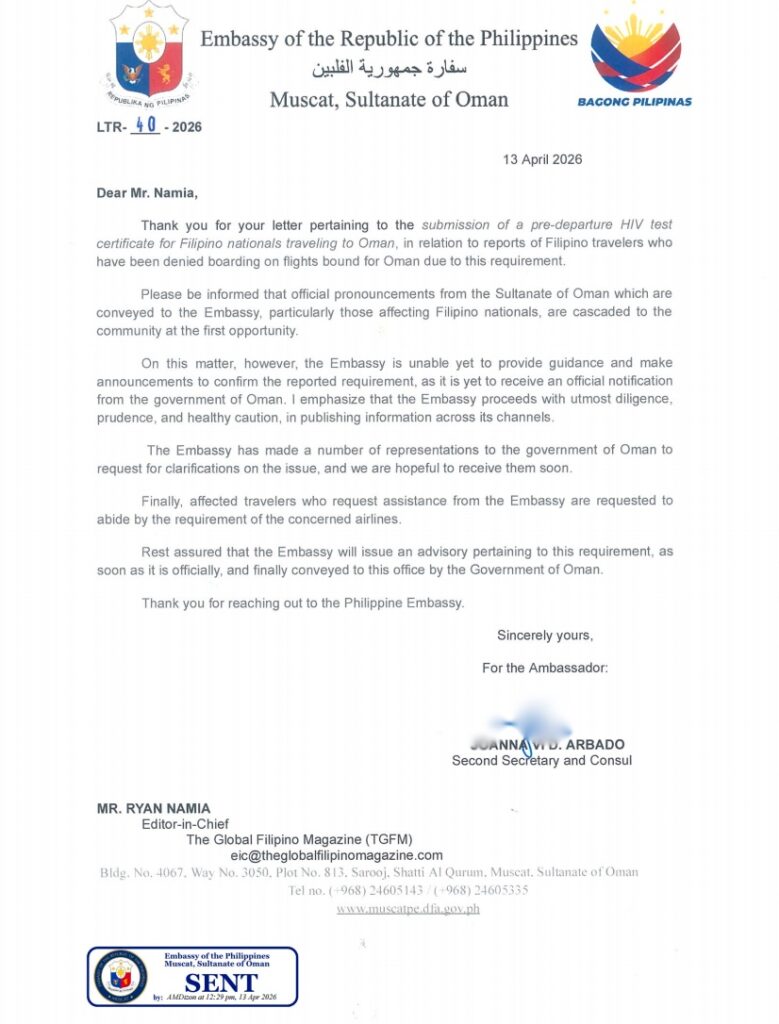
The Embassy said it had already reached out to Omani authorities for answers. “The Embassy has made a number of representations to the government of Oman to request for clarifications on the issue, and we are hopeful to receive them soon,” the letter stated.
In the meantime, the Embassy advised Filipino travelers who seek its assistance to comply with what the airlines are requiring. An official advisory, it said, would be issued “as soon as it is officially, and finally conveyed to this office by the Government of Oman.”
On the ground, enforcement continues
The Embassy’s response comes as community-level accounts of the requirement’s enforcement continue to mount. Filipino travelers have reported being stopped at check-in counters — including by Oman Air — upon failing to present an HIV test certificate. At least one traveler recounted being denied boarding on a flight from Thailand to Oman on March 20, despite holding a 14-day tourist visa and having received no prior notice of the requirement.

A document bearing the logo of Oman’s Civil Aviation Authority (CAA), obtained by TGFM, describes the measure as an “Explanatory Annex to Circular Regarding Entry Facilities for Nationals of the Philippines” and specifies that it applies to all Philippine nationals regardless of departure point — including those based in GCC countries — with children exempted. A screenshot appearing to be from Oman Air’s internal operations system similarly shows an active directive to check-in staff to enforce the certificate requirement.
A representative of the Overseas Workers Welfare Administration (OWWA) in Oman, when contacted by a Filipino traveler, also confirmed the requirement — though characterizing it as one being enforced by the airlines rather than as a standalone Omani government directive formally communicated through official channels.
A gap between policy and communication
The Embassy’s letter draws a careful distinction: it does not dispute that the requirement is being enforced in practice. It disputes only that it has received a formal, official communication from Oman to that effect — a prerequisite, the Embassy indicated, for it to issue its own public advisory.
That gap between on-the-ground enforcement and formal diplomatic notification is itself significant for affected travelers. Filipino nationals planning trips to Oman on tourist or family visit visas — regardless of which country they are departing from — are, based on available accounts, being required to present an HIV test certificate from an accredited medical facility at the point of check-in. Returning Filipino residents of Oman holding valid residency or labor cards appear to be exempt.
The development comes against the backdrop of Oman’s recently introduced visa-free entry policy for Filipino nationals — a 14-day facility that took effect in early 2026 and was intended to strengthen bilateral ties and ease tourism. The HIV testing requirement, if formally institutionalized, would effectively attach a medical prerequisite to what was framed as a more accessible entry arrangement.
