



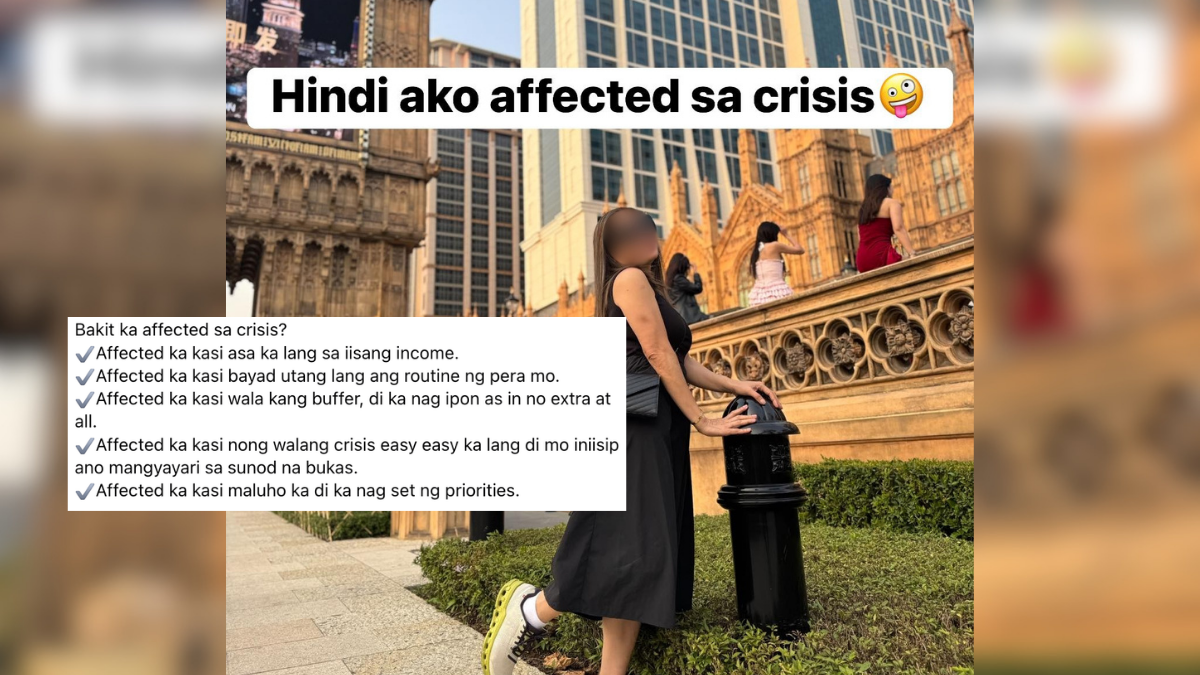

A social media post by a Florida-based Filipina with over 43,000 followers has drawn sharp criticism from Filipinos in the Philippines, after she publicly declared herself unbothered by rising fuel prices — and attributed other people’s financial struggles to poor habits and lack of preparation.

Luz Basagre, whose profile indicates she lives in the United States, posted the checklist-style commentary as fuel costs climb across the Philippines amid the global energy shock triggered by the closure of the Strait of Hormuz. She acknowledged at the outset that her words might come across as arrogant or insensitive, but proceeded to list what she characterized as the reasons people are hurting financially — among them dependence on a single income, debt-driven spending, zero savings, and what she described as a failure to set priorities. She then contrasted each point with her own circumstances: daily hard work, multiple income streams, financial reserves, and a safety net she said she had deliberately built.
The geographic gap between where Basagre is posting from and where most of her audience is living was not lost on commenters.
Cherry Rose, who drew over 1,000 reactions, pushed back while noting she herself is a business owner. “May mga business din po ako pero ung sinsbi mo ‘if you depend on one income only’ hndi po lahat kasing lucky mo,” she wrote. “Alam mo nman po ang buhay dto sa pinas. So just be kind nlng po. Keep it low key. Kasi mas madami ang kababayan natin ang mahirap.”
The phrase “dto sa pinas” — here in the Philippines — underscored a distinction commenters kept returning to: that the financial realities Basagre was diagnosing are not ones she is currently living inside.
Laine Almoro, whose comment accumulated over 1,200 reactions, challenged the post’s underlying assumption that outcomes are primarily a product of individual choices. “Di lahat ng tao may opportunity like you. Di lahat, may capabilities to have multiple income,” she wrote. She added: “Kaya yang statement mo napaka insesitive. Mga ganyang bagay dapat sinasarili na lang sa mga times na to. Hindi siya nakakainspire.”
Mae Mapada wrote: “If you’re not affected, it’s okay but sometimes it’s better to keep it to yourself. You don’t need validation from others. Let’s also be mindful and sensitive, because not everyone has the same income or situation. Many people are genuinely struggling during this crisis.”
Jeanine was more direct: “You’re not encouraging people but simply bragging and letting the world know you’re not affected with the crisis. Tip: You can encourage people without making everything about yourself.”

A comment by Chris Arsenio, which drew 430 reactions, raised questions about whether Basagre’s financial position was entirely the product of her own effort — a remark she engaged with across 61 replies.
Denise Nicdao Sol wrote: “Ma’am, stop comparing apples to oranges. Just because you’re ‘stable’ doesn’t mean others didn’t try or prepare. Some people just don’t have it as easy as you.. and not everything needs to be loud. Staying lowkey is more impressive.”
Joy Ce acknowledged there was some truth to the practical advice while rejecting its framing. “Tama naman po. Ganyan din naiisip ko minsan. But some people are not as lucky. Some were not given the opportunity to change their lives,” she wrote, adding that hardworking, educated people still find themselves without meaningful opportunities through no fault of their own.
Ana Banuelos Mendoza offered a pointed two-line verdict: “You are right but you’re bragging,” before arguing that no level of financial preparation is truly absolute.
Ho Ney Di Az suggested the post’s core point could have landed differently with a reframe: “Instead of ‘Hindi ako affected kasi…’ Try: ‘What helped me stay stable during crisis…'” — describing the message as needing “a bit more balance + empathy para mas maraming makarelate instead of ma-off.”
GB Villena kept it brief: “Try to have some ‘Empathy’ it’s for free lang naman.”
The Strait of Hormuz has remained largely closed to commercial shipping since late February, following U.S. and Israeli strikes on Iran. The UN has warned that the disruption is already registering in the daily lives of people across Southeast Asia struggling with climbing food and fuel costs — the same people Basagre’s post was ostensibly addressing, from across the Pacific.Florida-based Filipina tells struggling kababayans to ‘work harder’ as fuel prices bite back home
