



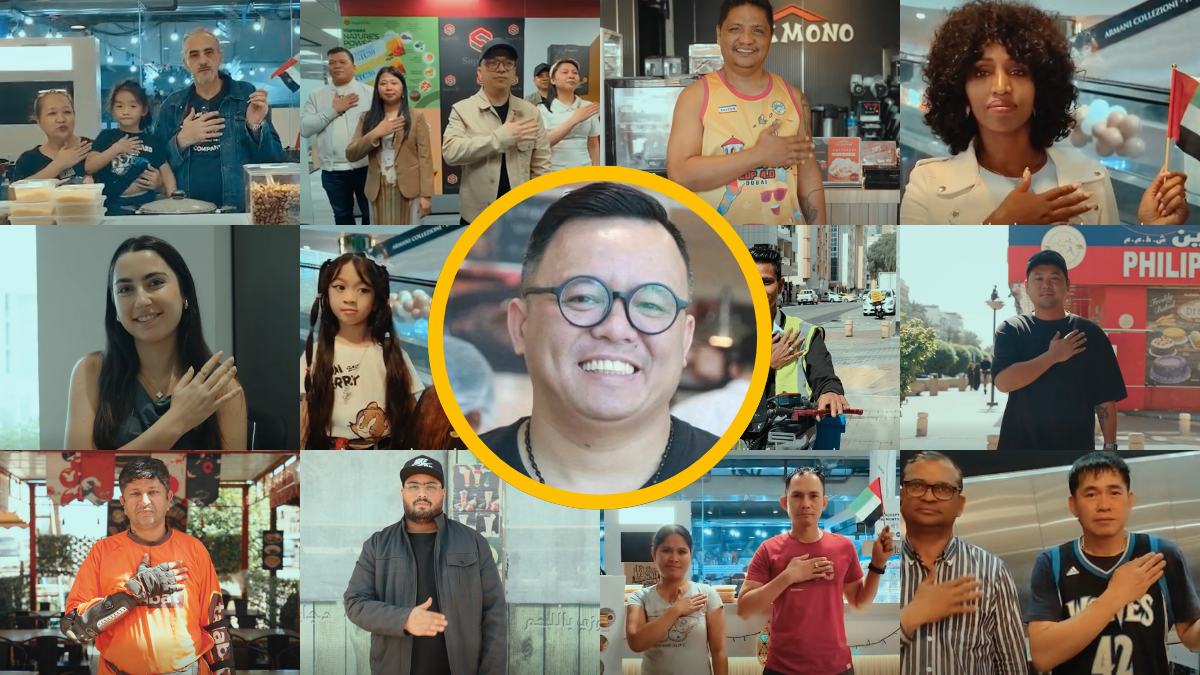

Twenty-six years of living in the United Arab Emirates will do something to a person. For Francis Luscianne J. Gacer — known in creative circles as Direk Kiko — it produced a song written in a single night, a music video assembled from dozens of strangers’ phone clips, and a project that has since pulled nearly 3,000 reactions and 1,500 shares from people who recognised something of themselves in it.

Gacer is the founder, writer, and director of Kikoman Films, a Dubai-based non-profit film production collective operating under a legal UAE business license. The collective has accumulated over a hundred awards from international film festivals across seven years of independent filmmaking. But “IN THE UAE, EVERYONE IS EMIRATI” — the music video at the centre of this moment — arrived not from a formal production pipeline, but from a question he asked himself when regional tensions began to rise.
“How can I give back to a country that has continuously protected us and given us so much?” he recalls asking. That question, he shares with TGFM, was where it started.
The answer took shape on the last day of Eid, in a park, with a few members of his production team and their phones. Gacer had sketched out a concept: ordinary people placing their right hand over their heart — a gesture simple enough for anyone to replicate, symbolic enough to carry weight. They filmed sample takes on the spot, testing what it might look like on screen.
By the time he got home that night, he was already writing lyrics. He comes from a family of artists and musicians, and had a clear sense of how the song needed to feel — emotional, accessible, easy to carry. Without a recording studio available, he turned to Suno AI, an artificial intelligence music platform, to realise the composition. The song title was drawn from a UAE campaign message that had stayed with him. That same night, in the early hours, the track was finished.
Getting other people into the project came next. Gacer began reaching out through his production network, inviting individuals to submit their own clips performing the gesture. Early on, uncertain about the publishing guidelines for this kind of content, he sought advice from Josie Conlu, a longtime friend who also served as the project’s social media consultant. Conlu connected the initiative with Filipino influencers across the UAE, who began contributing and amplifying it. The team also took the effort to the streets of Al Muraqqabat and Al Rigga, approaching people directly.
What Gacer encountered there surprised even him. “There was no hesitation — just genuine enthusiasm and love for the UAE,” he says. Workers paused mid-shift to record themselves. Others filmed independently and sent clips without being asked. He compiled the submissions, matched them to the music, and edited the whole thing into a single cohesive piece.
Kikoman Films did not emerge overnight, and neither did Gacer’s instinct for this kind of storytelling. He was born and raised in Pampanga, in a household where painters, musicians, and performers were a constant presence. As a young man, he became involved in political activism during one of the more turbulent periods in Philippine history, an experience that sharpened his lens on class, power, and the stories that rarely get told.

He arrived in the UAE as both a producer and designer — and, as he notes, as a person with a disability. The country, he says, gave him more than employment. “It gave me dignity, stability, and belief in my abilities.” That personal history runs underneath the music video in ways that don’t announce themselves but are hard to separate from it.
The collective he built over the years reflects a similar ethos. Kikoman Films runs acting workshops and talent discovery programmes for overseas Filipinos, many of whom have no formal performance training but, in Gacer’s view, carry something cameras respond to. He describes the organisation as a space where OFWs can engage creatively, process their experiences, and participate in stories that reflect their own lives. Earlier this year, he expanded the outfit’s reach with a sister label, Peanut Pictures, intended to bring in non-Filipino collaborators.
The public response to the video has moved beyond what Gacer anticipated. Comments from viewers across the UAE describe the project in terms that go well past appreciation for a well-made clip. Carine Joy Emperado, a viewer who says her children were born and raised in the UAE, wrote that the video reminded her family of how fully the country had become their home. “We’ve never felt like outsiders, we’ve always felt like we belong,” she noted, adding directly: “Thank you Kiko Man KikomanFilms for making us a part of this honoring project.”
Josie Conlu, whose role shifted from advisor to participant in the project’s spread, described it as something that captured “the love and gratitude in every frame.” Others framed their responses around the wider regional moment — Jennifer Castro-Agostinho called it a “wonderful tribute” and expressed gratitude for UAE leadership’s efforts to protect residents. One commenter, Ecitsuj Pasa, drew a line between the gesture in the video and the way Filipinos honour their own flag, calling the connection a mark of Filipino creativity.
Gacer describes the reception through a metaphor he returns to: birds gathering broken twigs to build a nest. Individual pieces that seem incomplete on their own, assembled into something that holds. He sees the video as functioning the same way — fragments of different lives, different backgrounds, different stories, brought into a single frame.
The project, he is clear, is not a standalone gesture. Gacer frames “IN THE UAE, EVERYONE IS EMIRATI” as what he calls an aggregator — a new platform and direction for Kikoman Films, one that reaches past conventional narrative filmmaking toward something with broader social reach.
“We are living in what I call the ‘thinking age,'” he says, “where people are more aware, more analytical, and more engaged with the world around them.” In that context, he argues, unity is not a crisis response but a practice — something that must be demonstrated in ordinary times so that it holds in difficult ones.
Every completed film, he says, functions not as an endpoint but as a reason to begin again. He has not stopped. He says he never ran dry. The legacy he is building in the UAE, as he describes it, is rooted in purpose, service, and stories that bring people together — and he intends to keep making them.
