



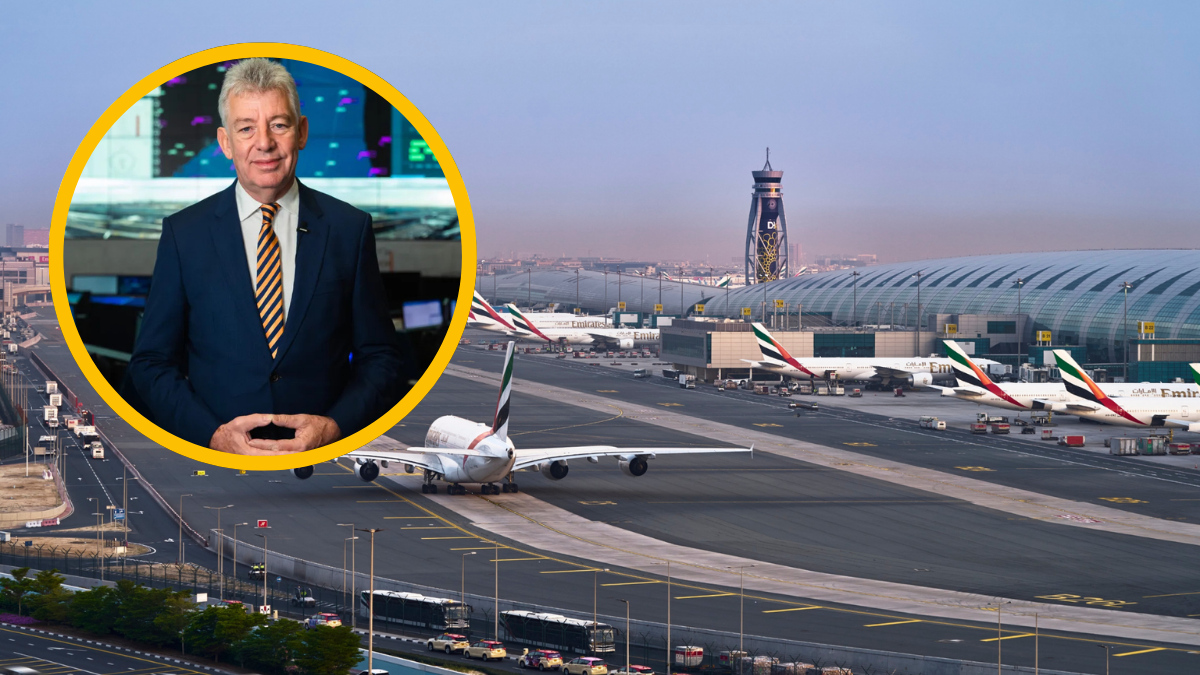

The chief executive of Dubai Airports has ruled out any pause to the emirate’s ambitious airport expansion programme, saying the organisation remains fully committed to growth even as military conflict continues to disrupt regional airspace.

Dubai International Airport, which processed 95.2 million passengers last year, has seen operations intermittently suspended over the past 18 days following drone incidents linked to Iranian attacks on Gulf states — a spillover from the US-Israel-Iran war that began in February. The conflict has prompted the UAE and neighbouring countries to impose airspace restrictions.
Despite the disruptions, Paul Griffiths said recovery was already underway. Traffic movement has climbed back to between 40 and 45 per cent of normal capacity, he told CNN, with more than one million passengers facilitated across the 17-day period of restricted operations.
“We closed the airspace and reopened it as the threat level changed. We have been able to keep aircraft in the air and route them through corridors properly designated by the General Civil Aviation Authority, while holding aircraft at outstations and ensuring they can be safely diverted if there is a threat,” Griffiths said.
He credited coordination across aviation stakeholders and the armed forces for containing the impact. At its peak before disruptions hit on February 28, Dubai International was managing around 320,000 travellers daily.
“When that supply chain gets interrupted, it is incredibly important that we keep people informed, ensure those already at the airport are safe and secure, and deal with the backlog by getting people to where they need to be. Dubai Airports provided information to ensure that people came to the airport only when necessary. That worked well, as the airport remained calm and composed,” he said.

On the question of whether the $35 billion expansion of Al Maktoum International Airport — also known as Dubai World Central — would be reconsidered, Griffiths was unequivocal.
“Absolutely not. We are still confident in the aviation industry and Dubai’s place in it. If you look at all the things that we have had to deal with over the last 20 years or so, we have bounced back and taken the opportunity to continue growing,” he said.
The first phase of the Al Maktoum expansion is scheduled to open in 2032, at which point the facility is expected to accommodate 150 million passengers per year. Full build-out would bring that figure to 260 million.
Griffiths framed the region’s aviation infrastructure as a global necessity, not simply a commercial asset. “The aviation ecosystem in the Middle East is incredibly important to the world. When you consider the amount of capacity that comes through hubs in the region, the world cannot do without that. One-third of the world’s population is within four hours’ flying time of Dubai, and two-thirds within eight hours’ flying time,” he said.
Dubai Airports reported 454,800 total flight movements for 2025, a year-on-year increase of 3.3 per cent, with Q4 alone recording 118,000 movements — up five per cent on the same period the previous year.
“We will bounce back from the current situation very quickly. Of that I am convinced. We are doing everything we can to preserve both the capability and confidence to bring our operations up to 100 per cent capacity as quickly as possible,” Griffiths said.
