



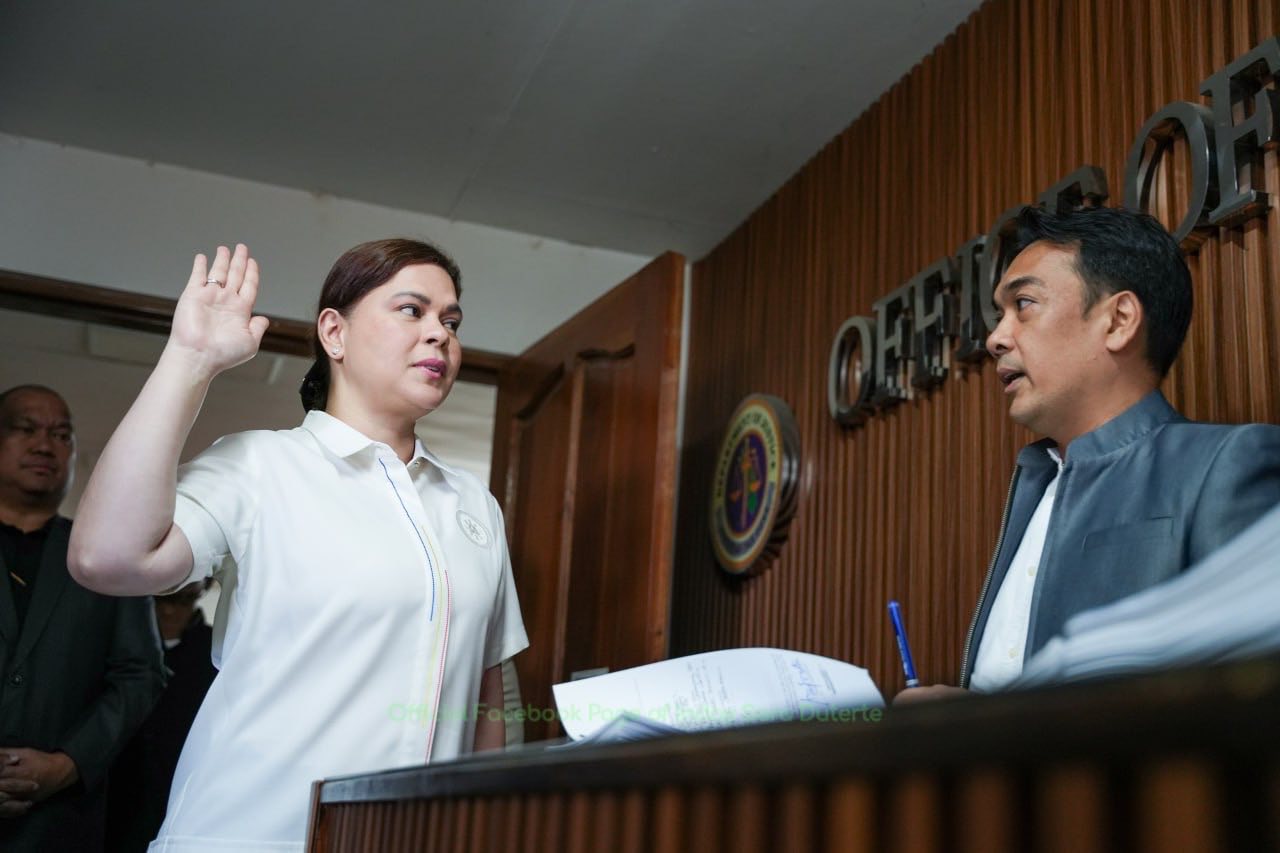

Vice President Sara Duterte is pushing back against a move by a House minority lawmaker to compel the submission of key documents in her impeachment proceedings, arguing that the effort exposes a fundamental weakness in the case against her.

Akbayan party-list Rep. Chel Diokno, the House deputy minority leader, filed a motion before the House committee on justice seeking a subpoena duces tecum to obtain records including Duterte’s Statements of Assets, Liabilities and Net Worth. Diokno framed the request as necessary for the panel to properly weigh whether sufficient grounds for impeachment exist.
Duterte rejected that framing outright. “This only reinforces what I have been saying all along. There is no sufficient evidence to warrant an impeachment case against me,” she said in a statement.
She argued that the committee’s earlier finding that the complaints against her are sufficient in substance already implies that the allegations are backed by proof — and that going out to gather more would contradict that conclusion.
“The Committee cannot conduct an investigation to search for evidence to support accusations already made in the impeachment complaints. Doing so would amount to a third ‘fishing expedition’ by the House of Representatives,” she said.
Duterte identified what she described as the first two such attempts: the 2024 budget hearings, and the subsequent inquiry by the House committee on good government and public accountability — the latter of which she linked to the “Mary Grace Piattos” episode that drew public attention during that period.
“Now we are witnessing yet another desperate attempt to search for evidence where none exists,” she said.

She went further, framing the entire impeachment process as politically motivated. “Let me say this again for the nth time: The impeachment is a political attack designed to protect certain individuals and advance personal and foreign interests,” Duterte said.
The Vice President also took aim at the timing of the proceedings, saying continued attacks by Malacañang and the House amid the ongoing Middle East crisis amounted to an “insult” to overseas Filipino workers, impoverished Filipinos, and families caught in the regional turmoil.
Diokno, for his part, stood by the motion while acknowledging Duterte’s right to respond through proper channels. “I respect the Vice President’s opinion about the proceedings. However, my motion is clear: to preserve the documentary evidence and secure a witness so the Committee on Justice can fulfill its duty of assessing the evidence,” he said.
In Filipino, he added: “Sa huli, ang ebidensya ang magsasabi kung dapat may pananagutan. At ang impeachment proceeding ang tamang lugar para lumabas ang katotohanan.” (In the end, evidence will determine whether there should be accountability. And the impeachment proceeding is the right place for the truth to come out.)
Beyond the document subpoena, Diokno has also sought to place Ramil Madriaga — identified as Duterte’s alleged former aide — under the custody of the justice panel for the duration of the proceedings.
Duterte’s legal counsel, Atty. Paolo Panelo Jr., expressed support for that particular request, saying they want Madriaga kept “alive and well.”
The House committee on justice declared the impeachment complaints against the Vice President sufficient in substance on March 4. The complaints include allegations of betrayal of public trust and culpable violation of the Constitution, centered on the alleged misuse of P612.5 million in confidential funds. Existing law under the Bank Secrecy Act allows bank records — otherwise strictly protected — to be examined in impeachment proceedings.
