



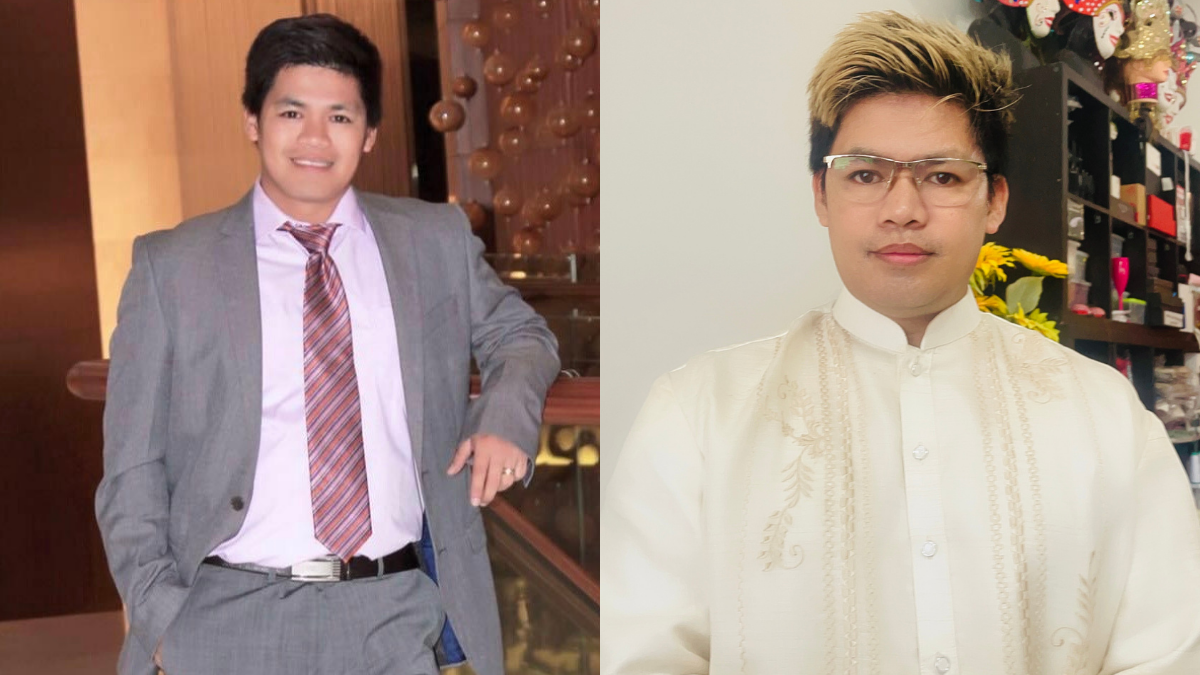

He spent five years studying how to build walls — and ended up tearing them down instead. Vincent Noe Villarin Gunot, 45, is today the owner and CEO of two creative companies in Dubai, a choreographer, a costume designer, and a man who will tell you plainly that architecture school prepared him for all of it.

It just took a decade and a half, a Muslim country he’d never set foot in, a manager who underestimated him, and the woman who would become his wife to get there.
A degree that never got used
Gunot graduated with a Bachelor of Science in Architecture in 2005. The credential looked good on paper, but it never quite fit. “Deep in my heart, I knew that my true passion was in performing and the arts,” he shares with TGFM.
Rather than sit in a drafting office, he walked into a university dance studio. For five years, he served as choreographer at Negros Oriental State University, training young performers and building something he found more satisfying than any blueprint: confidence in other people. When the chance to go abroad came in 2014, he took it — not because he had a clear plan, but because he believed, as many OFWs do, that more money meant a better life.
He was wrong about that, at least in the simple way he’d imagined it.
“I soon realized that being an OFW is far from easy,” he says. “Behind the promise of a higher salary are sacrifices, homesickness, long working hours, and the emotional challenge of being away from family and loved ones.”
His first role in Dubai was as a Kids Club Animator at Al Habtoor Grand Hotel in Dubai Marina — far from architecture, further still from fashion. But it was there that something clicked. He liked performing. He liked making people feel something. By 2016, he had landed a role as a pioneer performing and supporting actor at IMG Worlds of Adventure, one of the largest indoor theme parks in the world.
The manager who made him work harder
Not every chapter of his Dubai story reads like a highlight reel. Gunot is candid about an early episode that stung: a Filipino manager who, rather than support a fellow kababayan, chose to undercut him.
“Some people did not want to see others succeed,” he says. “I experienced this in my first job, where my Filipino manager underestimated my capacity, my skills, and my strength.”
Crab mentality — the tendency to pull down those who are climbing — is a phrase Filipinos know well. That it followed him from the Philippines to the Gulf was a harder lesson than any culture shock. But Gunot is deliberate about what he did with that experience. “Instead of letting that break me, I allowed it to build me. I worked harder. I stayed focused. I proved to myself — not to them — that I was capable of more.”

After his entertainment contracts, he shifted again, spending five years as a performing arts teacher at Pristine Private School. The classroom grounded him. It also quietly prepared him for what came next.
When fashion found him
“I never imagined that I would become a fashion designer here in Dubai,” Gunot admits. With an architecture degree and a performing arts background, couture gowns were not exactly on the itinerary. But once he started learning the craft, he noticed something familiar in it.
Both architecture and fashion, he found, demand the same core instincts: creativity, structure, vision, and obsessive attention to detail. “Through fashion, I found a new way to bring my sketches to life. What once existed only on paper became masterpieces worn with pride and confidence.”
He obtained his business license and launched Nina Florence Creative Minds (NFCM), a brand built around the promise that every client’s vision — from couture gowns to elaborate festival costumes — deserves to be executed with excellence. A second company, NV Dream Makers, followed. He also founded Lunhaw International Performing Arts Dubai, where he serves as artistic director and choreographer, continuing the work he began in that university studio years ago.
Running two companies and a performing arts group while managing the everyday demands of life abroad is not a small undertaking. What keeps him going, he says, is simpler than any business strategy.
“Seeing the smiles on my clients’ faces whenever they wear my creations is one of my greatest achievements. Each design is not just a garment, but a story, a dream, and a reflection of their personality.”
His mantra — Dream big. Start small. Stay faithful. — sounds like something you’d find embroidered on a throw pillow. But coming from a man who built a fashion brand from a performing arts background and an architecture degree he never used professionally, it carries more weight than it might otherwise.
Dubai, he says, is not the final destination. The plan is to eventually return to the Philippines, where he and his wife are already preparing a home and laying the groundwork for the next chapter of their business. “Dreams are not limited by location,” he says. “They grow wherever you choose to plant them.”
To fellow OFWs, his advice is characteristically direct: start with what you have, love what you do, and do not wait for the conditions to be perfect before you begin. “Every big success starts small. What is small today will grow and flourish tomorrow through patience, hard work, and faith.”
Twelve years ago, he arrived in Dubai alone, carrying, as he puts it, “nothing but faith, courage, and a promise to myself.” The buildings he designs now are made of fabric. But they stand.
