



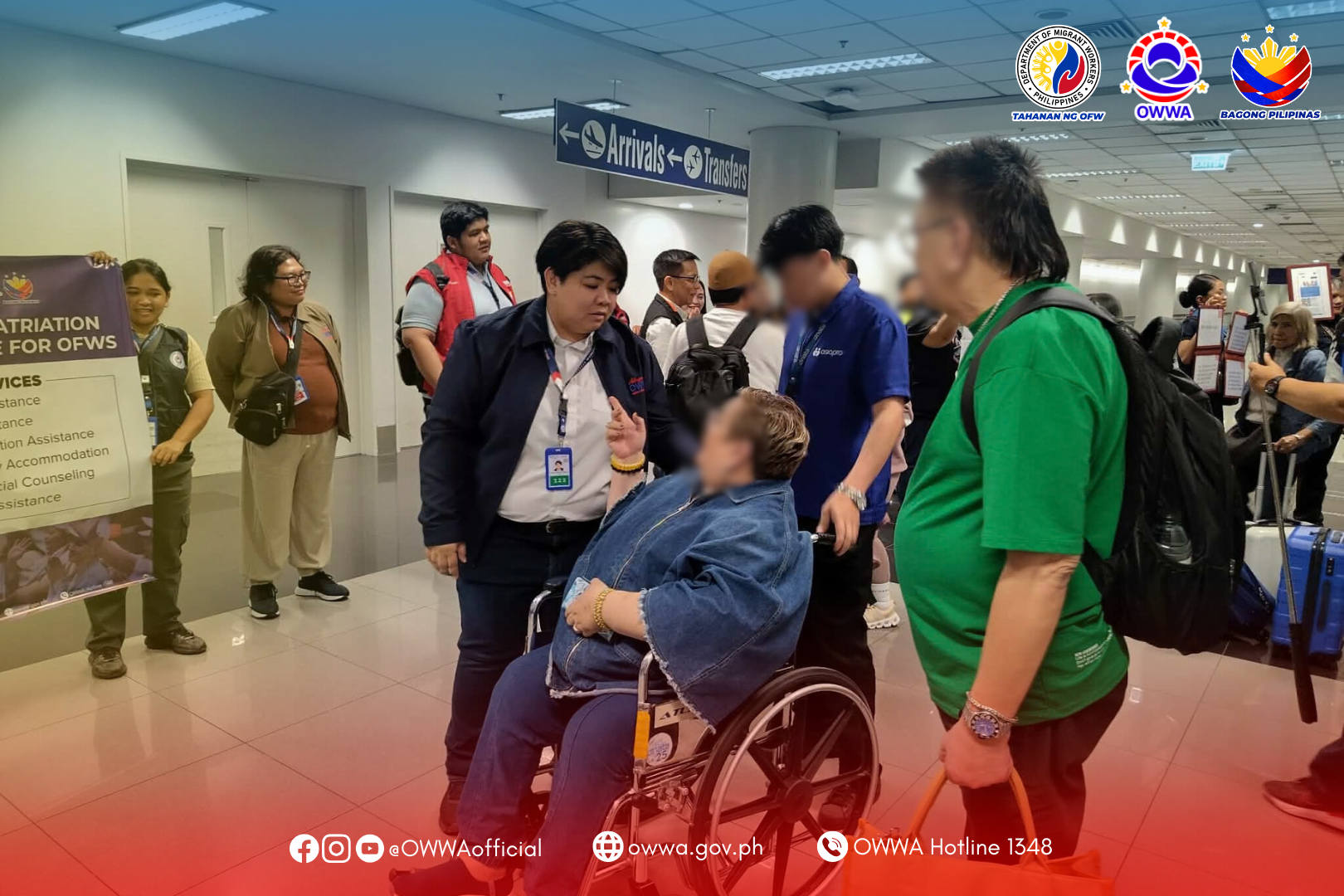

The Overseas Workers Welfare Administration has laid out the step-by-step process it follows to bring home overseas Filipino workers affected by the ongoing Middle East conflict, as the government continues to field a growing volume of repatriation requests from Filipinos across the region.

OWWA Administrator Patricia Yvonne Caunan shared the infographic on her personal Facebook page, offering a rare behind-the-scenes look at the mechanics of OFW repatriation during a crisis. “Behind every homecoming of our Kababayan is a careful and continuous movement of government to ensure their safety,” Caunan wrote in her caption. “From monitoring the situation, processing travel documents, exit visas and transit clearances, to arranging plane tickets and safe return to the Philippines — this is not a simple process.”
The four-step framework begins with a Request for Assistance (RFA), which OFWs can file through multiple channels — walk-in at OWWA offices, the OWWA Hotline 1348, Viber, WhatsApp, phone call, or email at tulong@owwa.gov.ph. Upon receipt, welfare officers immediately assess the OFW’s safety and immediate needs, including evacuation, temporary shelter, and food. The third step covers the processing of travel documents and transit visas, with OWWA helping workers safely cross borders when necessary. The process concludes with repatriation itself — carried out through either chartered or commercial flights.
“In every step, the government makes sure our OFWs come home safely,” the infographic reads. “This is the promise the government continues to fulfill for our Kababayan overseas.”
The transparency comes as repatriation figures continue to climb. Government data shows nearly 2,000 Filipinos across nine Middle East countries have formally sought repatriation, with Kuwait accounting for the largest share at 633. Around 400 OFWs and their dependents have already been brought home since March 5, with batches arriving at NAIA Terminal 3 aboard Emirates Airlines flights. The youngest among the returnees was a one-month-old infant, a dependent of one of the repatriated workers.

Airspace restrictions have forced the government to improvise evacuation routes. Sixteen OFWs from Tel Aviv were rerouted overland to Eilat, crossed into Egypt via the Taba border crossing, and flew home via Cairo and Muscat. A separate group of 20 OFWs from Dubai crossed into Oman through the Khatmat-Malaha border crossing before catching a Muscat-to-Manila flight.
In Iran, 11 Filipinos were safely brought out to Van, Turkey, through coordination between the Philippine embassies in Tehran and Ankara. The DFA estimates around 800 Filipinos remain in Iran who may still wish to return.
The conflict has claimed at least one Filipino life. Mary Ann Velasquez de Vera, a caregiver based in Israel, was killed in an Iranian strike. Her remains have yet to be repatriated due to the continued closure of Ben Gurion Airport. One Filipino in Qatar was also wounded by intercepted missile shrapnel and is currently recovering.
Despite the rising numbers, the government has not declared mass repatriation, as the situation has not reached Alert Level 4 — the threshold that triggers mandatory evacuation. DMW Secretary Hans Leo Cacdac has said that deploying a Philippine Navy ship, while considered, could complicate the situation given the active conflict environment.
Senator Sherwin Gatchalian has warned that the government may need an additional ₱7 billion in funding should the conflict escalate further and mass repatriation become necessary. In the meantime, OWWA and the DMW continue to provide on-site assistance — food, hygiene kits, and temporary shelter — to over 1,800 OFWs still in the region who have yet to depart.
