



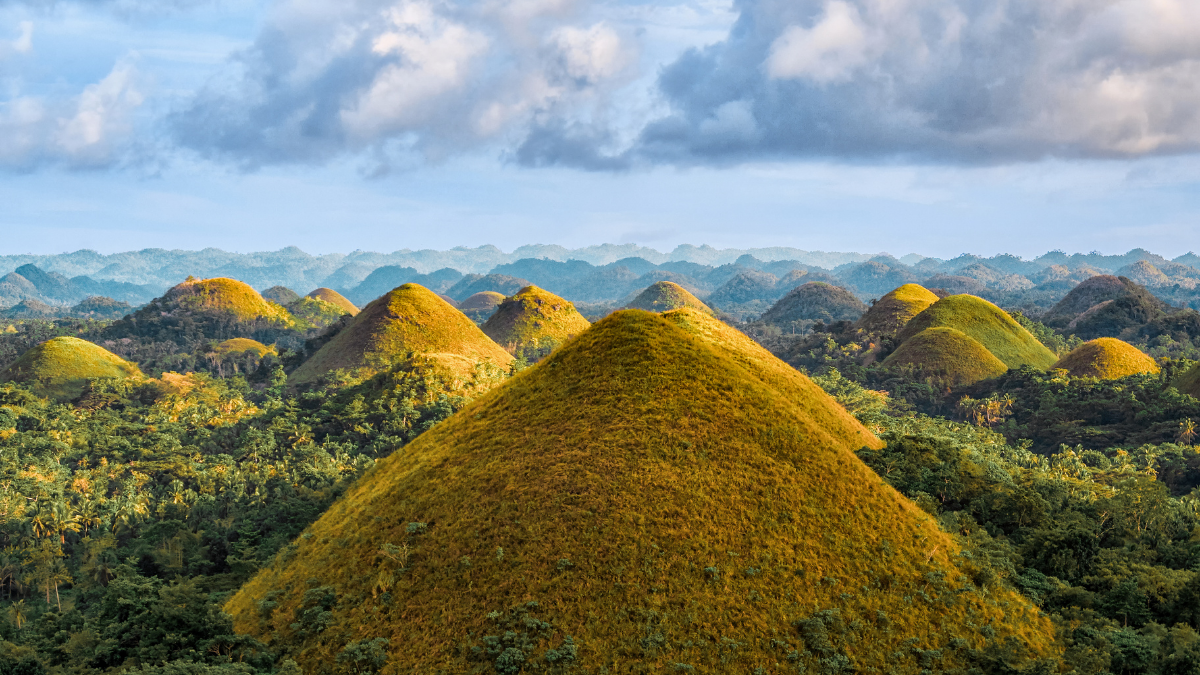

At the very center and heart of the Visayas lies one of the Philippines’ most breathtaking natural treasures—the world-famous Chocolate Hills. For generations, this surreal landscape has captured the imagination of travelers, scientists, and storytellers alike. Considered one of the country’s crown jewels of nature, the Chocolate Hills remain a compelling symbol of how geography, legend, and cultural heritage converge in a single majestic destination.

1,200 perfectly shaped mounds
Rising gracefully from the earth, these perfectly shaped mounds—numbering more than 1,200—spread across the towns of Carmen, Batuan, and Sagbayan. During the dry season, the hills turn a deep brown, resembling giant chocolate drops scattered across more than 50 square kilometers of rolling terrain. When the rains arrive, they shift into lush green, offering a striking transformation that makes the landscape seem almost alive.
Scientists attribute this natural wonder to thousands of years of weathering of marine limestone—shaped by rain, groundwater movement, and the slow uplift of ancient coral formations. Yet beyond geological explanations, the Chocolate Hills are also deeply woven into Boholano folklore. One legend speaks of two giants who hurled rocks at one another during a fierce battle; another tells of a heartbroken giant whose tears solidified and formed the hills. These stories, passed down across generations, enrich the mystique surrounding this iconic landscape.
Sea of green and brown domes
Visitors often begin their journey at the Chocolate Hills Complex, where a panoramic viewing deck offers a sweeping 360-degree view—an unforgettable moment for both first-time tourists and returning admirers. Seen from above, the hills stretch endlessly into the horizon, forming what many describe as “a sea of green and brown domes.” On clear days, the vista becomes even more dramatic, a perfect showcase of the Philippines’ natural artistry.
Beyond the hills, the province of Bohol unfolds a world of adventure. Here, travelers can encounter one of the smallest primates on Earth—the enchanting Philippine tarsier. With large, expressive eyes and a gentle demeanor, the tarsier is a beloved icon of local conservation efforts. Visiting sanctuaries in Corella, Loboc, and Bilar offers not only a glimpse of this delicate nocturnal species but also an opportunity to learn about its protection, as tourists are reminded to maintain silence, avoid flash photography, and respect the animals’ natural habitat.

The broader landscape surrounding the Chocolate Hills is equally captivating. Rice fields and farmlands paint the lowlands in shades of emerald, while rings of forest vegetation outline the base of the cone-shaped formations. Various grasses—such as Imperata cylindrica and Saccharum spontaneum—thrive on the hillsides, contributing to their uniform color and texture. Bohol’s unique terrain has made it a favorite among eco-travelers, photographers, natural scientists, and cultural enthusiasts seeking a deeper experience beyond typical beach destinations.
DENR-protected natural monument
Recognizing the area’s exceptional natural value, the Philippine government declared the Chocolate Hills a protected natural monument through Proclamation No. 1037. This designation places the site under the care of the Department of Environment and Natural Resources (DENR), ensuring that conservation measures and sustainable tourism practices remain at the forefront. In 2006, the hills were also included on the Philippines’ UNESCO World Heritage Tentative List—further highlighting their global significance.
Traveling to Bohol has become more accessible through the Bohol-Panglao International Airport, which connects visitors from major Philippine cities and nearby international destinations. From Tagbilaran or Panglao, tourists may explore the island by tour van, motorbike, or local transport, making the journey to the hills both convenient and scenic. Ferry routes from Cebu, Dumaguete, Siquijor, and northern Mindanao also continue to bring a steady flow of tourists eager to experience Bohol’s charm.
Symbol of resilience and national heritage
Today, the Chocolate Hills remain not only an iconic tourism magnet but also a symbol of Philippine resilience, natural heritage, and cultural identity. As the world rediscovers the beauty of the archipelago, Bohol’s rolling landscape stands as a reminder that nature still holds wonders beyond imagination—quiet, timeless, and eternally inspiring.
