



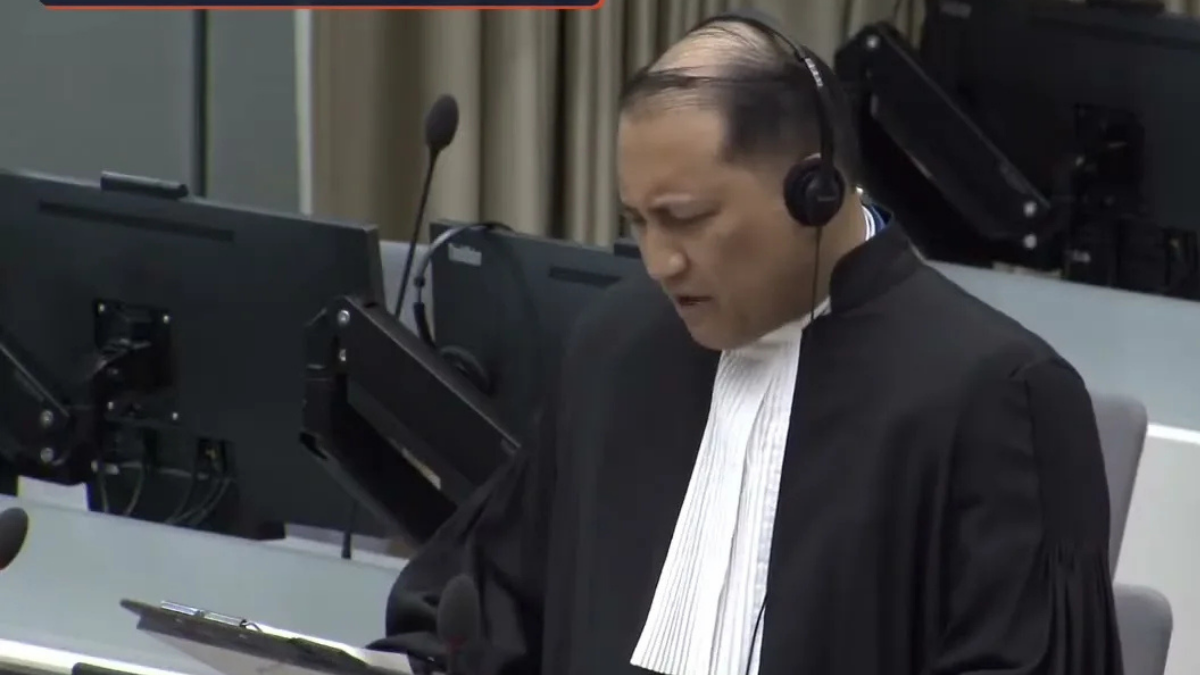

A lawyer representing victims in Rodrigo Duterte’s crimes against humanity case argued before the International Criminal Court on Friday that the former Philippine president’s government left thousands of drug war killings unaddressed by the justice system.

Gilbert Andres, delivering closing remarks, told the court that of the 3,967 deaths the Duterte administration itself acknowledged in anti-drug operations between July 2016 and November 2017, criminal charges were pursued against the responsible police officers in at most 302 cases. He also said the mandatory motu proprio investigations required under the Philippine National Police’s 2013 Revised Operational Procedures were never carried out.
The figure of 3,967 came from the administration’s own 2017 year-end report, which Andres noted listed those deaths alongside other accomplishments — a framing the Philippine Supreme Court found significant. Andres quoted the High Court’s finding directly: “The government’s inclusion of these deaths among its other accomplishments may lead to the inference that these are state-sponsored killings.”
The Supreme Court, he said, also ruled that police could not shield themselves behind a presumption of regular conduct. “The PNP cannot claim the presumption of regularity in official functions because deaths are not supposed to occur during any of their operations,” Andres quoted the court as saying.

Andres pushed back against several arguments raised by the defense. On the claim that Duterte was “intolerant of rotten police officers,” he said the prosecution record contradicted that directly. He also rejected the characterization that killings during Duterte’s time as mayor were “hardly widespread,” arguing instead that the attacks showed both geographical spread and sustained repetition, targeting a segment of the civilian population — those perceived as connected to drug activity — in a manner that was both large in scale and organized in execution.
The cultural and constitutional weight of presidential speech was another point Andres pressed. He said Duterte’s legal team had framed his public statements as “merely bluster,” but that this misread how executive authority functions in the Philippines. “Whatever the president publicly states is policy,” he said, adding that in a society where deference to government figures — especially the president — runs deep, such statements carry directive force.
Duterte faces three counts of crimes against humanity before the ICC, covering alleged murder and attempted murder committed during his tenure as both mayor and president. The ICC Office of the Prosecutor brought the charges.
Andres also told the court that children were among those killed, describing their deaths as deliberate rather than incidental, and that the defense had failed to undermine the prosecution’s case. Victims, he said, are pressing for confirmation of all charges in part because many remain under threat. “They are still in the shadow of fake news, of fear, and of threats from Mr. Duterte’s supporters,” he said.
