



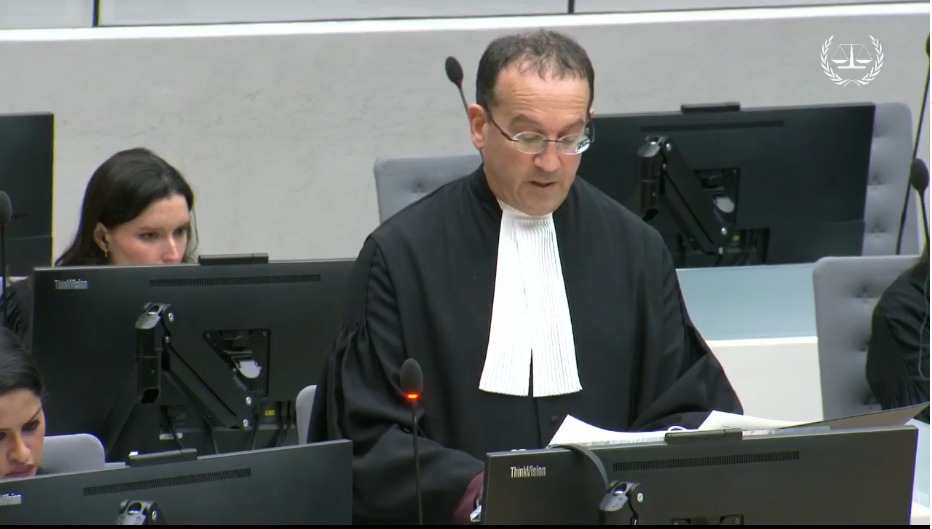

The emotional weight of the International Criminal Court proceedings surfaced inside the courtroom this week, as defense counsel Nicholas Kaufman acknowledged seeing a grieving relative in the gallery during the confirmation of charges hearing against former President Rodrigo Duterte.

In an Inquirer.net report, Kaufman said he was moved by the sight of an elderly woman in tears but maintained that sympathy does not alter his legal position. He stressed that while victims occupy a central place in the court’s framework, their suffering does not automatically establish the criminal responsibility of an accused.
“Because in every case in the ICC, the victims are always at the center because this court is set up to counter impunity,” he said. “But that has nothing to do with whether or not someone who’s brought before this court is criminally responsible.”
Kaufman reiterated that he does not dismiss the pain experienced by families affected by the anti-drug campaign. “Of course, I felt for the old lady in the gallery who was crying because I’m a human being… I don’t make light of grief. However, having said that, I have a job to do, and my job is to defend someone who I believe has been wrongly charged,” he said.
Earlier in his courtroom presentation, Kaufman addressed relatives of those killed, assuring them that the defense’s legal challenges were not meant as personal attacks. “Any criticism made by us today will not be levelled at the loved ones of those such as the tearful relative whom I saw in the gallery here on Tuesday,” he told the chamber. He also said he does “not disrespect the soul of any deceased person, nor does it make light of the loss of life.”
Llore Pasco, who lost two sons during the drug war and was identified as the woman Kaufman referenced, rejected the defense’s framing of the case. She said she felt diminished by how their experiences were characterized in court.
“It was as if [he] did not give importance to our suffering,” Pasco said. She also described the defense presentation as lacking merit and called it “pure lies.”

The hearing has centered on whether there are substantial grounds to bring Duterte to trial for alleged crimes against humanity tied to the anti-drug campaign. Kaufman argued before judges that the killings cited by prosecutors were “minimal” and occurred “at random,” disputing the claim that there was a coordinated strategy to target suspected drug offenders.
Human rights lawyer Neri Colmenares challenged that assertion, dismissing the idea that the absence of a formal meeting disproves the existence of a coordinated effort. “They (defense) said there’s no common plan. I don’t see any procedural requirement that they had to have a meeting for a common plan… That doesn’t shatter [evidence],” he said.
Colmenares also rejected the notion that the violence was spontaneous. “No. It was an order, there was a pattern, there was public vilification of targets, and there was an execution of the targets in broad daylight with many witnesses in public plazas and markets as if the perpetrators were never afraid … There was also a pattern of cover-up, except for a few sacrificial lambs,” he said.
He further questioned why the defense highlighted the prosecution of “self-confessed murderers,” noting that ICC cases typically focus on those considered most responsible for orchestrating crimes rather than on direct perpetrators.
ICC-accredited lawyer Kristina Conti pointed out that the defense itself cited figures showing around 118,000 arrests during the anti-drug operations. She said such numbers are relevant to arguments raised by victims’ legal representatives regarding the scope of alleged crimes.
“So to the point of view of the legal representatives of victims, who pointed the issue out on Monday, that the crimes against humanity encompass so many acts, including detention and arrest,” Conti told reporters.
