



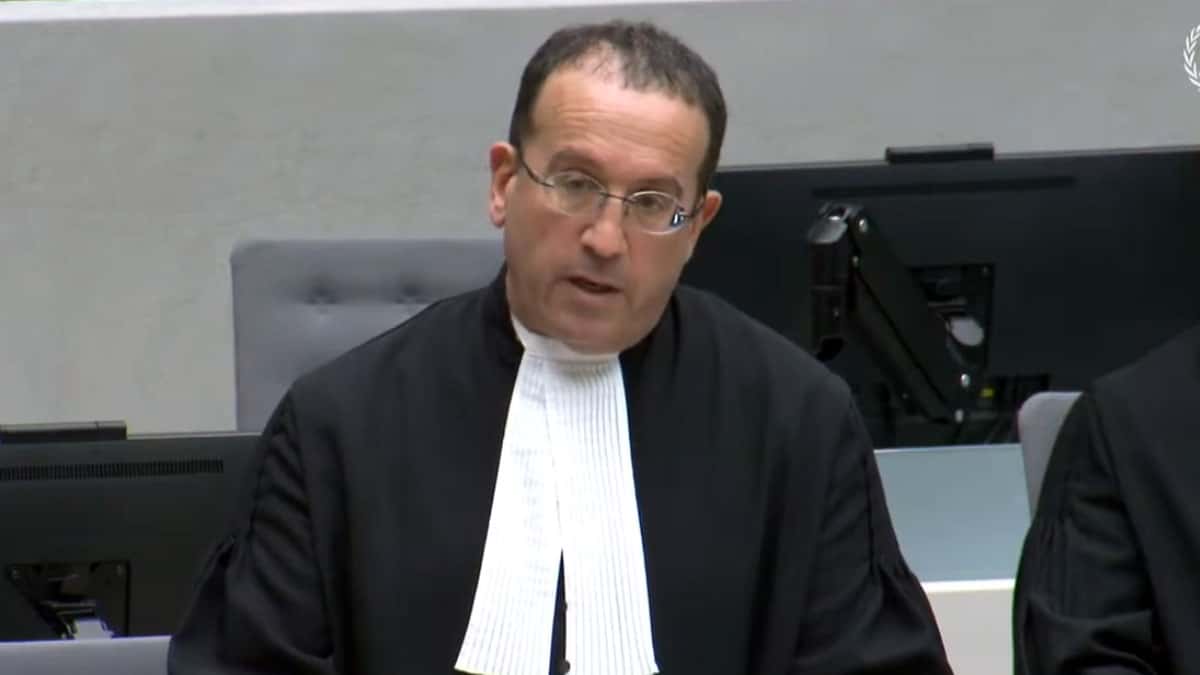

A defense lawyer for former Philippine president Rodrigo Duterte told judges at the International Criminal Court that prosecutors have not established a direct connection between Duterte’s public remarks and the killings tied to his anti-drug campaign.

Speaking on the third day of proceedings to determine whether the case will move forward to trial, Nicholas Kaufman argued that the charges lack concrete proof that Duterte ordered anyone to carry out murders. “There is no smoking gun in this case,” Kaufman told the three-judge panel.
He maintained that none of the individuals connected to the 49 incidents cited in the case would testify to receiving explicit instructions from the former president. “Not one witness relevant to any of the 49 incidents with which Mr. Rodrigo Duterte is charged will testify that he received a direct order from the former president to go out and kill someone,” Kaufman said.
Duterte, who is 80, did not appear at the hearing after waiving his right to attend. According to his lawyer, he is not mentally fit to follow the proceedings.
The defense contended that prosecutors failed to demonstrate a “causal nexus” between Duterte’s speeches—described in court as “uniquely colourful and crusty”—and the alleged crimes. Kaufman told the panel that the absence of such a link “should be sufficient to convince any reasonable bystander… that Rodrigo Duterte is innocent of these charges levelled at him.”
Earlier in the week, prosecutors outlined their position that Duterte played a “pivotal” role in a campaign of extrajudicial killings that left thousands dead. They alleged that he compiled lists of targets, encouraged unlawful killings, and later publicly boasted about the operations. Video clips were presented in court showing Duterte issuing threats against suspected drug offenders and making remarks about extrajudicial actions.

Kaufman countered that those clips did not reflect the full context of Duterte’s statements. He accused the prosecution of selectively presenting excerpts while overlooking instances in which Duterte emphasized adherence to the law. The defense cited one speech in which Duterte said, “Do not kill if you are not in danger of losing your life.”
Questions about witness credibility also featured prominently in the defense’s submissions. Kaufman described several prosecution witnesses as unreliable, noting that some admitted involvement in killings and were cooperating with the court. He said they were “inherently unreliable because (they are) self-confessed vicious murderers testifying in return for virtual immunity from proceedings at the ICC.”
He further argued that shielding such individuals from prosecution to secure testimony against Duterte raised ethical concerns. Kaufman characterized parts of the evidence as “assumption layered upon hearsay” and urged the judges to assign it “negligible evidentiary weight.”
During earlier sessions, a legal representative for victims told the court that the ICC served as the “last refuge” for families seeking accountability for the deaths linked to the anti-drug campaign.
The week-long confirmation of charges hearing will conclude with a decision by the three-judge panel within 60 days on whether the case will proceed to trial. Kaufman told the court, “The defence does not disrespect the soul of any deceased person, nor does it make light of the loss of life.”
