



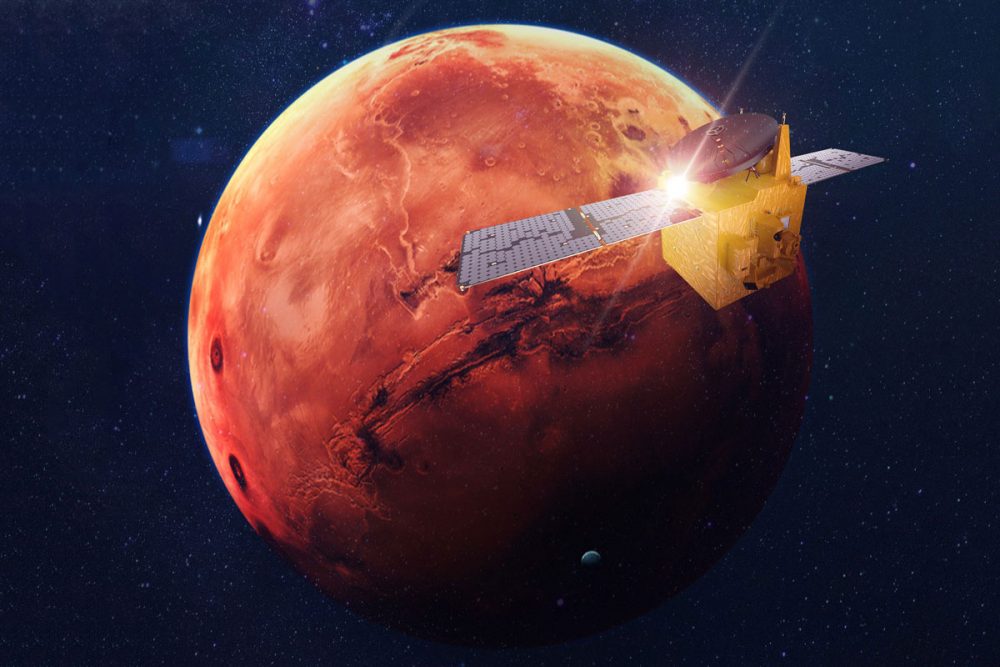

The UAE Space Agency has confirmed that the Emirates Mars Mission (EMM), widely known as the Hope Probe, will continue operating until 2028, following a formal announcement made during a press conference on Tuesday.

According to Khaleej Times, the extension was revealed by Dr Ahmad Belhoul Al Falasi, UAE Minister of Sports and Chairman of the UAE Space Agency, during a briefing focused on the latest developments surrounding the country’s Mars exploration programme.
The extension adds three more years to the mission and was announced with the backing of Sheikh Hamdan bin Mohammed bin Rashid Al Maktoum, Crown Prince of Dubai, Deputy Prime Minister, and Chairman of the Space Council.
Dr Noora Al Saeed, Principal Investigator of the Emirates Mars Mission, underscored the mission’s recent scientific contributions, including the Hope Probe’s observations of Comet C/2023 A3 (Atlas), described as the third-known object from outside the solar system discovered passing through the region.
She explained that the rare event allowed researchers to examine material believed to have originated from another star system. The probe was able to capture detailed imagery of volatile gases being released from the comet as it neared the sun.
Since reaching Mars orbit in 2021, the Hope Probe has surpassed its initial scientific targets by documenting Martian dust storms over a full Martian year, identifying unexpected atmospheric structures in the planet’s upper layers, and taking the highest-resolution images ever recorded of Deimos, one of Mars’ moons.

The mission has also generated more than 10 terabytes of scientific data—far exceeding its original goal of 1 terabyte. This information has been distributed openly to the global scientific community through 16 separate data releases.
With the mission now extended, scientists are expected to gather additional Martian-year datasets, which officials say could support research for decades to come. The expanded phase will also prioritize studying how Mars’ lower atmosphere interacts with its upper atmosphere, a focus that could improve atmospheric modelling not only for Mars but also for Earth.
“Every additional Mars year of data that we get is going to unlock hundreds of years of research,” Dr Noora stated.
Originally intended to last one Martian year, equivalent to two Earth years, the Hope Probe has already remained active for five Earth years. Officials said a technical assessment confirmed the spacecraft remains in excellent condition, allowing the mission to proceed through 2028.
Beyond scientific output, the agency also pointed to broader national impact. The UAE Space Agency noted a 31 per cent rise in STEM enrolment from 2020 to 2025, alongside more than 35 scientific papers published and over 250 scientific participations in international conferences. The mission has also supported 58 Emirati students through university-based research training programmes.
The UAE became the fifth country to reach Mars and the second nation to successfully complete a Mars mission on its first attempt, achieving the milestone during the Covid-19 pandemic.
