



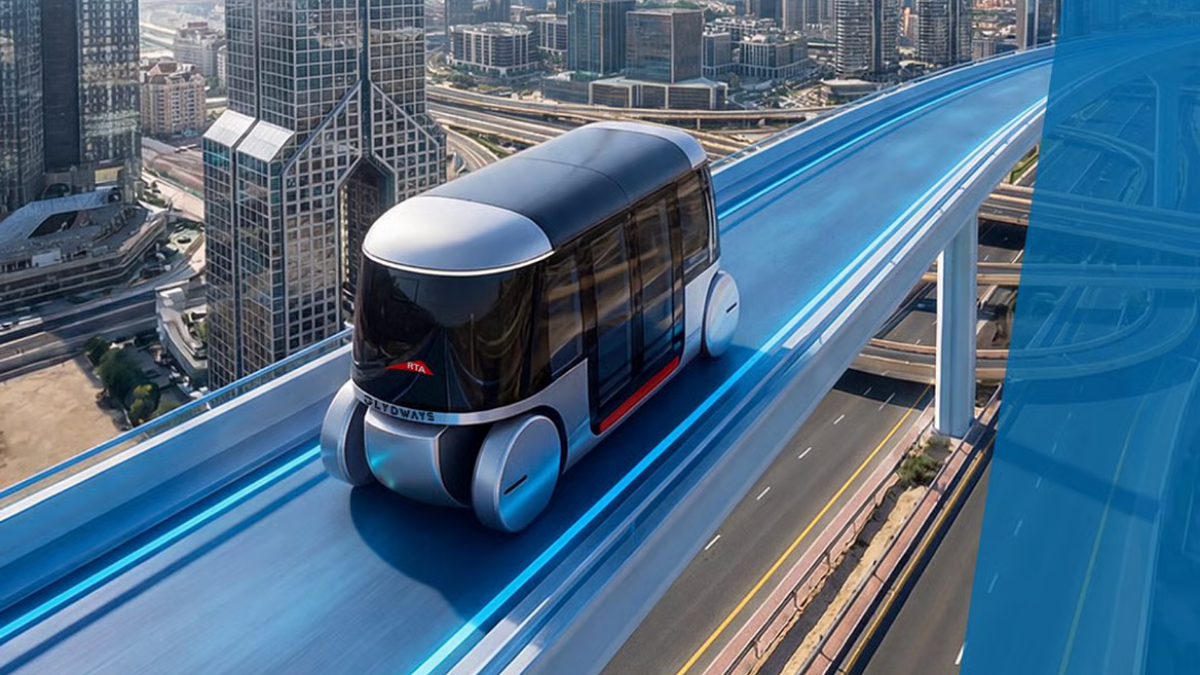

Dubai’s transport authority has presented a new autonomous mobility system that could offer residents a way to move around the city without getting caught in road traffic.

The Roads and Transport Authority (RTA) unveiled the concept during the World Government Summit (WGS) 2026, where a prototype was displayed as part of a proposed network of compact electric vehicles running on narrow, dedicated guideways. The system is intended to connect metro stations to nearby districts, offering a solution for last-mile travel.
According to information shared at the summit, the project—called Revolutionize Urban Mobility—is planned to launch across four areas in Dubai: Bluewater Island, Umm Suqeim, Al Quoz, and Dubai Festival City. No official start or completion schedule has been announced.
The initial trial route is expected to cover 2.8 kilometres, linking the National Paints metro station to Bluewater Island. Another planned segment will span 1.9 kilometres from the Mall of the Emirates metro station to Madinat Jumeirah in Umm Suqeim.
In Al Quoz, the dedicated track is set to run 2.6 kilometres, connecting the Onpassive metro station to Alserkal Avenue and Times Square Centre. The longest route is proposed for Dubai Festival City, covering 7 kilometres, with the possibility of integrating with the Dubai Metro Blue Line in the future.

The enclosed pods showcased at the summit are designed to carry four to six passengers and are capable of travelling up to 250 kilometres on a single charge. The vehicles are expected to operate at speeds of up to 50 kilometres per hour and could carry more than 10,000 passengers per hour in each direction.
The prototype on display featured a ticket scanning area, passenger assistance options, and an SOS button positioned near the door beside a large support handle.
The system was developed by California-based company Glydways, which said the technology could significantly reduce infrastructure and operational costs. The company estimates capital requirements could be reduced by up to 90 per cent, while operational savings may reach as high as 70 per cent.
Glydways said its electric vehicles operate in guideways roughly the size of a bicycle lane and can be installed alongside existing roads, whether above ground or underground, without requiring additional wiring or rail tracks.
