



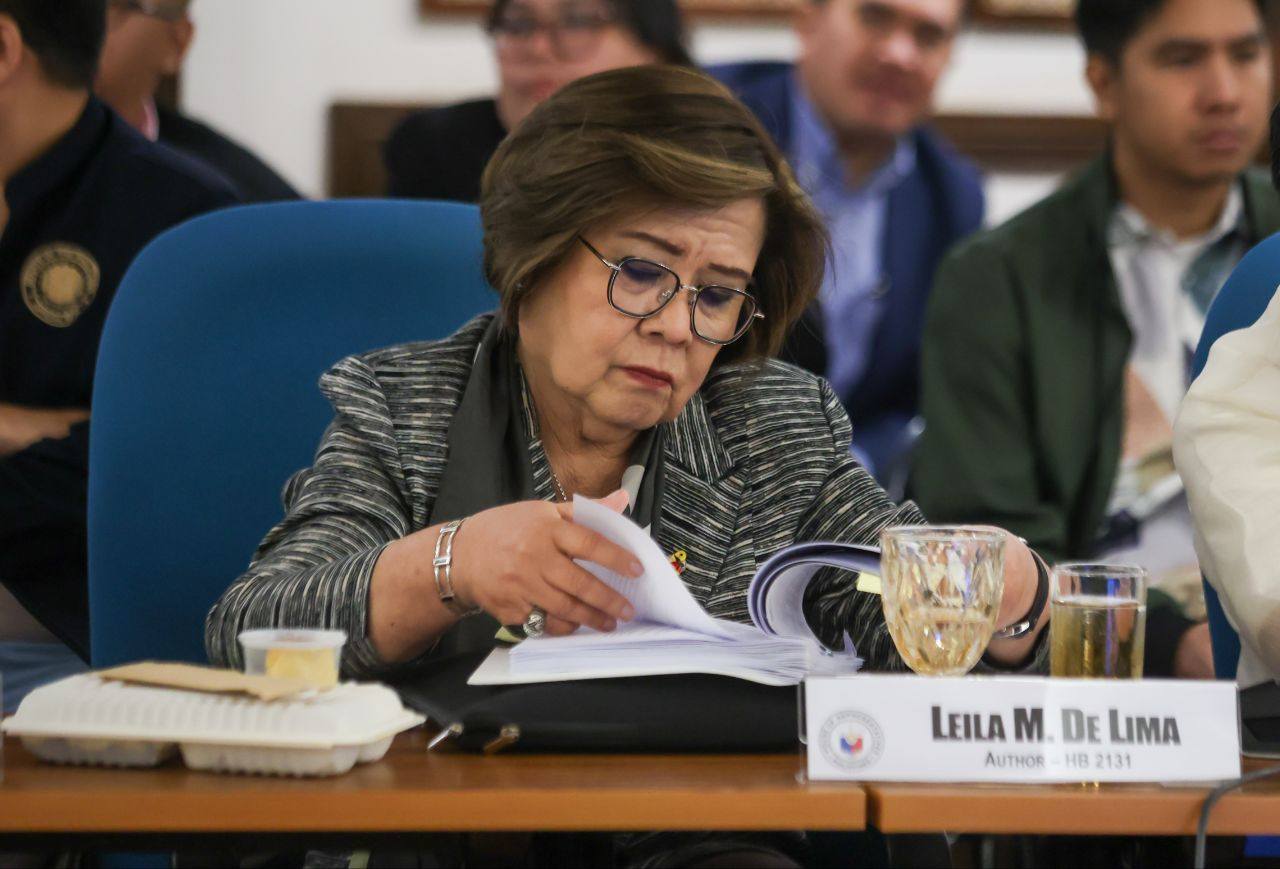

A debate over legal thresholds—not political accusations—dominated the House Committee on Justice hearing on Tuesday, Feb. 3, as Mamamayang Liberal (ML) Party-list Rep. Leila de Lima questioned whether the first impeachment complaint filed against President Ferdinand Marcos Jr. met the minimum standards required under House rules.

De Lima raised her objections during the panel’s initial assessment of the complaint lodged by lawyer Andre de Jesus and later endorsed by Pusong Pinoy Party-list Rep. Jett Nisay. The committee’s task at this stage, she emphasized, was confined to examining the sufficiency of the allegations on their face, rather than weighing their truth or evidentiary strength.
One of the principal grounds cited in the complaint involved accusations that the President received kickbacks linked to anomalous and so-called “ghost” flood control projects. De Lima, a former justice secretary, said the pleading fell short because it did not identify concrete details such as dates, locations, or individuals allegedly involved, and instead relied on general conclusions.
“I just wonder, in light of the evidence uncovered in the multiple fora investigations conducted on the floor control scam, medyo kapos talaga sa allegation yung complaint (there complaint is lacking in terms of allegations),” she said.
She added that the lack of specificity undermined the legal basis for impeachment. “It seems overly complacent for the complainant to be sparing in his factual allegations as to establish the ground for impeachment. For me, madam chair, there is simply paucity of factual allegations. Again, this is insufficient,” De Lima said.
The former senator also addressed the complaint’s reference to alleged drug use by the President—claims that had earlier surfaced following public statements by Senator Imee Marcos. According to De Lima, the allegations failed to establish the necessary legal connection to betrayal of public trust.
“The recital of allegations to this ground is still insufficient in terms of showing the nexus–kasi yung po yung importante (because that’s the important thing)–between the facts raised or alleged and betrayal of public trust,” she said.

She further explained that even if taken together, the accusations cited did not amount to a legally sufficient cause of action. “Public accusations of PBBM’s addiction, Senator Imee’s claim of PBBM’s addiction, PBBM’s refusal to submit to a drug test, and his silence on accusations of being an addict still does not constitute the factual allegations necessary to satisfy the legal exercise and the formulation of causes of action that, assuming they were all true, they establish the betrayal of trust,” De Lima said.
Throughout her intervention, De Lima underscored that the committee was not yet judging credibility or proof, but merely determining compliance with procedural standards under impeachment rules.
“Technically and strictly, and if we go by the standard set of the House Rules itself, the rules of procedure in impeachment proceedings, it’s supposed to be just, you just have to look at whether the complaint has a recital of facts constituting the impeachable offense charged and determinative of the jurisdiction of this committee,” she said.
She cautioned that broad assertions were not enough to meet the requirement of substance. “When we talk about substance, it refers to first whether the complaint alleges ultimate facts that if hypothetically admitted would constitute an impeachable offense,” De Lima said.
Laying out what she described as the governing standards, De Lima enumerated the criteria required under House rules. “A complaint is sufficient in substance when it, number one, narrates specific acts or omissions, not mere conclusions,” she said.
“Number two, it shows a nexus, a connection, between the acts complained of and an impeachable ground. Kailangan konektado ‘yung allegations of facts doon sa constitutional ground,” she added.
She also stressed that allegations must be understandable and capable of being answered. “Number three, should be intelligible and coherent, allowing the respondent to meaningfully answer. Number four, it is not purely speculative or opinion-based,” De Lima said.
