



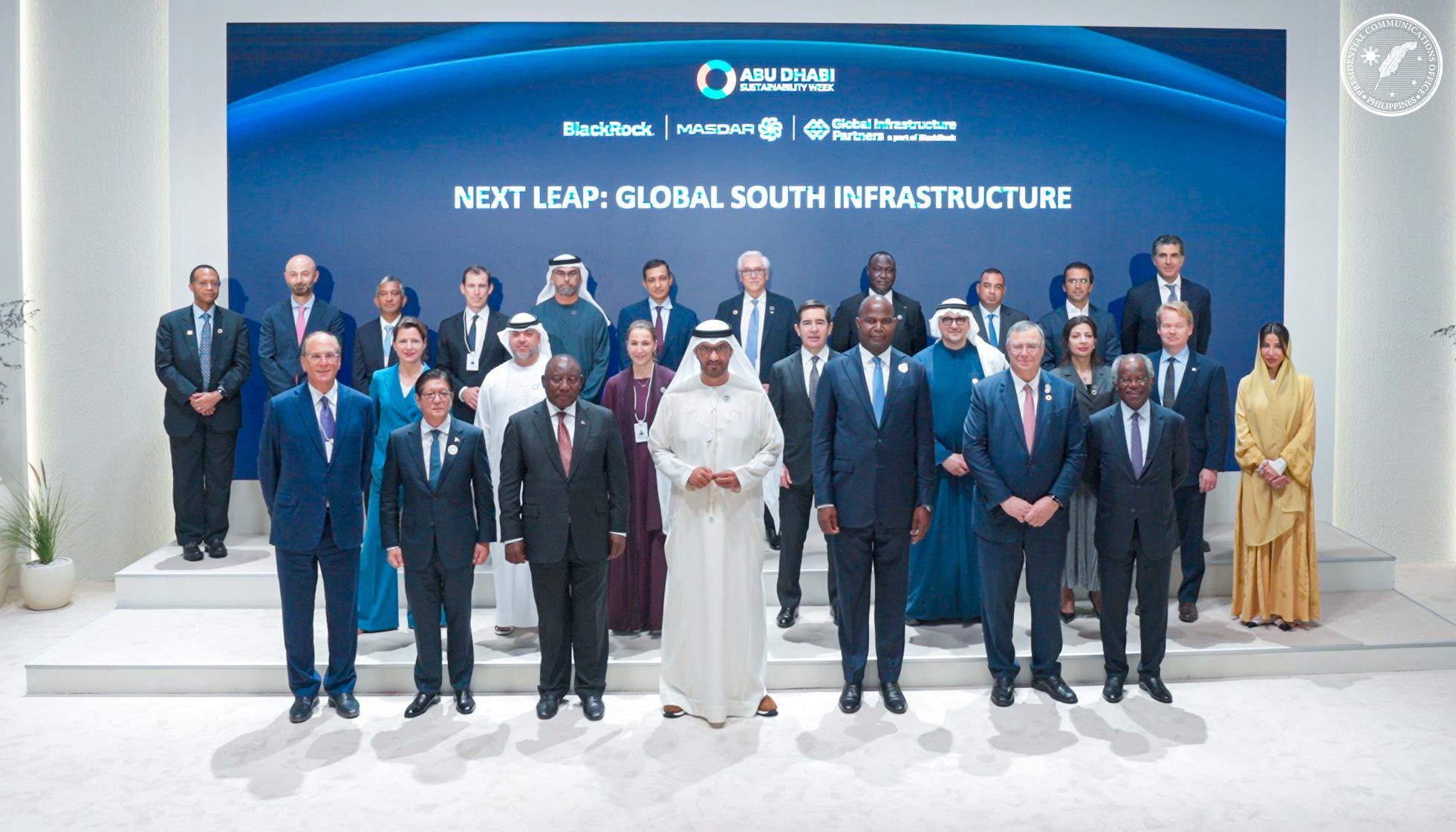

President Ferdinand R. Marcos Jr. used a high-level sustainability dialogue in Abu Dhabi to press for stronger international cooperation as countries confront climate risks alongside economic and geopolitical pressures.

Speaking at Abu Dhabi Sustainability Week, Marcos described the gathering as a critical venue where governments, businesses, and civil society can align policy direction, technology, and capital toward long-term sustainability goals. He credited the United Arab Emirates for convening the forum and emphasized that progress now depends on collective action rather than isolated efforts.
“The Abu Dhabi Sustainability Week (ADSW) reminds us that sustainability is no longer the concern of any single sector but a shared imperative,” the President said during the dialogue titled “Next Leap: Global South Infrastructure.”
“This year’s theme, ‘The Nexus of Next: All Systems Go,’ captures this reality well. Progress today means that we must move together with purpose,” he added.
Marcos is in the UAE on a working visit—his second in just over a year—aimed at reinforcing cooperation between Manila and Abu Dhabi in areas including trade, defense, and sustainable development.
During his address, the President linked climate action with economic growth, reiterating the Philippines’ commitment to the Sustainable Development Goals amid rapid global change. He outlined a development agenda centered on inclusive growth, innovation, resilient infrastructure, and effective institutions, while noting the country’s exposure to climate-related risks.

As chair of the Like-Minded Group of Middle-Income Countries, Marcos pointed to shared constraints faced by many economies, including high debt levels, limited fiscal space, and restricted access to development financing. He renewed calls to reform global financial institutions so climate and development funding becomes fairer and more responsive.
“The Philippines views the People’s Survival Fund as complementing the Green Climate Fund, Adaptation Fund, and the Fund for Responding to Loss and Damage—three global mechanisms where we are board members. We are also the proud host to the Fund for Responding to Loss and Damage,” he said, citing the country’s community-led climate resilience efforts.
Marcos also referenced discussions from the Fourth International Conference on Financing for Development in Spain, where governments acknowledged that the existing global financial architecture is “no longer fit for purpose,” particularly for climate-vulnerable nations.
“Borrowing costs for climate-vulnerable countries exceed growth rates, while debt burdens crowd out investments in health, education, and resilience. This is not simply a matter of finance. It is a matter of equity, stability, and shared responsibility,” the President said.
He further outlined the Philippines’ “Whole-of-Nation PLUS” approach, which expands partnerships and innovation, and said a long-term priority of his administration is to hasten the energy transition by scaling up renewable energy deployment.
