



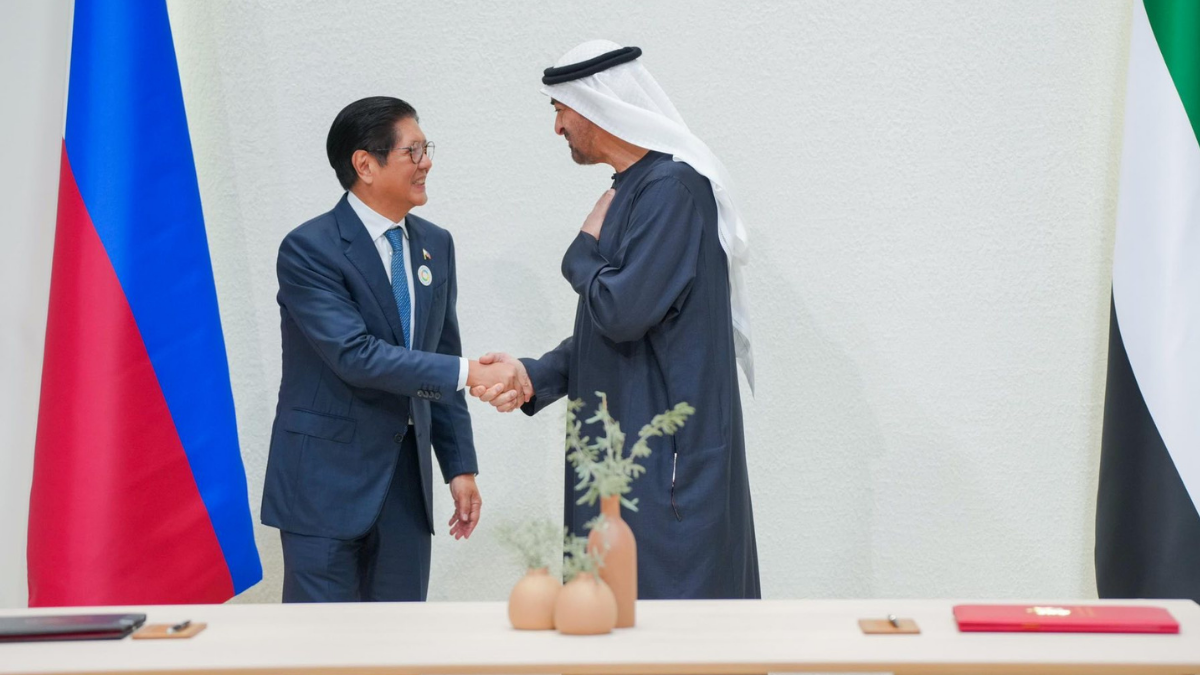

A new trade framework between the United Arab Emirates and the Philippines was formally put in place on Tuesday, January 13, 2026, after both governments concluded a Comprehensive Economic Partnership Agreement in Abu Dhabi.

The accord was exchanged in the presence of UAE President Sheikh Mohamed bin Zayed Al Nahyan and Philippine President Ferdinand R. Marcos Jr., underscoring the political backing behind the deal. It was signed by Dr Thani bin Ahmed Al Zeyoudi, the UAE Minister of Foreign Trade, and Cristina Aldeguer-Roque, Secretary of the Philippine Department of Trade and Industry.
According to the UAE’s state news agency, WAM, the agreement is expected to mark a significant shift in bilateral economic ties, positioning both countries for expanded commercial cooperation. The UAE President said relations between the two nations continue to strengthen, driven by a shared approach to widening collaboration in areas that serve mutual interests. He added that the CEPA represents a substantive step toward advancing common development objectives and reflects the UAE’s broader policy of building long-term global partnerships.
For the Philippines, the agreement carries added significance as its first free trade pact with a Middle Eastern country. President Marcos is in the UAE on a two-day working visit and was among the leaders received during the opening of the Abu Dhabi Sustainability Week Summit 2026. In a post on X, Sheikh Mohamed said the summit seeks to promote “collaboration and dialogue” in support of a more sustainable future.

The CEPA sets out to lower tariffs, improve access for goods and services, and encourage greater investment flows. It also opens new avenues for Filipino professionals and service providers in the UAE, while covering areas such as digital trade, micro, small and medium enterprises, sustainable development, intellectual property, competition policy, consumer protection, government procurement, and technical cooperation.
Products expected to benefit on the Philippine side include bananas, pineapples, canned tuna, electronics, machinery, and other high-demand exports. In services, the agreement provides for a stable and non-discriminatory environment for Filipino companies, including MSMEs, across industries such as IT-BPM, tourism, healthcare, education, construction, and professional services.
Trade data show bilateral trade reached nearly $1.83 billion in 2024, with the UAE ranking 18th among the Philippines’ trading partners and accounting for close to 39 percent of Philippine exports to the Middle East. Initial assessments indicate the CEPA could raise Philippine exports to the UAE by about 9.13 percent, while generating consumer savings and strengthening links with the wider Gulf region.
The agreement is also intended to complement the Philippines’ existing free trade arrangements with Japan, South Korea, the European Free Trade Association, and regional partners under ASEAN, as well as reinforce earlier UAE-Philippines accords on investment protection and cooperation in trade, energy, logistics, innovation, and tourism.
