



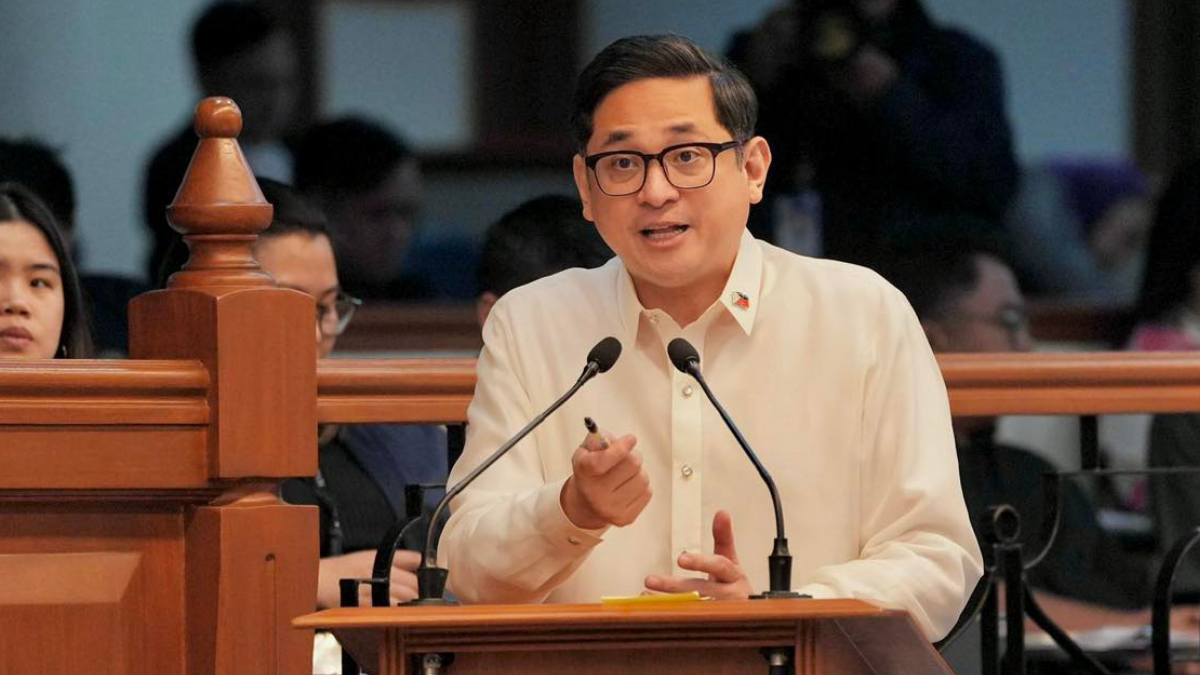

Senator Bam Aquino registered the strongest public approval among lawmakers in a year-end national survey, as several of his legislative proposals were elevated to the priority agenda of the Legislative-Executive Development Advisory Council (LEDAC).

The findings came from the Pahayag 2025 End-of-Year (PEOY-2025) survey conducted by PUBLiCUS Asia Inc., which polled 1,500 registered voters nationwide from December 7 to 10. Aquino posted a net favorable rating of 54 percent, placing him at the top of the rankings.
He was followed by Senators Francis Pangilinan with 47 percent, Risa Hontiveros with 46 percent, Bong Go with 42 percent, and Rodante Marcoleta with 38 percent.
According to PUBLiCUS Asia, Aquino’s rating was driven by public recognition of his legislative output, particularly proposals focused on education reform, government transparency, and institutional accountability.
Aquino returned to the Senate in the 2025 midterm elections after securing 20.8 million votes. He currently chairs both the Senate Committee on Basic Education and the Committee on Science and Technology, positions that have shaped his legislative agenda.
One of his flagship education measures is the proposed Classroom-Building Acceleration Program (CAP) Act, filed as Senate Bill No. 1482, which seeks to address the country’s classroom shortage by decentralizing school construction. Under the proposal, local government units and non-government organizations would be allowed to directly build classrooms to reduce the backlog estimated at 165,000 rooms over six years.
“Lahat ho tayo nagulat nung nalaman natin na bente-dos lang ang classroom na ginawa ng DPWH ngayong taon. Ang backlog po natin ay higit 145,000, kaya hindi po talaga katanggap-tanggap,” Aquino said.

Another measure advanced under his sponsorship is the Contract Accountability and Digitalization for Effective Nationwide Action (CADENA) Act, or Senate Bill No. 1506, which passed third reading in December. The bill proposes a blockchain-based portal that would allow real-time public monitoring of all government contracts to strengthen transparency and deter corruption.
“Sa dulo po ng lahat, iisa pa rin ang pinaglalaban natin — transparency at accountability sa paggamit ng pondo ng gobyerno na pera ng taumbayan,” Aquino said.
Aquino has also pushed for the livestreaming of the 2026 Bicameral Conference Committee deliberations, particularly discussions involving the ₱1.38-trillion education budget, which represents about 4.5 percent of gross domestic product. He said the move was intended to prevent what he described as “midnight deals” during budget negotiations.
Among his other filed proposals is the Party-List Reform Act, or Senate Bill No. 1559, which seeks to realign the party-list system with its original mandate of representing marginalized sectors. The measure includes provisions disqualifying relatives of incumbent officials up to the third degree of consanguinity, barring government contractors from participating, and requiring public hearings to validate the track records of party-list groups.
He has also authored Senate Bill No. 1512, the Independent People’s Commission (IPC) Act, which proposes the creation of an independent body tasked with investigating corruption and irregularities in government.
Four of Aquino’s legislative measures, including the CAP Act and the CADENA Act, have been formally included in the LEDAC priority list, reflecting coordinated executive-legislative support for education-focused and transparency-driven reforms.
