



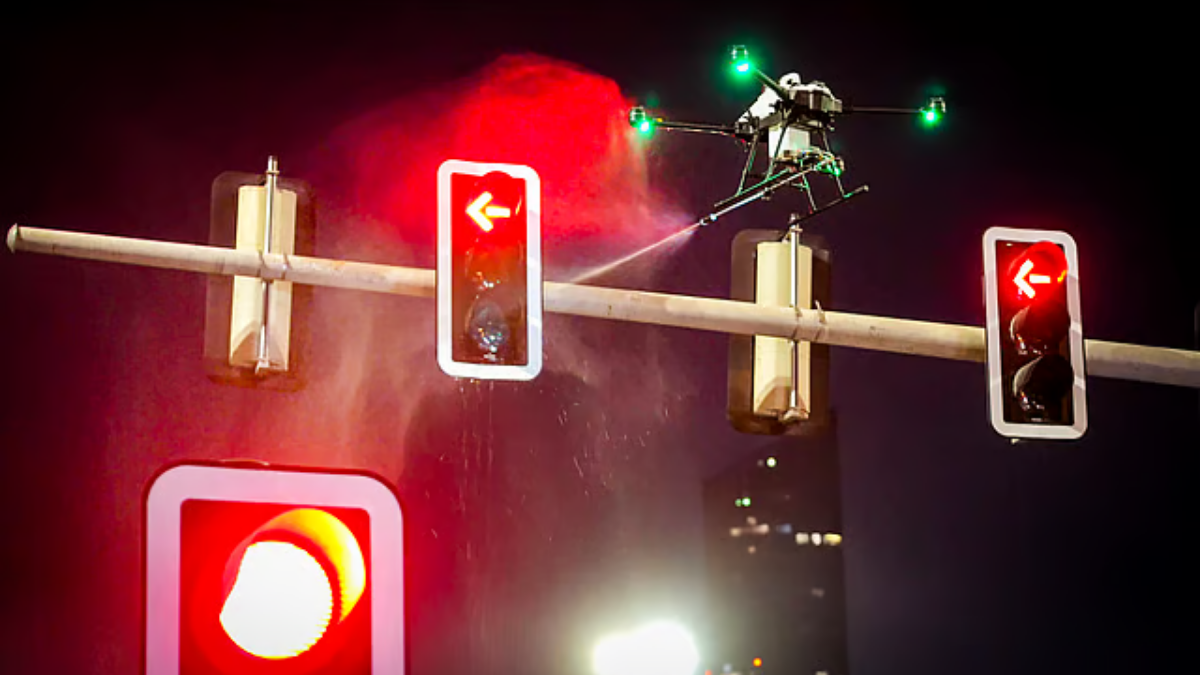

A drone-equipped maintenance team has begun servicing traffic signals in Dubai as part of a new trial aimed at reshaping how roadside infrastructure is maintained. The initiative, launched by the Roads and Transport Authority (RTA), explores whether aerial cleaning can replace conventional methods that rely on manlifts and heavy equipment.

The pilot reflects a broader push to integrate advanced technology into routine operations, with safety and efficiency at the core of the experiment. By eliminating the need for elevated platforms, the approach reduces exposure to risk for maintenance crews while also cutting back on machinery use.
Environmental considerations are built into the test. Drone operations consume less fuel and water than traditional cleaning setups and generate fewer emissions, aligning the project with the emirate’s sustainability targets while trimming operational costs.

The trial is being overseen by the Traffic and Roads Agency, which is benchmarking drone-based cleaning against standard practices. Assessments focus on how long tasks take to complete, overall cost efficiency, quality of work, and compliance with safety requirements.
Initial field tests were carried out at the junction of Marrakech Street and Rebat Street, where short-term traffic controls were introduced to safeguard road users during the exercise. Early data indicates a reduction in operating time of between 25% and 50%, with a single signal face cleaned in roughly three to four minutes. Current cost savings are estimated at about 15%, with expectations that this figure could rise to 25% as drone capabilities continue to advance.
Further testing is planned to fine-tune procedures, confirm safety standards, and limit any impact on traffic movement while evaluating how the method could be expanded across Dubai’s road network.
